
 ezna-io
May Day 2026: Lecornu contains France's labor breach
6 months ago

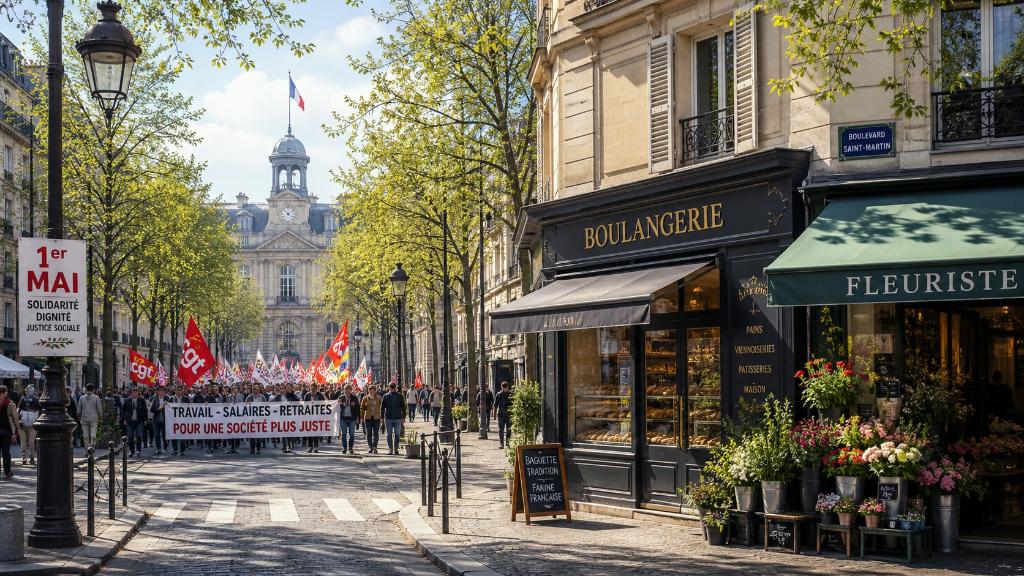
- France's May 1 2026 marches drew 158000 people according to police and more than 300000 according to the CGT.
- The dispute centers on salaried work in artisan bakeries-pastry shops and florists.
- Lecornu is trying to turn a social controversy into a tightly framed exception.
- A 15.4 percent rise in the benchmark gas price adds concrete pressure on purchasing power.
May Day 2026 has turned a local retail question into a national test of government. The issue is not only whether artisan bakeries-pastry shops or florists may employ staff on Labor Day. It touches the only French public holiday that must be paid and not worked by all employees, and therefore an old social symbol that any government changes at political cost.
The turnout figures frame the balance of pressure. TF1 Info and Le Monde report 158000 demonstrators according to police, including 24000 in Paris, against more than 300000 according to the CGT, including around 100000 in the capital. Such counting gaps are common in French labor disputes. They mainly reveal two measuring tools: the state counts public order, while unions count pressure capacity.
Sebastien Lecornu's strategy can be summed up as narrowing in order to control. Like a tight connection between Paris, Brussels and Milan, the Prime Minister is trying to keep several constraints on the same timetable: secure artisans, avoid a rupture with unions, contain Parliament and prevent a general reform of public holidays.
An artisan exception, not broad liberalization
The April 29 2026 Council of Ministers report states that May 1 is the only public holiday that must be paid and not worked by all employees. Exceptions apply only to establishments and services whose activity cannot be interrupted.
That boundary is where the tension lies. An artisan may open a shop alone. Employing a worker that day is another matter. Bakers and florists have therefore become the visible faces of a wider arbitration: who decides that an activity cannot stop on labor's symbolic day?
According to Le Monde, the centrist proposal initially aimed to give a legal basis to older professional practices and also covered other sectors, including some food shops and cultural venues. The government has narrowed the perimeter to artisan bakeries-pastry shops and florists, with voluntary employees, double pay and rules set by sector branches. The political core is clear: authorize without normalizing.
The Conseil d'Etat eases pressure without closing the file
On April 30, the Conseil d'Etat held that there was no longer a need to rule on legal actions filed against the government. The decision reduces immediate pressure, but it does not replace adopted legislation. It therefore does not permanently settle the framework for salaried work on May 1.
The uncertainty must remain explicit. For 2026, the executive appears mainly to be trying to avoid confrontational inspections and provide administrative direction to state services. The lasting framework still depends on Parliament and branch agreements. None of the sources reviewed supports the claim that a broad May Day reform has been adopted.
The political conflict is already visible. The environmentalist group referred the matter to the Conseil d'Etat. The left and unions denounce the risk of a breach that could widen. Centrists and part of the governing camp instead describe the text as legal clarification for artisans. Lecornu stands between those lines, with a containment method: less visible reform, more administrative and professional framing.
Purchasing power gives the conflict depth
The marches did not only challenge the possible opening of some shops. They also focused on wages, welfare benefits and constrained spending. The energy link must be stated carefully: it does not by itself explain the mobilization, but it clarifies the material backdrop.
Info.gouv.fr says the benchmark gas sales price rises by 15.4 percent from May 1 2026, or 6.19 euros per month on average for the consumers concerned. The French energy regulator publishes May 2026 benchmark prices, with an average VAT-included kWh price of 0.15616 euro for cooking and hot water, and 0.12558 euro for heating in the GRDF area.

Reuters also reports that TotalEnergies is extending its French fuel price caps during the Middle East crisis, with 1.99 euros per liter for gasoline and 2.25 euros for diesel. The Banque de France mentions, in its March 2026 projections, oil potentially reaching 92 dollars per barrel in the second quarter and gas at 51 euros per MWh before gradually easing.
These figures do not mechanically turn a legal controversy into a social crisis. They mainly show that the May Day debate is unfolding in a less stable price environment. The social symbol then becomes an anchor point for more concrete concerns about disposable income.
Lecornu's calculation: concede little, frame heavily
The Prime Minister's method is defensive. He is not proposing broad liberalization. He limits the exception, conditions it on voluntary work, maintains double pay and sends part of the fine-tuning to sector branches. The goal is to turn a national controversy into a sectoral clarification.
For unions, the risk is not only the number of shops open in 2026. It is the precedent: today bakeries and florists, tomorrow other sectors. For employer groups, by contrast, the perimeter may look too narrow. Le Monde reports that employers are pushing to expand the list of shops allowed to open.
The scene is therefore triangular: unions against normalization, employers for flexibility, government for a controlled exception. That triangle, more than the question of baguettes or bouquets alone, gives the file its political reach.
A French debate under international scrutiny
The Financial Times and The Straits Times read the case as a test for a fragile government. Reuters emphasizes energy, prices and companies. Xinhua gives more weight to public support measures in response to costs. The Guardian places the sequence in a European context of aid for sectors exposed to higher fuel and fertilizer costs.
These framings do not contradict each other. They shift the focal point. From France, May Day remains first a labor symbol. From international agencies, it is also an indicator of social resilience under energy pressure. From Europe, it shows how governments are trying to cushion shocks without reopening wider social conflicts.
Sources, framings and identifiable bias
French general-interest sources, especially TF1 Info and Le Monde, emphasize marches, figures, unions and Matignon's arbitration. Institutional sources such as the Elysée, Info.gouv.fr, Service-public.fr and the French energy regulator focus on the legal framework and economic parameters. Reuters uses a market angle. Xinhua highlights state stabilization. The Guardian, The Straits Times and the Financial Times broaden the international reading.
No direct conflict of interest appears in the sources reviewed. The biases are mostly editorial framings: social in French media, energy-driven at Reuters, stabilizing at Xinhua, institutional in public sources. The strongest conclusion remains limited: Lecornu is trying to lock down the May Day symbol while arranging a controlled artisan exception.
FAQ
Why did May Day 2026 become political?
Because salaried work in some bakeries and florists touches the only French public holiday that must be paid and not worked by all employees.
How many people demonstrated?
The estimates diverge: 158000 demonstrators according to police and more than 300000 according to the CGT nationwide. In Paris, the figures range from 24000 to around 100000.
Has the law already changed?
No. The government supports a targeted direction, but the lasting framework still depends on Parliament and branch agreements.
- TF1 Info - May 1: more than 300000 demonstrators according to the CGT, 158000 according to police
- Le Monde - May 1: 158000 demonstrators according to police, 300000 according to the CGT
- Le Monde - Labor Day protesters in Paris denounce proposed changes to the paid holiday
- Le Monde - Shop openings on May 1: the government has taken back control
- Le Monde - May 1 work: the Conseil d'Etat says there is no longer a need to rule
- Le Monde - May 1: employers push to expand the list of shops allowed to open
- Le Monde - May 1: the environmentalist group refers the matter to the Conseil d'Etat
- Le Monde - May 1 work: the fear of a widening breach
- Le Club des juristes - May 1 work: bakers, florists and independent artisans allowed to open
- Elysée - Council of Ministers report, April 29 2026
- Info.gouv.fr - What changes in May 2026
- Service-public.fr - Benchmark gas sales price to rise by 15.4 percent from May 1
- French Energy Regulatory Commission - Benchmark natural gas sales price for May 2026
- Banque de France - March 2026 macroeconomic projections
- Reuters - TotalEnergies to extend fuel price cap in France during Middle East crisis
- Xinhua - France to extend energy support measures into May amid rising fuel prices
- The Guardian - EU farmers and hauliers to get up to €50000 to cover extra costs of Iran war
- The Straits Times - Baguettes take centre stage on France's Labour Day
- Financial Times - France allows flower shops and bakeries to open on May Day