
 ezna-io
Art Deco 2026: living legacy and aesthetic tensions
7 months ago

- The Art Deco centenary extends into 2026 with major exhibitions and events in Paris.
- Sources confirm its historical importance and lasting global influence.
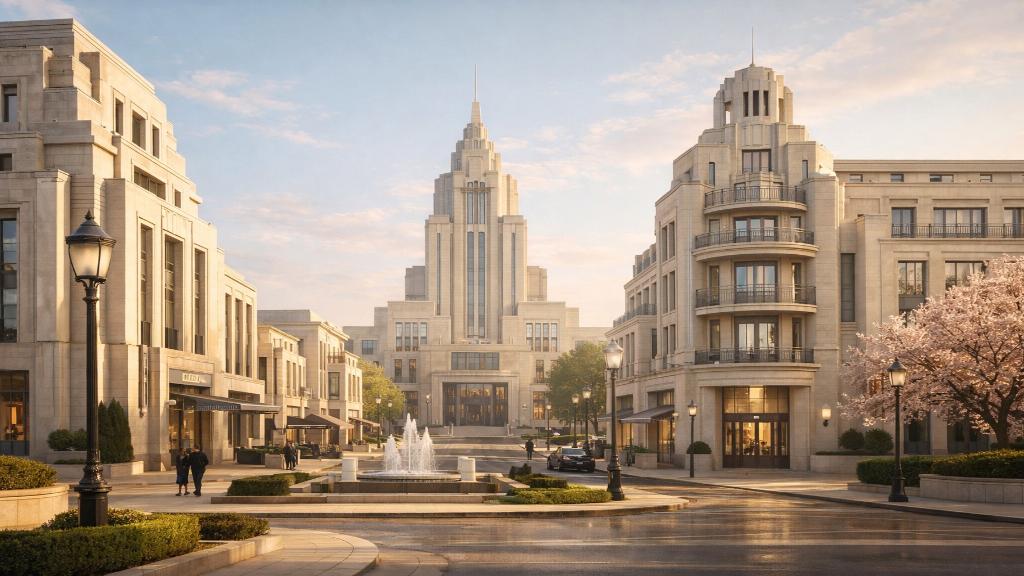
- The style remains active in contemporary urban planning, notably in Villeurbanne.
- A debate emerges between authentic reinterpretation and decorative pastiche.
In spring 2026, Art Deco is no longer just a commemorative subject. In Paris, its centenary continues to shape a dense cultural landscape across museums, design fairs and architectural discourse. The exhibition '1925-2025. One Hundred Years of Art Deco' at the Musée des Arts Décoratifs runs until April 26, 2026, while PAD Paris takes place from April 8 to 12. This extended timeline shows that the phenomenon has moved beyond a symbolic anniversary into a sustained cultural dynamic.
Sources converge on the historical scale of the movement. The Cité de l'architecture recalls the 1925 International Exhibition as a foundational moment. Wallpaper reports that it covered 23 hectares and attracted around 15 million visitors. While widely cited, this figure should be understood as a commonly accepted estimate rather than a fully documented statistic in every source.
Current exhibitions emphasize material richness. Architectural Digest mentions over a thousand objects, while Architectural Record highlights works by André Groult, Jacques-Émile Ruhlmann and Pierre Chareau. Together, they illustrate a comprehensive artistic universe where interior design, craftsmanship and architecture intersect.
Yet beyond celebration, a more structural reading emerges. The Cité de l'architecture frames Art Deco within broader urban and social transformations, referencing figures such as Auguste Perret and Le Corbusier. This perspective shows that Art Deco was also a response to modernity, not merely a decorative style.
This dimension persists today. In Villeurbanne, Xinhua describes the Gratte-Ciel district as a living example of Art Deco urbanism. The ongoing 'Gratte-Ciel Downtown' project plans around 900 housing units and public infrastructure across eight hectares. Art historian Emmanuel Breon notes that Art Deco provides 'a shared geometrical vocabulary', highlighting its adaptability.

At the same time, the design market plays a crucial role. Le Monde reports that PAD Paris gathers 77 exhibitors and reflects a strong collector-driven dynamic. Founded in 1998, the fair remains a key platform for design. This economic dimension enhances visibility but introduces a tension between historical fidelity and market adaptation.
Different sources hint at this tension. Design media often emphasize spectacle and iconic objects, while institutions focus on historical rigor. Xinhua frames the subject through urban continuity, without addressing potential criticisms. This reveals an implicit divide between heritage and commodification.
Some observers suggest a risk of decorative pastiche in contemporary reinterpretations. This claim is not universally documented but reflects a broader debate about the use of historical styles today. It should therefore be treated as an analytical hypothesis.
Despite these tensions, a consensus remains. Art Deco continues to answer contemporary expectations of structure, materiality and visual coherence. In a context where some recent aesthetics are perceived as abstract, it offers a readable and grounded alternative.
In 2026, its return is neither nostalgia nor trend alone. It represents a broader reassessment of inherited forms as active tools for contemporary creation. This balance between continuity and transformation defines its current relevance.
More fundamentally, this moment raises a deeper question about how societies choose to shape their environments. Between reproduction and reinterpretation, Art Deco becomes a lens through which cultural continuity itself is reconsidered.
FAQ
Why is Art Deco still relevant in 2026?
Because it combines clarity, material richness and adaptability.
Is there a risk of pastiche?
Yes, but this remains a debated issue.
Is Art Deco still used in architecture?
Yes, especially in projects inspired by its principles.