
 ezna-io
Artemis II: why the Moon return is happening now
By Zoé Marquand
7 months ago

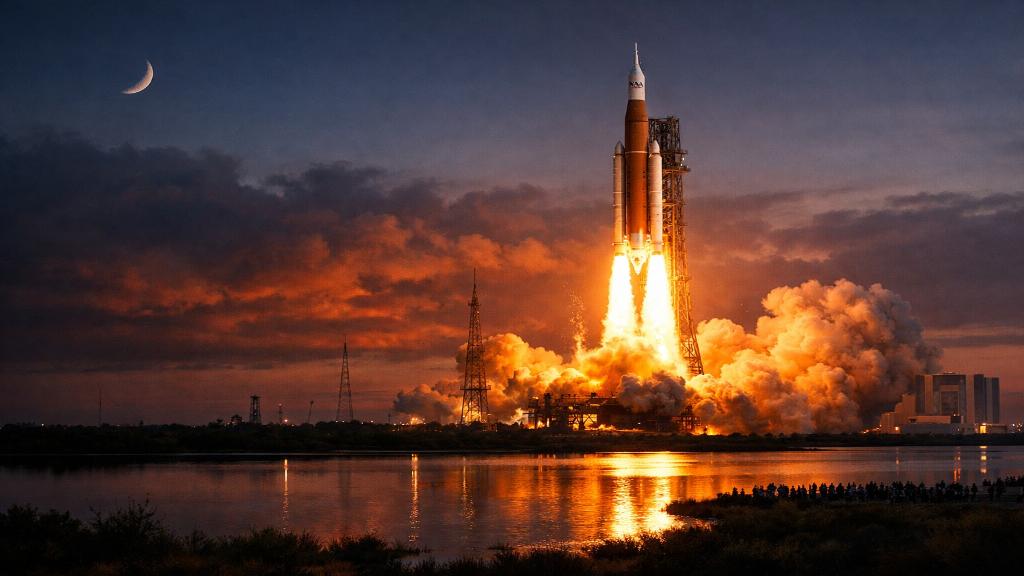
- Artemis II lifted off on April 1, 2026 at 6:35 p.m. EDT for an about 10-day mission around the Moon.
- The flight is meant to qualify Orion and SLS with crew before a US return to the lunar surface targeted for 2028.
- ESA provides the European Service Module, Canada sends Jeremy Hansen, and Argentina flies a science microsatellite.
- The timing also reflects growing strategic competition with China, which is targeting a crewed lunar landing before 2030.
The human return toward the Moon is no longer a distant slogan. On April 1, 2026 at 6:35 p.m. EDT, NASA's SLS rocket lifted off from Kennedy Space Center with four astronauts aboard Orion on Artemis II, the first crewed mission into lunar space in more than fifty years. The flight is expected to last about 10 days. NASA presents it not as a landing attempt, but as a crewed test designed to prove that the spacecraft and the operational chain can work reliably far from Earth before the next steps of the Artemis campaign.
The timing is driven by several overlapping logics. First comes the technical one. Artemis I validated an uncrewed flight in 2022. Artemis II crosses the more politically delicate threshold: putting people aboard the SLS-Orion system. NASA's press kit lays out a notably practical sequence of tests: life-support verification, navigation beyond the usual reach of GPS and near-Earth relay coverage, a manual piloting demonstration around the ICPS upper stage, emergency procedures, lunar observations, optical communications and ocean recovery with US Navy support. NASA's mission priorities document sums up the core purpose in a concise phrase: a 'crewed test flight in lunar space'.
The numbers show how methodical that approach is. NASA says SLS delivers more than 8.8 million pounds of thrust at liftoff. The mission profile first places Orion in a so-called safe high Earth orbit of about 44,525 by 115 statute miles, then sends the crew on translunar injection on flight day two. NASA also says the trajectory will take the crew about 4,600 miles beyond the far side of the Moon, with the flyby occurring, depending on the exact launch date, roughly 4,000 to 6,000 miles above the lunar surface. A NASA communication document puts the full round trip at about 685,000 miles.
Why now
The answer is not only technical readiness. It is also geopolitical timing. Reuters notes that Washington openly frames Artemis as the step before a human return to the lunar surface later this decade, with China's own crewed landing plans in the background. The South China Morning Post reported in February that China's Mengzhou spacecraft and Long March-10 launcher had passed a key test tied to Beijing's goal of putting astronauts on the Moon before 2030. In other words, the Moon has become a contest of sequencing again: the side that first accumulates credible test flights, partners, infrastructure and operating norms gains a durable advantage.
NASA does not describe the Moon simply as prestige. In its public material, the agency links the lunar push to three wider promises: science, economic benefits and preparation for Mars. That triangle says a lot about the new lunar rhetoric. Under Apollo, the Moon was primarily political theater. Under Artemis, it is becoming a training ground, an industrial demonstrator and a place where long-term rules and habits may be set.
What the mission is actually trying to prove
The first objective is human safety. The 'Artemis II Priorities and Objectives' document emphasizes validation of Orion's life-support system, metabolic loading tests, meal preparation, waste disposal, cabin atmosphere monitoring, suit performance, exercise, medical procedures, fire response and the use of a radiation shelter. From the ground, this can sound mundane. In deep space, it is the substance of the mission. A sustainable lunar campaign will be judged not only by dramatic images, but by whether ordinary human functions remain reliable far from home.
The second objective is operational. The crew must manually fly Orion around the ICPS upper stage to test handling qualities and prepare for future rendezvous and docking work. That matters because Artemis has been reshaped in recent weeks. Reuters reported that NASA has widened the role of commercial competition in later missions and changed several parts of the architecture under discussion. In that context, Artemis II is not just a symbolic flight. It is a full-scale examination of hardware built by the traditional prime contractors Boeing, Northrop Grumman and Lockheed Martin.
The third objective is scientific and preparatory. NASA's press kit lists a lunar observation campaign, biomedical investigations and several payloads, including ATENEA, an Argentine microsatellite chosen to test navigation and measure radiation in deep space. Reuters reported that ATENEA is the only Latin American satellite selected among the mission's international payloads. That adds a quieter but important layer to the story: Artemis is no longer only a US-European undertaking, but a magnet for smaller scientific partners seeking a place in the deep-space technical ecosystem.

International partnerships that are more than decoration
The mission is American in political impulse, but it is already impossible without partners. ESA says its European Service Module sits 'at the heart' of Artemis II. The module provides electricity through four solar arrays, air, water, thermal control and, crucially, propulsion for key maneuvers including translunar injection and trajectory corrections. Put differently, Europe is not a diplomatic extra here. It is providing Orion's power, consumables and propulsion backbone.
Canada contributes more than symbolism as well. According to the Canadian Space Agency, Jeremy Hansen becomes the first Canadian and the first non-American to fly around the Moon. That role fits into a broader exchange in which Canadian participation in Artemis has been tied to robotics contributions for future lunar systems. In practice, the Artemis coalition revives an older Western logic in updated form: share costs, divide technical responsibilities and tie those pieces to a wider political framework, the Artemis Accords. NASA's inspector general noted in its 2025 challenges report that 56 countries have signed the Accords.
This partner network also has a normative function. By establishing standards, interfaces and working habits before a durable human presence is built, Washington is trying to turn a space program into an architecture of influence. The launch imagery can hide that point, but it is central. The first power that installs not only crews, but rules and routines, gains strategic depth.
The harder reality: costs, delays and industrial pressure
There is, however, a less romantic side to the program. Reuters reports that each SLS launch is estimated to cost between 2 billion and 4 billion dollars. NASA's Office of Inspector General says the agency had estimated in 2021 that Artemis would cost 93 billion dollars by fiscal year 2025, and that additional substantial funding will still be needed before the next successful lunar landing. The same report says three Artemis projects accounted for almost 7 billion dollars in cost overruns, nearly half of the agency total in the GAO sample it cited.
Those figures explain why Artemis II arrives in a moment of industrial tension. The flight has to work because it is being watched as proof that the heavy, expendable SLS-Orion architecture remains defensible against potentially cheaper commercial systems from SpaceX or Blue Origin. Reuters quoted analyst Michael Leshock calling Artemis II a 'critical validation moment'. That is a compact and accurate description. If the mission succeeds cleanly, the older architecture buys itself political time. If it fails, or if it looks too costly compared with commercial alternatives, the debate over its long-term viability will harden quickly.
Why the Moon again
The question often sounds naive but it is fair. Why spend so much to fly around the Moon without landing? Because the Moon is again being treated as a system-level step. Future Artemis missions target the lunar south pole, a region of interest because permanently shadowed areas may preserve water ice. That ice could one day support breathable oxygen and perhaps propellant production. NASA presents the Moon as a training ground for Mars, but also as a place for science and possible economic activity. More simply put, the Moon combines relative proximity, genuine difficulty, symbolic value and logistical utility in a way no other destination currently does.
For now, Artemis II settles nothing. It does not plant a flag at the south pole, install infrastructure or resolve the program's financial sustainability problem. What it does do is subtler: it puts humans back on the lunar road with partners already embedded in the system, protocols already written, tests already measurable and a Chinese competitor that is no longer hypothetical. That may be the clearest answer to the timing question. The era of announcements is ending; the era of credible technical sequences has begun.
FAQ
Why does Artemis II not land on the Moon?
Because the mission is first meant to qualify SLS, Orion, survival procedures, manual piloting, communications and recovery operations before a crew is sent to the surface.
How long and how far is the mission?
NASA describes Artemis II as an about 10-day mission covering roughly 685,000 miles around the Moon and back.
Which international partners matter most on this flight?
ESA supplies the European Service Module that powers and propels Orion, Canada sends Jeremy Hansen, and Argentina contributes the ATENEA science microsatellite.
- NASA - Liftoff! NASA Launches Astronauts on Historic Artemis Moon Mission
- NASA - Artemis II Press Kit
- NASA - Artemis II Priorities and Objectives
- NASA - Artemis II Flight Update: Perigee Raise Burn Complete
- NASA SVS - Moonbound! NASA's Artemis II Mission Days From Launch
- Reuters - NASA launches first crewed lunar mission in half a century
- Reuters - NASA's moon mission tests aerospace old guard as SpaceX, Blue Origin hover
- ESA - Europe powers Artemis II mission to the Moon
- Canadian Space Agency - Artemis II daily logbook
- Reuters - Argentina joins NASA's moon return with microsatellite testing GPS beyond Earth
- South China Morning Post - China's Mengzhou spacecraft passes key test for 2030 crewed moon mission
- NASA OIG - 2025 Report on NASA's Top Management and Performance Challenges