
 ezna-io
Nearly Half of Americans Say Their Finances Are Worsening: A Warning Sign for the Economy
By Léo Piquemal
10 months ago

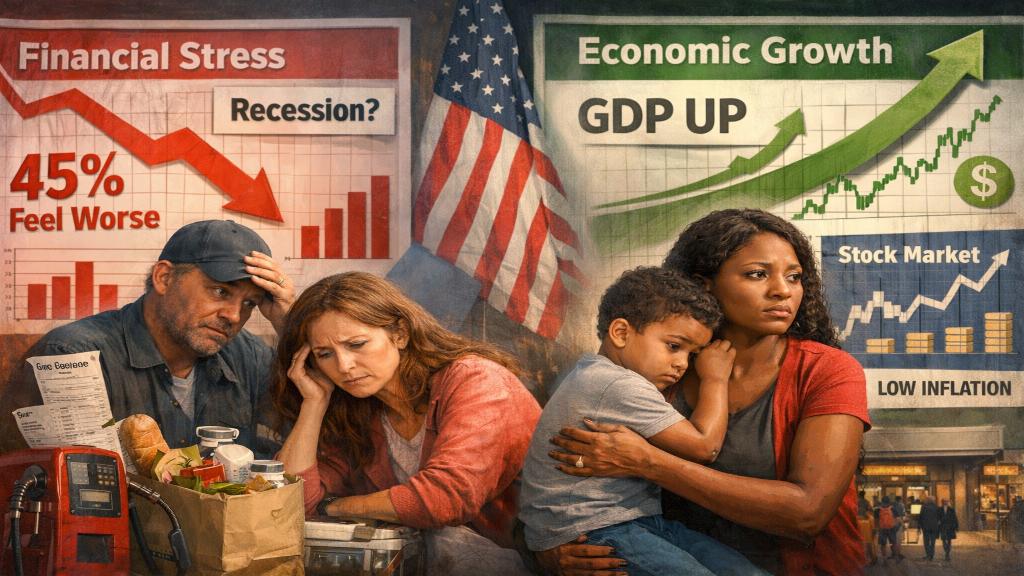
- 45% of Americans say their financial security worsened in 2025.
- 57% mistakenly believe the U.S. is in recession.
- Pessimism is stronger among lower incomes, women, and some racial groups.
- Consumer confidence and employment worries drive sentiment.
A Harris poll published on 29 December 2025 shows that 45% of U.S. adults feel their financial security deteriorated in 2025, compared with just 20% who say it improved. Notably, 57% of respondents believe the U.S. economy is in recession, despite official definitions requiring two consecutive quarters of negative growth and recent data indicating continuing expansion.
This disconnect between macroeconomic data and lived experience highlights a profound divide between aggregate economic performance and household realities. Official indicators point to GDP growth and controlled inflation, yet consumer confidence remains weak, and the labor market shows signs of stagnation or weakness, with hiring trends down in some sectors.
The poll also reveals sharp differences by income, gender, and political affiliation: those earning under USD 50,000 a year are significantly more likely to report worsening finances than wealthier households. Women and certain racial groups, including Black and Hispanic Americans, report deeper pessimism, reflecting structural disparities in how economic conditions translate into daily life.
Political polarization shapes economic perceptions as well: Democratic voters are more likely to criticize the current administration’s handling of the economy, while Republicans are generally less critical. This polarization reflects not only ideological differences about economic policy but also heterogeneous experiences in job security and inflation.

Another recent measure, the Conference Board consumer confidence index, fell to its lowest level since tariffs were imposed, linking economic sentiment closely to real cost-of-living pressures faced by households. The drop in confidence coincided with a rise in unemployment to 4.6%, the highest since 2021, reinforcing economic uncertainty.
Concrete impacts: For households, this pessimism translates into reduced consumption, increased precautionary savings, or cuts in discretionary spending, which can dampen domestic growth. Widening income inequalities amplify these effects as lower-income groups spend a larger share of their income on essential goods, more affected by inflation and tariffs. This dynamic fosters a cycle of weak confidence and slowing demand.