
 ezna-io
PFAS Pollution: New Technological Path to Safer Water Treatment
9 months ago

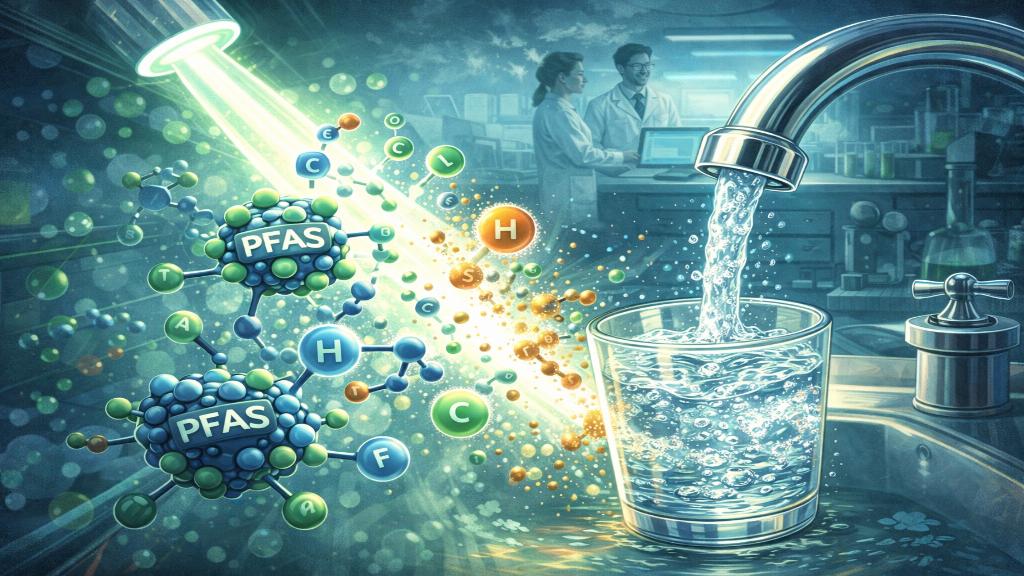
- An LDH-type material is being studied for capturing certain PFAS in water.
- Current results are based on laboratory experiments.
- No commercial or industrial application has yet been announced.
What are PFAS and why are they a concern?
Per- and polyfluoroalkyl substances (PFAS) are a large group of synthetic chemicals used since the 1940s in industrial processes and consumer products such as non-stick coatings and firefighting foams. Their chemical stability makes them highly persistent in the environment.
PFAS have been detected in water, soil, air, and living organisms. Scientific studies associate some PFAS with potential health effects, including hormonal disruption and immune system impacts, though risks vary depending on exposure and compound type.
Environmental spread
PFAS contamination is primarily linked to industrial emissions, product use, and waste management. Their presence has been documented globally, including in drinking water sources.
A technology under investigation
Recent reports describe laboratory research on an LDH (layered double hydroxide) material containing copper and aluminum. Under experimental conditions, the material can adsorb certain PFAS from water.
Researchers suggest that this process may be followed by partial chemical degradation through oxidation. Reported results indicate rapid action in controlled settings, though these findings are limited to laboratory-scale tests.

Current evidence and reporting
The findings have been reported by science news outlets such as ScienceDaily and regional media. At present, no peer-reviewed academic publication is explicitly cited in public reports, limiting independent verification.
Potential applications and limitations
If confirmed by further studies, this approach could complement existing water treatment technologies. However, challenges remain regarding scalability, cost, durability, and the wide diversity of PFAS compounds.
This technology does not address PFAS production at the source and would function solely as a treatment solution.
Research outlook
Additional research is required to assess environmental impact, economic feasibility, and performance at larger scales. The technology remains experimental.
FAQ
Can PFAS be destroyed?
Some PFAS can be degraded under specific chemical conditions, but doing so at scale remains challenging.
Is this technology commercially available?
No. It is currently limited to laboratory research.
How can exposure to PFAS be reduced?
Reducing use of PFAS-containing products, using appropriate water filtration systems, and supporting regulatory measures can help limit exposure.