
 ezna-io
Solid-state batteries: industrial breakthrough and limits
7 months ago

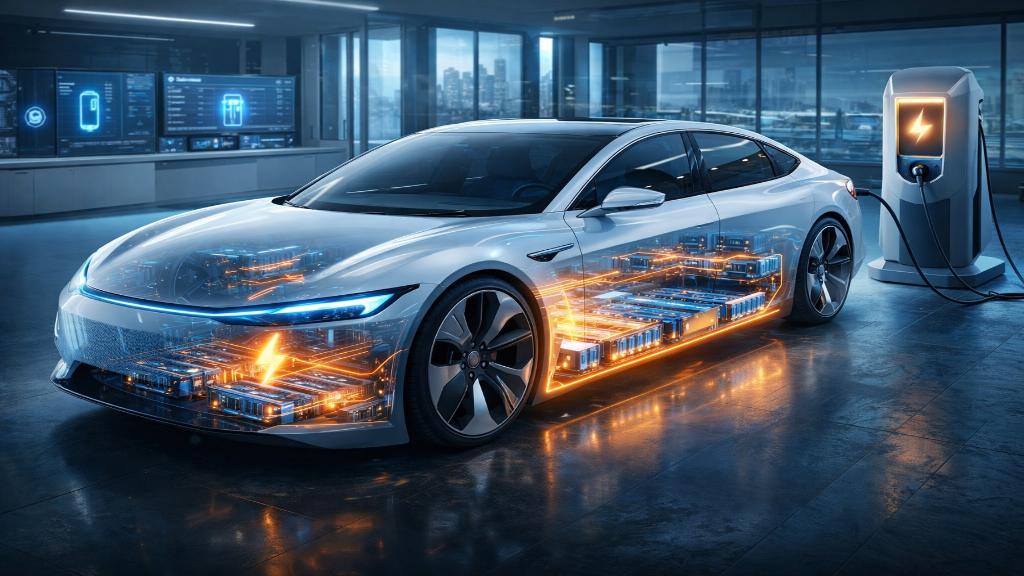
- Recent industrial progress in solid-state batteries
- Potential gains in range and safety for electric vehicles
- High costs and scaling challenges remain
- Global competition between Asian, US and European players
Solid-state batteries are emerging as a key innovation in the energy transition. Unlike traditional lithium-ion batteries, they use a solid electrolyte, which can improve energy density, safety and lifespan. These promises attract strong interest from automakers, industry players and governments.
In recent years, several industrial announcements have marked acceleration in this field. Companies such as Toyota, QuantumScape and CATL have reported progress in energy capacity and charging speed. Some prototypes aim for faster charging and greater range, but these claims still depend on cautious industrial timelines.
This technology relies on a fundamental change: replacing the liquid electrolyte, which is often flammable, with a more stable solid material. This reduces fire risks and improves overall battery safety, a key concern for electric mobility.
From a performance standpoint, solid-state batteries could significantly increase vehicle range. Some estimates suggest gains of 30% to 50%, although these figures vary depending on technology and conditions.
Automakers are increasingly interested in these developments. Several companies are planning gradual integration into future models, though most deployments remain experimental.

Despite these advances, major obstacles remain. Industrialization is a key challenge. Producing solid-state batteries at scale requires complex and costly processes. Materials can be difficult to stabilize, affecting reliability.
Durability is another issue. While these batteries promise longer life, some prototypes still show degradation after repeated charging cycles. This remains an active research topic.
Cost is also a limiting factor. Solid-state batteries are currently more expensive to produce than lithium-ion batteries, which slows adoption in price-sensitive markets.
At the geopolitical level, competition is intensifying. Asian companies, particularly in Japan and China, currently hold a strong industrial lead. Europe and the United States are investing heavily to catch up.
This technological race could reshape the electric vehicle market in the coming years. However, some claims remain uncertain, and experts warn against overly optimistic projections.
Uncertainties persist regarding real-world performance. Some results observed in laboratories are not always reproducible at scale, which could delay adoption.
Overall, solid-state batteries represent a promising but still immature technology. Their success will depend on the ability to move from prototypes to reliable, scalable and cost-effective production.
FAQ
What is a solid-state battery?
A battery using a solid electrolyte instead of a liquid one, improving safety and performance.
When will they be available?
Initial applications are expected before the end of the decade, but large-scale adoption remains uncertain.
What are the main challenges?
Industrial scaling, cost and durability.
- Reuters - Toyota to roll out solid-state battery EVs globally in a couple of years, executive says
- Reuters - Solid state: EV giants chase 'holy grail' of batteries
- Toyota - Toyota Unveils New Technology That Will Change the Future of Cars
- Toyota - Idemitsu and Toyota Announce Beginning of Cooperation Toward Mass Production of All-Solid-State Batteries
- Idemitsu - Construction of Large-Scale Pilot Facility for Solid Electrolytes for All-Solid-State Batteries
- IEEE Spectrum - Solid-State Batteries Could Face Production Hell
- IEEE Spectrum - Solid-State Batteries Rev Up Electric Cars, Boost Grid Storage
To go further on related energy and technology topics, you can read these associated articles on Nezna.io.