
 ezna-io
France Budget 2026: Energy and public trade-offs
By Hugo Delorme
6 months ago

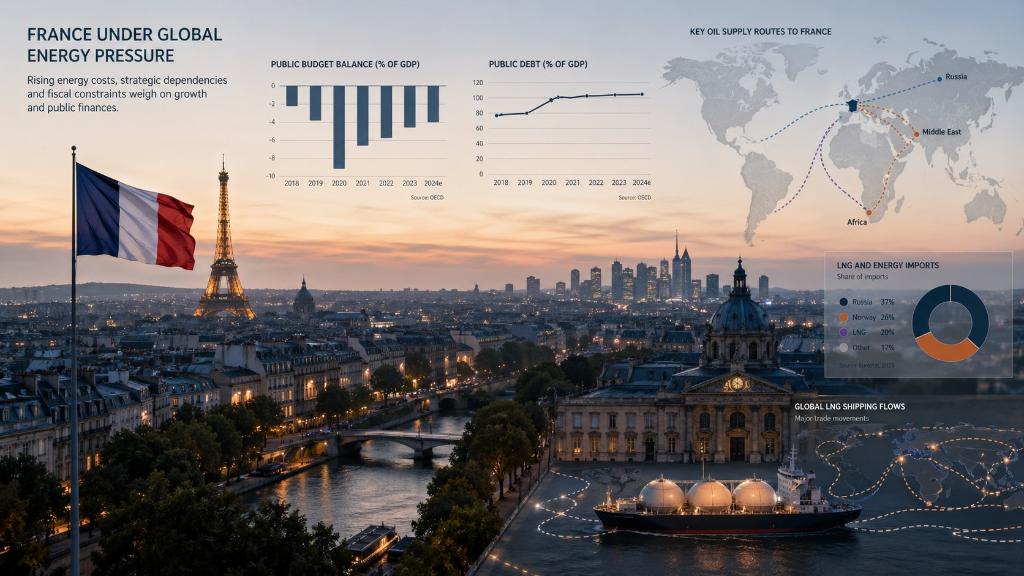
- The budgetary cost of the energy shock could reach several billion euros, with no consolidated official figure.
- Trade-offs involve public spending, economic support, energy policy and transition investment.
- The World Bank forecasts a 24% rise in energy prices in 2026.
- France remains exposed to global energy markets despite its nuclear power base.
France's 2026 budget is being prepared in a zone of uncertainty. Several estimates reported by French media, including Le Monde and TF1 Info, point to a potential multi-billion euro impact linked to energy and geopolitical tensions. No consolidated official figure has been confirmed at this stage. That distinction matters: the issue is not a definitive number, but the way an external crisis is reshaping domestic fiscal choices.
This uncertainty rests on three variables: energy prices, the duration of tensions in the Middle East and the ability of the French economy to absorb higher costs without weakening growth further. In this context, the possible fiscal tools remain familiar: spending freezes, delayed public investment, targeted adjustments to support schemes and revisions to some expenditure paths.
Energy renovation offers a concrete example. If budget pressure intensifies, some spending can be spread over time rather than cancelled. This approach reduces the immediate fiscal burden but shifts part of the constraint into future budgets. It is an arbitration mechanism, not a definitive solution.
The challenge is that several priorities now overlap. The state must contain spending, support economic activity, fund defence, accelerate energy transition and protect exposed households. These goals are not mutually exclusive, but they compete more directly when growth is weak and energy costs rise.
The global backdrop increases the pressure. According to the World Bank, energy prices could rise by 24% in 2026 if disruptions linked to the Middle East conflict continue. Reuters reports that the institution's baseline scenario puts Brent crude at around $86 per barrel, with higher risks if export disruptions persist. The World Bank also expects higher commodity and fertiliser prices, with possible effects on agriculture and food costs.
The transmission to the French economy is gradual, but not theoretical. The Banque de France reports that energy-related cost increases remain concentrated in some sectors, while showing signs of diffusion. It also notes that more companies are considering price adjustments. Its growth projection of around 0.9% in 2026 describes an economy that is still moving forward, but with limited room to absorb a prolonged shock.
At the European level, France is not alone, but it does not enter this period with the same fiscal space as all its neighbours. Public debt above 110% of GDP limits the scope for a spending-led response. European fiscal rules, even when adapted to circumstances, push governments to justify deviations more strictly. The energy shock is therefore also a test of budget credibility.
International comparisons help clarify the issue. Germany responded to the 2022 energy crisis with large-scale public support, but at a fiscal cost. Japan's post-Fukushima experience showed how energy dependence can weigh on the trade balance. In some emerging economies, sustained oil price increases can quickly trigger currency pressure. France sits between these cases: protected by institutions and electricity production, but exposed through oil uses.

France's response partly relies on electrification. The government's plan aims to reduce dependence on hydrocarbons through electric vehicles, heat pumps and some industrial uses. This strategy is consistent with the objective of limiting the transmission of international crises into domestic economic conditions. But the transition remains slow compared with the speed of energy shocks.
Despite its nuclear fleet, France still depends on oil for transport, parts of industry and logistics. That is the main vulnerability: electricity autonomy is not the same as energy autonomy. A country can produce a large share of its electricity and still remain vulnerable to global oil prices.
On fuel supply, the government says, according to statements reported by Le Parisien, that there is no shortage risk in the coming weeks. This confirms short-term stability. It does not guarantee lasting immunity if international energy routes face prolonged disruption.
The central question is therefore political: who absorbs the shock? If the state maintains support, debt may rise. If it reduces some measures, households or companies may become more exposed. If it delays investment, the transition may slow. No option is neutral, which is why the 2026 budget matters beyond accounting.
The decisive point is not to freeze a definitive cost today. It is to understand that the energy constraint is changing how the state arbitrates between protection, investment and fiscal discipline. France is not only facing higher costs; it is measuring the gap between its ambition for autonomy and its real dependence on global flows.
FAQ
Is the budgetary cost known precisely?
No. Several estimates suggest several billion euros, but no consolidated official figure has been confirmed.
Which spending areas could be affected?
Spending freezes, delayed investments or targeted adjustments to public support schemes may be considered.
Is France protected from the energy shock?
Partly in the short term through its electricity system and reserves, but it remains exposed to oil and global markets.
- Le Monde - Estimated cost linked to the Middle East crisis
- TF1 Info - Budget savings under discussion
- Reuters - World Bank energy price forecast
- World Bank - Commodity Markets Outlook 2026
- Banque de France - Monthly Business Survey, April 2026
- Banque de France - Macroeconomic projections, March 2026
- Le Parisien - Fuel supply situation