
 ezna-io
Heatwaves in France: care homes, hospitals and cooling costs
By Léo Piquemal
4 months ago

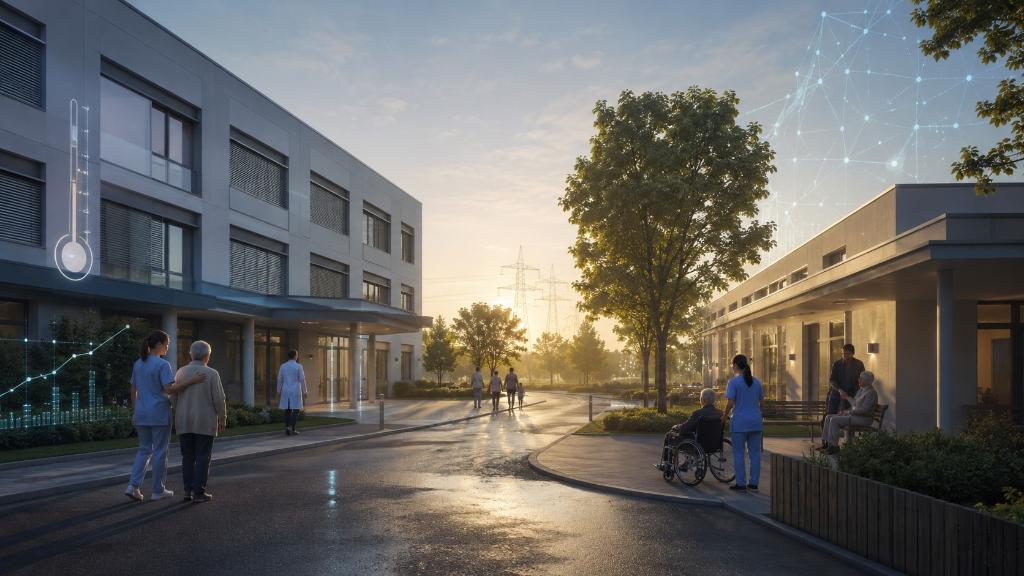
- Cooling vulnerable places requires inventories, adapted buildings, electricity, maintenance and public trade-offs.
- France’s solidarity day raises €3.36 billion in 2026 to fund autonomy broadly.
- The Insee/Drees comparison suggests about 101,000 fewer full-hospitalisation beds between 2003 and 2024.
- High resale prices for Lidl air conditioners are documented as observed listings; alleged paid reservations remain unverified.
The sale of a €179 air-conditioning unit, followed by online resale listings at several hundred euros, captures the shift triggered by the heatwave: when access to cooling becomes scarce, it becomes a price, an inventory and a public priority. The question is no longer only who can buy a device, but who has access to a bearable place when heat becomes a health risk.
The French debate is particularly sensitive because of the memory of 2003. Santé publique France estimates that the August 2003 heatwave caused about 14,800 excess deaths between August 1 and August 20, mainly among older people. After that crisis, the solidarity day was introduced to finance support for older people and people with disabilities. The CNSA states that in 2026 this mechanism will raise €3.36 billion within a national autonomy effort of €43.37 billion, supporting 7.7 million life paths.
This figure should not be read as an air-conditioning budget. The contribution finances autonomy broadly: benefits, facilities, services and support. The question is more precise: why does recurring funding not yet ensure bearable places during a 40°C heat spike?
Recent data reinforce the point without providing a final assessment. According to Le Monde, citing Santé publique France, a first estimate reported 2,025 additional deaths between June 22 and June 28, 2026, a 29.1% increase from the previous week. The figure is explicitly provisional: it relies in part on available electronic death certificates and may be revised. It nevertheless shows that 85% of additional deaths concerned people over 65 and that deaths at home rose more sharply than in institutions.
The pressure was also visible in retail. Lidl put a large stock of low-cost air conditioners and fans on sale in France, including a €179 air-conditioning unit. Le Parisien described heavy crowds and disorder in some stores. Le Parisien and La Dépêche du Midi later reported online resale listings at several hundred euros, sometimes up to €700 or €900 according to the observations cited. These amounts are not verified transaction prices: they correspond to listings observed at a specific moment.
Messages circulating on social networks have also referred to possible informal paid reservations of units before some stores opened. Without solid journalistic or institutional corroboration, this element must remain presented as an unverified allegation.

An example of material urgency in the hospital sector was reported by Le Parisien with AFP. According to that report, the French prime minister’s office said that 30,000 air conditioners had been ordered for hospitals, with a €100 million envelope for urgent cooling needs. Since no directly accessible official document is included among this article’s sources, the information remains attributed to that AFP-based report. If confirmed by budgetary or administrative documents, this order would illustrate the targeted use of air conditioning as health-continuity equipment.
The position of France’s environment minister Monique Barbut, who criticised the idea of “putting air conditioning everywhere”, illustrates the tension. Air conditioning does not address the causes of global warming and can increase electricity peaks. But in places hosting older, ill, very young or isolated people, access to a cooled space may be a targeted health measure.
Schools involve another public trade-off. The French education ministry’s heatwave management plan provides for protective measures, operational changes and, when safe reception can no longer be ensured, the possibility of closing a school. Official recommendations include shaded rooms, limiting heat entry, closed blinds or shutters and access to drinking water.
Behind these decisions, local authorities must finance shade, ventilation, insulation or sometimes active cooling. The cost appears in concrete situations: a south-facing classroom where heat limits concentration, a care-home room where night-time heat prevents recovery, or a hospital service where staff must protect both patients and sensitive equipment.
The hospital system provides another measure of the constraint. Insee data from Drees SAE surveys show 468,418 installed full-hospitalisation beds in 2003. Drees counted 367,300 beds at the end of 2024, along with 91,200 partial-hospitalisation places and capacity for 25,400 patients to be treated simultaneously at home. The comparison therefore suggests a decline of about 101,000 beds between 2003 and 2024, subject to the statistical scopes used. It does not mean an equivalent reduction in healthcare supply, because outpatient and partial-hospitalisation care have expanded. It does reduce physical margins during shocks.
Medical demography follows the same capacity logic. Drees reports that on January 1, 2025 France had 237,200 active doctors, 9.9% more than in 2012, and that 11% had obtained their diploma abroad, compared with 7% in 2012. These practitioners are not responsible for the pressure: they help the French system operate. The economic issue is long-term planning: the past numerus clausus, training duration, working conditions and territorial distribution.
European sources mostly read heat as an adaptation lag. Reuters stresses effects on productivity, transport, buildings and energy; Euronews and the International Energy Agency underline the growing pressure of cooling on power grids. Outside Europe, Xinhua highlights the opportunity for Chinese manufacturers, with the possible bias of a state news agency; The Economic Times focuses on the limits of responding only by buying air conditioners in infrastructures designed for winter. These readings describe three dimensions of the same market: European adaptation, Asian production and energy constraints.
Available facts do not show a total absence of action since 2003. They reveal instead a gap between recurring funding, continued health vulnerability, constrained hospital capacity and a private cooling market under pressure. For households, the cost appears in urgent purchases and electricity bills; for facilities, in works and maintenance; for the state, in its ability to convert solidarity into places that remain habitable during heat peaks.
FAQ
Does France’s solidarity day directly fund air conditioners?
No, not through a dedicated mechanism. It broadly finances autonomy support for older people and people with disabilities. The heatwave nevertheless raises the question of how much of this funding becomes material protection against heat.
Has France lost more than 100,000 hospital beds since 2003?
On a broadly comparable scope, Insee/Drees data show 468,418 full-hospitalisation beds in 2003, compared with 367,300 at the end of 2024 according to Drees, or about 101,000 fewer beds. This comparison must be read with scope cautions and alongside the growth of outpatient care.
Are foreign-trained doctors responsible for France’s shortage of doctors?
No. They contribute to the functioning of the French healthcare system. The issue concerns medical training planning, the former numerus clausus, working conditions and territorial imbalances.
- Santé publique France — The August 2003 heatwave: what happened?
- Le Monde — France records 2,025 excess deaths from heatwave, but data remains incomplete
- Service-public.fr — Solidarity day: how it works
- Le Parisien with AFP — Order for 30,000 air conditioners for hospitals
- Le Parisien — Monique Barbut’s statements on air conditioning
- Le Parisien — Lidl air-conditioner sale and store disorder
- La Dépêche du Midi — Lidl air conditioners listed for resale up to €900
- French education ministry — Heatwave management plan
- French education ministry — Heatwave prevention and recommended measures
- Insee, Drees SAE data — Installed full-hospitalisation beds, 1998-2016
- Sécurité sociale — Healthcare facility capacity, 2003-2022 data
- Drees — Hospital capacity in France in 2024
- Drees — Medical demography as of January 1, 2025
- Reuters — Europe, heatwaves and the climate adaptation gap
- Euronews — Europe’s growing cooling demand and electricity systems
- International Energy Agency — Staying cool without overheating the energy system
- Xinhua — Heatwaves and Europe’s cooling market
- The Economic Times — Europe can’t just air-condition its way out of the heatwave meltdown