
 ezna-io
Chichén Itzá reopens: Maya beauty and managed access
5 months ago

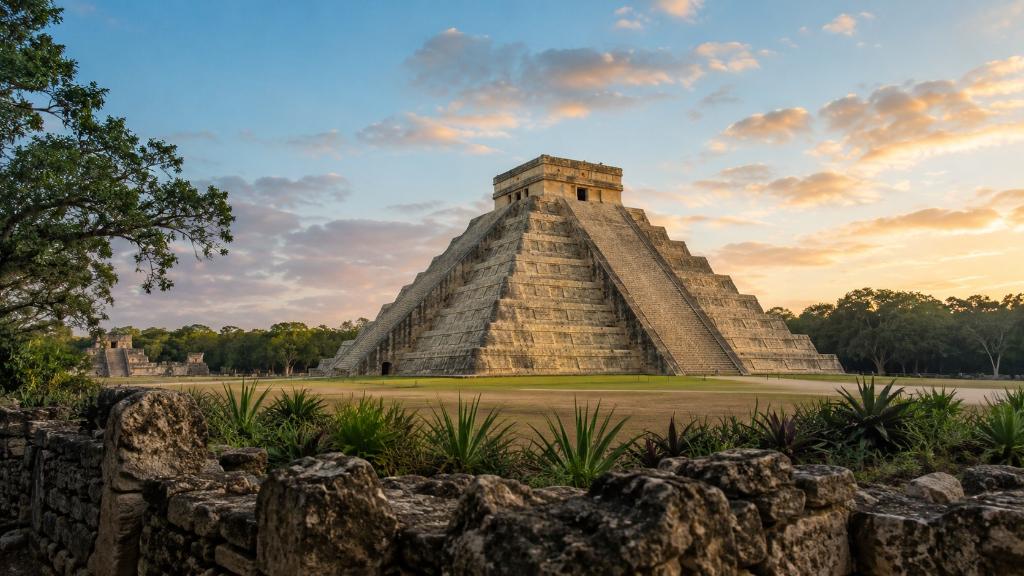
- Chichén Itzá reopened on June 1, 2026 after a closure of nearly thirteen days linked to CATVI, access routes, artisans and guides.
- The main sources agree on the reopening, but frame it differently: World Heritage value, public management, tourism economy or local conflict over use.
- The figures require nuance: more than 600 vendors and artisans affected according to The Art Newspaper, 666 vendors or artisans registered/authorised according to Mexican sources, and 962 commercial spaces at CATVI.
- The cultural issue is to preserve the legibility of a Maya-Toltec masterpiece without erasing the social economy built around the site.
The reopening of Chichén Itzá on June 1, 2026 was not simply the resumption of a tourist route. It exposed a lasting tension between conservation, public access and local life. For nearly two weeks, one of Mexico’s most visited pre-Hispanic ensembles remained closed amid disagreement between authorities, artisans, vendors, guides and actors from Tinum.
The main facts are cross-checked. The Art Newspaper reports a June 1 reopening after a 13-day closure linked to community opposition to the new CATVI visitor complex. The outlet says the dispute centred on the relocation of more than 600 vendors and artisans to that 16-hectare facility. Mexico News Daily confirms that visits resumed at 8 a.m. after thirteen days of negotiations. El Financiero, citing the Secretaría de Cultura and INAH, confirms the 8 a.m. to 4 p.m. schedule and the dialogue with artisans, the Yucatán government and the municipality of Tinum.
The chronology requires slight caution: some sources place the start of the blockade around May 18, while others refer to an effective or extended closure from May 19. La Jornada reports that artisans already working inside the archaeological zone remain there, while new merchants are directed toward CATVI premises. The Yucatán government states that artisans included in the 2025 census submitted to INAH will not be evicted, that no new vendors will be admitted, and that some rearrangements inside the zone will be coordinated.
The site’s value depends on legibility
UNESCO presents Chichén Itzá as one of the great Maya centres of the Yucatán peninsula, shaped by nearly one thousand years of history. Its stone monuments express an encounter between Maya vision, Toltec elements and influences from central Mexico. This hybridisation gives the site its particular force: architecture, sculpture, ceremonial urbanism and sky observation respond to one another.
The aesthetic criterion is central. UNESCO considers the monuments of the northern group, including the Great Ball Court, the Temple of Kukulcán and the Temple of the Warriors, to be masterpieces of Mesoamerican architecture because of the beauty of their proportions, the refinement of their construction and the splendour of their sculpted decoration. The site’s value depends as much on its voids as on its volumes: open axes, viewing distances, limestone masses and reliefs must remain legible.
El Castillo imposes an immediately recognisable geometry. El Caracol recalls the ancient relationship between architecture and astronomical observation. The Great Ball Court organises a ritual space where mass, echo and perspective matter. In a place so deeply shaped by axes, every reception infrastructure must remain subordinate to the reading of the monument.

CATVI: organising flows, shifting value
CATVI, the Visitor Assistance Centre, is the focus of the crisis. The Art Newspaper describes it as a 16-hectare infrastructure linked to the Maya Train system, with 962 commercial spaces, food areas and guide services, at a reported cost of $46 million. Its official function is to improve ticketing, security, orientation and reception. But a single entrance also decides where visitors pass, and therefore where economic value is created.
The distinction between figures matters. Mexico News Daily refers to 666 authorised vendors in the complex and 264 artisans agreeing to move into a new handicrafts market. La Jornada refers to 666 artisans working inside Chichén Itzá, not removed but reorganised under the new access scheme. These formulations are not identical; they point to the same order of magnitude, but not necessarily to the same administrative perimeter.
This conflict is not entirely new. AP News already described roadblocks in 2023 linked to Maya vendors’ access around the ruins, underlining a structural difficulty: tourism celebrates ancient Maya heritage while contemporary communities seek their place in the economy that follows from it. Spring 2026 updates that problem on a larger scale, with new infrastructure and a more centralised access order.
Visitor pressure turns beauty into responsibility
Public pressure explains why an access dispute becomes a heritage question. The Art Newspaper cites INAH for more than 8,000 visitors a day and 2.2 million a year. UNESCO provides a more stable frame: the site receives at least 3,500 tourists a day, rising to 8,000 in high season. Such attendance requires constant maintenance to prevent deterioration of the pre-Hispanic fabric.
UNESCO also identifies the risks: excessive use, inadequate service infrastructure, fire, limestone erosion and lack of long-term conservation monitoring. These elements show that the issue is not to oppose tourism and conservation. It is to determine when a service offered to visitors becomes a threat to the integrity of the place or to its aesthetic experience.
Sources, biases and uncertainties
The sources consulted do not look at the same event in the same way. The Art Newspaper privileges the heritage and local-community angle; Mexico News Daily stresses operational reopening and the tourism economy; El Financiero relays the official version from the Secretaría de Cultura; La Jornada follows the social dispute and the terms of relocation; the Yucatán government and INAH are essential for administrative decisions but remain stakeholders; UNESCO provides the most stable heritage frame without documenting daily negotiations.
No precise financial conflict of interest was identified in the verified sources. The biases are mainly structural: authorities defend the management order, tourism media look at economic losses, heritage sources stress conservation, and local actors protect their income. The medium-term effects on artisans, guides and the legibility of the route remain uncertain.
Why this reopening deserves a cultural article
Chichén Itzá shows that beauty does not transmit itself. A masterpiece of stone can be listed, photographed and admired; it can still lose intelligibility if its access routes, flows and surrounding activities become confused. Conversely, overly abrupt administration can weaken the social anchoring of a heritage site that also lives through those around it.
The success of the reopening will therefore not be measured only by ticket sales. It will depend on the ability to preserve proportion, distance, the reading of volumes and the experience of relative silence that architecture of this rank requires. For Chichén Itzá, better reception must not mean greater occupation; organising commerce must not mean erasing communities; protecting the monument must not mean cutting it off from its human territory.
FAQ
Why did Chichén Itzá close in May 2026?
Verified sources link the closure to the new CATVI system, access routes, sales areas, artisans and guides. The closure lasted nearly thirteen days before the June 1, 2026 reopening.
Is CATVI only a visitor building?
No. It is also a tool for managing flows and reorganising economic activity: The Art Newspaper mentions 16 hectares, 962 commercial spaces, food areas, guide services and a cost of $46 million.
Does the reopening solve the conflict?
It confirms an operational agreement, but the long-term effects on artisan income, guides, visitor routes and conservation will need to be observed over time.
Sources
- The Art Newspaper — Chichén Itzá reopens after dispute with vendors that led to 13-day closure
- Mexico News Daily — Chichén Itzá, Mexico’s top cultural attraction, reopens after 13-day closure
- El Financiero — Chichén Itzá reabrirá este 1 de junio tras acuerdos
- La Jornada — Tras 13 días, reabren zona arqueológica de Chichén Itzá
- La Jornada — Sin acuerdos, artesanos de Chichén Itzá y autoridades
- Gobierno de Yucatán — Gobierno estatal e INAH mantienen acercamiento con artesanas, artesanos y guías
- UNESCO World Heritage Centre — Pre-Hispanic City of Chichen-Itza
- AP News — Handicraft vendors block roads to Mexico’s Chichen Itza ruin