
 ezna-io
China Growth at 4.3% Reveals a Multi-Speed Economy
By Zoé Marquand
3 months ago

- China's economy grew 4.3% year on year in the second quarter of 2026, down from 5.0% in the first.
- Technology industries and exports remain resilient, while goods consumption, private investment and property are weak.
- The national figure conceals several geographies: the coast remains wealthier, but some inland provinces grow faster through catch-up effects.
- The national accounts are preliminary, and additional support measures discussed for late July have not yet been confirmed.
China's economy has not stopped growing. It is now moving at several speeds. According to data released on July 15 by the National Bureau of Statistics, gross domestic product increased by 4.3% year on year in the second quarter of 2026, down from 5.0% in the first. Activity grew 4.7% over the first six months, reaching 69.5704 trillion yuan at current prices.
The result was below the main forecasts, generally ranging from 4.5% to 4.6%. It was also the weakest year-on-year growth rate since late 2022, when pandemic restrictions were still disrupting activity. Beijing's target of 4.5% to 5% applies to the whole of 2026, however. With first-half growth of 4.7%, China remains within that range for now.
An economy producing faster than it spends
The official series reveal a more instructive divide than the headline GDP figure. Value added by industrial firms above the statistical threshold rose 5.4% in the first half. Equipment manufacturing expanded 9.3% and high-tech manufacturing 13.3%. Output of 3D-printing devices jumped 48.5%, lithium-ion batteries 39.3% and industrial robots 28%.
Household demand moved more slowly. Combined retail sales of goods and services increased 2.7%, supported mainly by services, up 5.3%, while goods sales gained only 1.1%. The traditional measure of retail sales of consumer goods rose 1.3% over the half year and only 1.0% in June.
Investment provides the sharpest contrast. Fixed-asset investment excluding rural households fell 5.7%. Even without property, it declined 2.7%. Private investment dropped 8.5%, manufacturing investment 1.2%, infrastructure investment 2.4% and real-estate development investment 18%. Sales of newly built commercial buildings fell 13.6% by value and 11.6% by floor area.
Not everything on the domestic side is weak. The service sector grew 5.2%, digital, information and software services 10.7%, and real per-capita disposable income 4.2%. Surveyed urban unemployment stood at 5.0% in June, down from 5.1% in May. China is slowing, but not everywhere and not in the same activities.
A national figure concealing several geographies
The 4.3% rate combines provincial economies with very different structures. Coastal provinces, largely located within the eastern statistical region, still concentrate the main ports, much of China's exports, major financial centres and several technology clusters. In 2025, the eastern region produced 73.0876 trillion yuan, slightly more than half of national GDP. The central and western regions each generated nearly 29.9 trillion yuan, compared with 6.5035 trillion yuan in the Northeast.
Wealth and growth rates do not move together mechanically. In 2025, the East expanded by 5.0%, compared with 5.2% in the central region and 5.1% in the West. The Northeast, marked by older industries, demographic ageing and decades of restructuring, grew by only 4.1%. Guangdong, China's largest provincial economy, expanded by 3.9%, compared with 5.8% in Gansu and 7.0% in Tibet, where a small economic base and public investment amplify growth rates. Jiangsu nevertheless grew by 5.3%, while Shandong and Zhejiang expanded by 5.5%.
These rates do not carry equal weight in the national total. Guangdong and Jiangsu each represented more than 10% of Chinese GDP in 2025. A modest slowdown in these large economies can matter more than several additional points of growth in a small inland province. Complete provincial accounts for the first half of 2026 have not yet been published, making it premature to attribute the current slowdown to any particular territory.

Exports cushion the slowdown
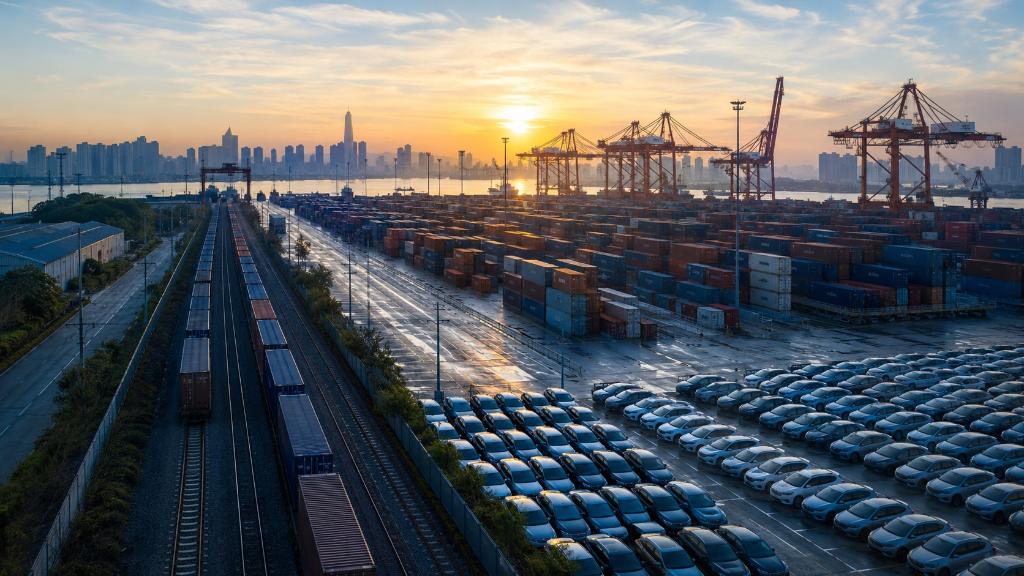
Foreign trade remains one of the main supports for activity. According to the National Bureau of Statistics, goods exports measured in yuan increased by 13.4% in the first half. Exports of mechanical and electrical products rose by 20.1%.
According to customs figures cited by the Associated Press, exports increased by 17.6% over the first half and 27% in June. Yuan- and dollar-denominated series are not strictly comparable, but both indicate external demand considerably stronger than domestic goods consumption. Some economists believe that orders may partly have been brought forward ahead of possible tariff increases; the scale of that effect has not been independently established.
This external strength supports factories and industrial employment, but also enlarges surpluses that fuel trade tensions. China recorded a global trade surplus of about $1.2 trillion in 2025, according to the Associated Press. The more slowly the domestic market absorbs production, the more growth depends on politically contested foreign markets.
Moderate consumer inflation, greater industrial pressure
The Consumer Price Index rose 1.0% year on year in June and averaged 1.0% over the first half. Excluding food and energy, prices increased by 1.2% over six months. Food prices fell by 0.6%, while service prices rose by only 0.8%.
Industrial prices followed a different path. The Producer Price Index increased by 4.1% year on year in June and by an average of 1.5% in the first half. Purchasing prices paid by industrial producers rose 6.4% in June, including increases of 21.6% for non-ferrous metals and cables and 11.8% for fuel and power. At the same time, factory-gate prices for consumer goods fell by 0.9%.
This combination can compress margins: some companies are paying more for inputs without being able to pass the full cost on to customers. Moderate overall inflation therefore does not mean an absence of industrial pressure.
Sources selecting different consequences
The National Bureau of Statistics and Xinhua describe an economy that has withstood pressure, with broadly stable employment, growing services and rapidly developing technological drivers. Their hierarchy also reflects their institutional role: the bureau produces official statistics under state authority, while Xinhua is China's state news agency.
The Hong Kong-based South China Morning Post gives greater prominence to the gap between exports and domestic demand, while The Straits Times describes a K-shaped economy in which technology and export sectors outpace property, investment and goods sales.
The Associated Press focuses more heavily on the social effects of transition, including employment and household caution. Reuters treats the result mainly as a market and policy signal. These editorial approaches correspond to their respective audiences; no specific conflict of interest was identified in the articles reviewed.
The sources therefore do not fundamentally disagree on the data. They prioritise different consequences: productive transformation for official Chinese sources, the coexistence of fast and slow sectors for Asian media, and consumption, employment and policy decisions for international agencies.
Cyclical slowdown or change of model?
Two interpretations coexist: deficient demand and an organised reallocation toward technology sectors. Investment in intellectual-property products rose 9.4% and investment in high-tech industries 4.6% while total investment declined.
It has not been demonstrated, however, that these sectors will generate enough jobs, income and consumption to replace property and infrastructure as mass engines of growth. The second-quarter figures document a transition; they do not guarantee its outcome.
The International Monetary Fund now expects growth of 4.6% in 2026, up from its previous 4.4% estimate, followed by 4.1% in 2027. It identifies moderate consumption, external imbalances and productivity among the structural challenges. The forecast remains conditional on energy prices, global demand and trade tensions.
Stimulus expected, but not confirmed
Attention is turning to the Politburo meeting usually held in late July. At the time of writing, no new measures had been officially announced. Scenarios involving fiscal support, consumer subsidies or further property easing therefore remain analysts' expectations.
Beijing must choose between rapid investment-led stimulus, which could add to local debt and excess capacity, and more structural support for households, which requires slower reforms of social protection, local taxation and income distribution.
China's slowdown is less a general breakdown than an imbalance among growth engines. Industry, exports and some provinces are still advancing quickly; consumption, property and private investment remain subdued.
FAQ
Is China in recession?
No. GDP grew 4.3% year on year and 0.9% from the previous quarter. This is a slowdown, not a broad contraction.
Do inland provinces grow more slowly than the coast?
Not necessarily. Some grow faster through catch-up effects, but their economic weight remains smaller than that of the major coastal provinces.
Why are exports not enough to rebalance the economy?
They support production and industrial employment, but cannot fully replace consumption, private investment and property. They also expose China more heavily to trade barriers.
- National Bureau of Statistics of China — first-half 2026 economic results
- National Bureau of Statistics of China — Consumer Price Index in June 2026
- National Bureau of Statistics of China — Producer Price Indexes in June 2026
- National Bureau of Statistics of China — 2025 regional results and economic communiqué
- Xinhua — resilience and new growth drivers
- South China Morning Post — quarterly growth and domestic demand
- The Straits Times — Asian reading of a multi-speed economy
- Associated Press — industry, exports and social consequences
- Associated Press — China's June export surge
- Reuters — slowdown, investment and policy expectations
- Bank of Finland Institute for Emerging Economies — provincial growth gaps
- International Monetary Fund — updated China forecasts