
 ezna-io
US Home Sales Plunge 8.4% in January 2026: Housing Market Warning Sign
By Léo Piquemal
8 months ago

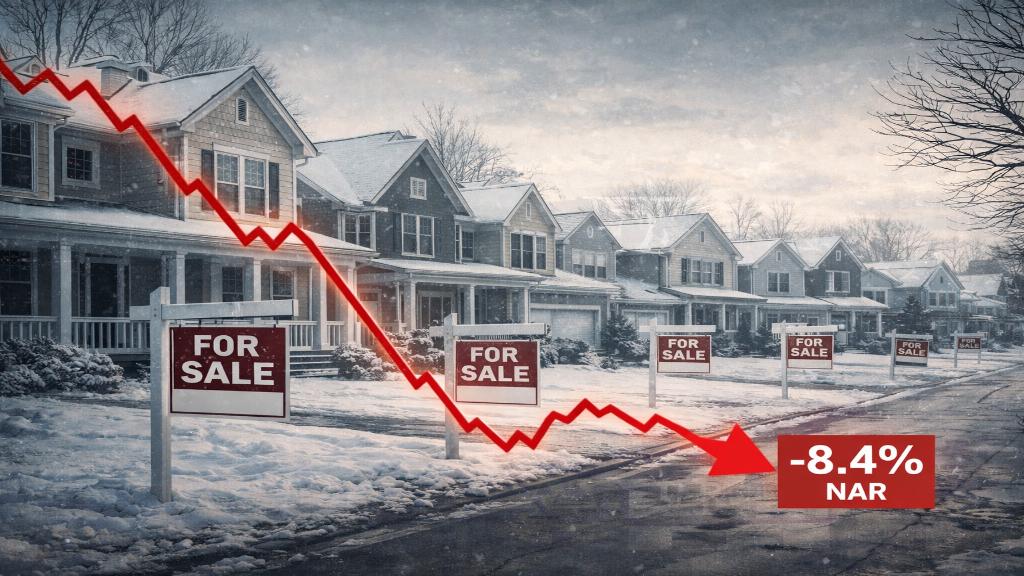
- Existing home sales fell 8.4% in January 2026 to 3.91 million annualized units (NAR).
- Largest monthly drop in nearly four years and slowest pace since December 2023.
- Median price at $396,800 (+0.9% YoY); inventory at 1.22 million units (3.7 months’ supply).
- Decline across all regions; possible weather effect but structurally low supply.
- Real-life impact: first-time buyers locked out, reduced mobility, rental pressure and wealth inequality.
On February 12, 2026, the National Association of Realtors (NAR) released concerning figures: existing home sales in the United States dropped 8.4% in January from December, reaching a seasonally adjusted annual rate of 3.91 million units. The number fell short of economists’ expectations (4.18 million per Reuters consensus) and marks the lowest level since December 2023.
Why did existing home sales plunge so sharply in January 2026?
Several factors converged. Inventory remains critically low (1.22 million units, down 0.8% month-over-month but up 3.4% year-over-year), keeping prices elevated. The median price rose 0.9% year-over-year to $396,800. Mortgage rates, although slightly lower, are still prohibitive for many households. NAR chief economist Lawrence Yun also cited extreme weather (colder temperatures and above-normal precipitation) that likely reduced viewings and closings.
Structural vs cyclical factors: what the data shows
Annual labor market revisions and cooling inflation (CPI at 2.4% in January) failed to spark demand. International sources (Reuters, AP News, CNBC) align on the raw numbers. No major divergence appears between Bloomberg, Financial Times and official NAR data. Russian (Kommersant) or Chinese (South China Morning Post) outlets did not cover the story within 24 hours, indicating primarily domestic US focus.
What are the concrete consequences for everyday Americans?
For first-time buyers, the impact is immediate: young families or modest-income households remain renters longer, fueling rental market pressure and higher rents in major cities. Geographic mobility declines, limiting job opportunities. Real estate agents and related sectors (moving, renovation) face slowdowns. Over the longer term, homeownership concentration among wealthier households widens wealth gaps.

The NAR Housing Affordability Index nevertheless shows improvement (highest level since March 2022 thanks to wage growth outpacing home prices). Yet insufficient supply prevents this theoretical gain from materializing. World Bank and IMF reports on affordable housing note the phenomenon is not unique to the US, but American figures remain among the tightest in the OECD.
Source comparison and possible biases
All figures originate from the NAR, a professional realtor organization. Reuters, AP and CNBC reproduce the data without notable alteration. No direct conflict of interest (lobby funding) was identified in recent publications. Social media (X) mostly relay the raw figures; some analysts mention weather possibly masking deeper structural issues.
FAQ
Is the drop solely due to weather?
No. While winter conditions played a role, historically low inventory and elevated prices are confirmed structural constraints across independent sources.
Will mortgage rates fall soon?
Expectations of further Fed rate cuts (after the soft January CPI) may help, but transmission to 30-year mortgages remains delayed and uncertain.
Are foreign buyers affected?
Indirectly: a slowing US market can influence international investment flows, as occasionally noted in Bloomberg and Wall Street Journal analyses.