
 ezna-io
North Korea: A Strategic Opening to China and Russia
By Zoé Marquand
an hour ago

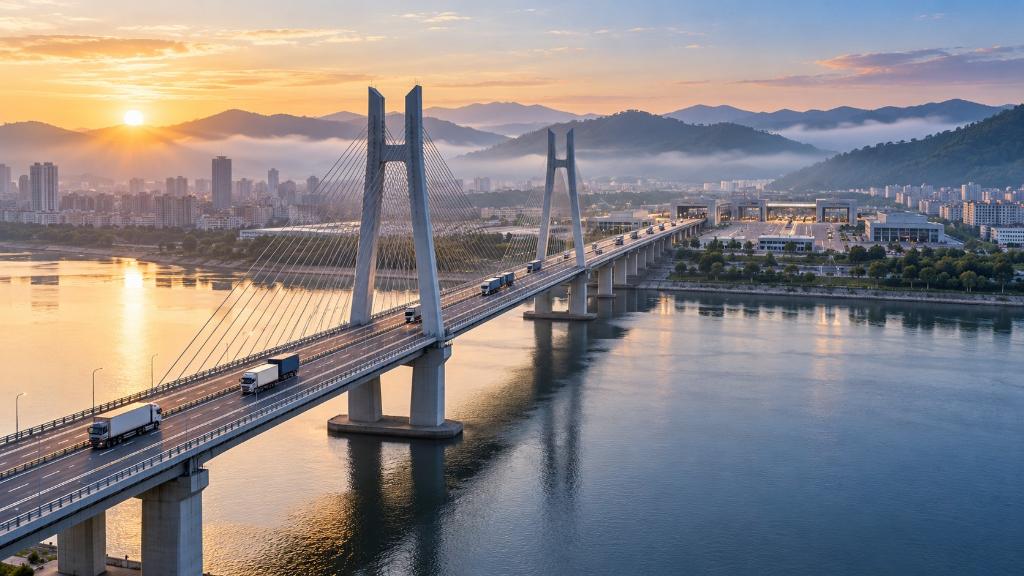
- Kim Jong Un visited China on October 24, 2026, and returned to North Korea across the new Yalu River Bridge, which had opened nine days earlier.
- In September, Pyongyang and Moscow inaugurated their first shared road bridge, extending their strategic rapprochement.
- China accounted for 98.2% of North Korea's recorded foreign merchandise trade in 2025, according to KOTRA.
- The new connections suggest selective external engagement without demonstrated domestic liberalisation.
A bridge can remain unused for twelve years before becoming a diplomatic symbol. Substantially completed in 2014, the New Yalu River Bridge connecting Dandong, China, with Sinuiju, North Korea, finally opened to traffic on October 15, 2026. Nine days later, Kim Jong Un visited Dandong before returning to North Korea across the newly opened bridge.
The October 24 trip combined several symbols. The North Korean leader met Wang Huning, a member of the Chinese Communist Party's Politburo Standing Committee, visited a Korean War memorial and toured a bus factory. According to Xinhua, both sides expressed their intention to strengthen bilateral cooperation.
The visit preceded the 76th anniversary of Chinese volunteers entering the Korean War. Beijing and Pyongyang thus linked military memory with economic prospects. History provides the language of their relationship; infrastructure is becoming one of its instruments.
Yet the visit takes on broader significance when viewed alongside developments on the Russian border. On September 7, North Korea and Russia inaugurated their first cross-border road bridge over the Tumen River. Within less than two months, Pyongyang opened two new overland connections to its principal partners. The sequence raises a larger question: is North Korea seeking to reduce its isolation through carefully chosen foreign relationships while preserving its domestic political and economic system?
The Yalu bridge: twelve years of waiting
Construction of the new China–North Korea bridge began in 2011 and was substantially completed in 2014. More than three kilometres long, it carries four traffic lanes across a 28.5-metre-wide deck, according to Xinhua.
Its opening was delayed by unfinished access roads and customs facilities on the North Korean side. For more than a decade, the infrastructure remained largely unused while the older China–North Korea Friendship Bridge continued to handle a significant share of road and rail traffic.
The new crossing could facilitate heavy trucks and containerised freight. Its technical capacity, however, says little about permitted trade or actual cargo volumes.
An early independent observation provides concrete evidence of activity. On October 20, Iliana Ragnone and Martyn Williams of the specialist website 38 North published an analysis of satellite imagery captured on October 16. Approximately 70 trucks were visible in the North Korean customs complex, some apparently loading or unloading at warehouses.
This was a snapshot, not a daily traffic count. The contents of the shipments remain unknown, and further observations will be needed to establish sustained traffic patterns. Nevertheless, the imagery shows that the crossing has begun operating.
China: North Korea's dominant trading partner
According to figures from the Korea Trade-Investment Promotion Agency (KOTRA), published in July 2026, North Korean merchandise exports reached $468.59 million in 2025, up 30% year on year. Imports totalled $2.66 billion, an increase of 13.9%.
Recorded foreign merchandise trade consequently amounted to approximately $3.13 billion, producing a deficit of around $2.19 billion. China accounted for 98.2% of those exchanges.
The percentage covers merchandise flows captured by available statistics, not every economic, financial or military transaction involving North Korea. Some exchanges with Russia may fall outside these measurements.
Chinese customs figures also indicate a recovery in bilateral trade following pandemic restrictions. That recovery began before the new bridge opened. The infrastructure may therefore reinforce an existing trend rather than create it independently.
This concentration provides Pyongyang with crucial access to Chinese supplies while exposing much of its foreign trade to decisions made in Beijing. The new bridge strengthens an already dominant connection; by itself, it does not diversify North Korea's economy.
Russia: a military partnership acquiring logistical depth
Rooted in ties dating back to the Soviet era, relations between Moscow and Pyongyang have intensified markedly since 2022, culminating in a new comprehensive strategic partnership treaty signed on June 19, 2024.
The agreement signed by Vladimir Putin and Kim Jong Un provides for military and other assistance if either party comes under armed attack and enters a state of war, subject to the conditions established by the treaty and national legislation.
Cooperation has moved beyond diplomatic commitments. North Korean deliveries of weapons and ammunition to Russia have been documented, as has the participation of North Korean soldiers in Russian military operations, particularly in the Kursk region.
In May 2025, the Multilateral Sanctions Monitoring Team (MSMT), established by eleven countries, issued a report detailing these transfers. The mechanism was created after the dissolution of the United Nations panel of experts monitoring sanctions against Pyongyang. It is not an independent UN body, and its members have their own security interests, an institutional context relevant to assessing its findings.
The precise benefits received by Pyongyang remain partly uncertain. Claims concerning transfers of sensitive military technology should not be confused with publicly established agreements.
On September 7, 2026, the partnership acquired a further physical dimension when the two countries inaugurated a road bridge over the Tumen River, connecting Russia's Khasan area with North Korea's Rason region. Construction began in April 2025, adding a road crossing to the older railway link.
The new route is approximately one kilometre long and could handle up to 300 vehicles per day, according to capacity figures announced by the Russian government and reported by ABC Australia. This projected capacity cannot be directly compared with the roughly 70 trucks observed at one point in North Korea's customs complex serving the Chinese crossing.
Moscow and Pyongyang describe the new bridge as a means of expanding trade, tourism and transport. The distinction between China as a commercial partner and Russia as a military partner is imperfect: Moscow also maintains economic, energy and logistics relationships with Pyongyang whose full scale remains difficult to measure.

Two partners with distinct interests
Beijing has a major interest in maintaining border stability and commercial continuity. Moscow benefits from military cooperation that addresses, among other things, requirements arising from the war in Ukraine. For Pyongyang, these relationships may offer different resources and greater diplomatic flexibility.
Robert King, a former US special envoy for North Korean human rights issues, argues in an October 20 analysis published by the Korea Economic Institute of America (KEI) that Beijing is seeking to curb Moscow's growing influence with Kim Jong Un. KEI distributes the analysis on behalf of South Korea's Korea Institute for International Economic Policy (KIEP) under a US Foreign Agents Registration Act disclosure, while stating that the views expressed are the author's own.
This remains an interpretation rather than proof of direct rivalry. Construction schedules and logistical needs may also explain the timing of the two openings. No public document reviewed establishes the existence of a coordinated trilateral plan.
North Korea may therefore benefit from two partly complementary partnerships without Beijing and Moscow necessarily sharing identical objectives on every issue.
External engagement without domestic reform
Opening new diplomatic channels and border crossings is not the same as opening the domestic economy.
Comparisons with China's reforms beginning in 1978 remain limited. Those policies progressively transformed production, investment and the country's integration into international trade. Recent North Korean announcements show no reform programme of comparable scope.
Pyongyang continues to impose strict controls on international travel and authorised economic activity. United Nations Security Council sanctions also restrict numerous transactions, particularly those associated with the country's nuclear and ballistic missile programmes.
Recovering cross-border trade has not, by itself, revived Dandong's economy. According to figures reported by Reuters on October 8, the city grew by just 0.3% in the first half of 2026, compared with 4.7% for China as a whole. Several factors contribute to this weakness, which cannot be attributed solely to restrictions on trade with Pyongyang.
Despite the recovery in China–North Korea trade, businesspeople interviewed by Reuters remained cautious: a new bridge would not guarantee an immediate revival of local commerce. Al Jazeera highlighted similar obstacles on October 16, drawing in part on the analysis of Phillip Park, a professor at the University of North Korean Studies in Seoul.
The paradox is tangible: bridges create new routes, but they do not determine who may cross them or what goods may be transported.
Complementary international perspectives
Comparing the sources reveals different editorial priorities. The principal events are widely corroborated, but their economic and strategic implications sometimes produce divergent interpretations.
Xinhua, China's state news agency, emphasises the historical continuity of relations between Beijing and Pyongyang and the expected benefits of cooperation. Its reporting reflects official Chinese diplomatic positions, with which the agency is institutionally connected.
Yonhap, based in South Korea, focuses on diplomatic chronology and regional implications. Some initial information came from anonymous government sources, but Kim's visit was subsequently officially confirmed.
Reuters and Al Jazeera examine economic obstacles more closely, while ABC Australia places the Russian bridge within the context of the war in Ukraine. 38 North offers satellite observations relatively independent of government statements, although the imagery cannot identify the cargo.
These perspectives differ chiefly over the potential consequences of the rapprochement and the intentions attributed to governments. Relevant institutional interests, including those of state news agencies, the MSMT and KEI's distribution arrangement, are disclosed where they help readers assess the evidence.
Sanctions and regional security: unresolved consequences
The expansion of border links raises questions about their use. Western and Asian governments consider certain aspects of Russia–North Korea military cooperation to be in breach of United Nations Security Council resolutions. The MSMT has documented their allegations and the evidence supporting them.
Documented military transfers between Moscow and Pyongyang must nevertheless be distinguished from the use of the new bridges. The reviewed sources do not identify prohibited shipments that specifically crossed either structure.
Beyond their commercial or military use, the new connections could also affect Pyongyang's diplomatic relations with other countries. More diversified economic and military support could reduce its dependence on potential Western concessions. That possibility, however, does not establish that negotiations with Washington will resume or that relations with Seoul will improve.
Continuity behind the change
North Korea has long sought external resources and security assurances while preserving political autonomy. The new infrastructure extends that approach with additional means.
Its importance will now depend on actual freight volumes, the composition of trade and changes in border controls. These indicators will help establish whether the new connections durably alter Pyongyang's economic relationships.
The Yalu and Tumen bridges do not necessarily signal a North Korea opening more widely to the world, but one becoming better connected to two essential partners. The question is whether these routes will expand its room for manoeuvre or primarily reinforce longstanding dependencies.
FAQ
Is North Korea opening up to the world?
It is strengthening ties with China and Russia and improving border infrastructure. This selective external engagement does not demonstrate domestic economic or political liberalisation.
Why are China and Russia important to Pyongyang?
China accounted for 98.2% of North Korea's recorded foreign merchandise trade in 2025, according to KOTRA. Russia has become a major military partner, particularly since the June 2024 strategic treaty, while also expanding economic ties that are difficult to quantify.
Could the new bridges be used to evade sanctions?
They increase transport capacity, but their opening does not prove that prohibited transfers have occurred. International restrictions still apply, and the cargo transported across the new crossings has not been fully documented.
Sources
- Xinhua — Kim Jong Un visits Dandong and meets Wang Huning, October 24, 2026
- Yonhap — North Korea confirms Kim Jong Un's visit and his return across the new bridge, October 25, 2026
- Xinhua — Opening of the New Yalu River Bridge, October 15, 2026
- 38 North — Satellite analysis of activity at the new bridge, October 20, 2026
- Yonhap / KOTRA — North Korean foreign trade in 2025, July 28, 2026
- Yonhap — First Russia–North Korea road bridge opens, September 8, 2026
- ABC Australia — Russia–North Korea road bridge and projected capacity of 300 vehicles per day, September 8, 2026
- Yonhap — Provisions of the Russia–North Korea strategic treaty, June 20, 2024
- Korea Economic Institute of America — Robert King's analysis of Chinese and Russian interests and KEI's institutional disclosure, October 20, 2026
- Al Jazeera — Economic limitations of the new China–North Korea bridge, October 16, 2026
- Reuters via Internazionale — Dandong's economic slowdown and local business expectations, October 8, 2026
- German Federal Foreign Office — MSMT joint statement on Russia–North Korea military cooperation, May 29, 2025