
 ezna-io
North Korea Unveils Housing for Ukraine War Dead Families
By Zoé Marquand
8 months ago

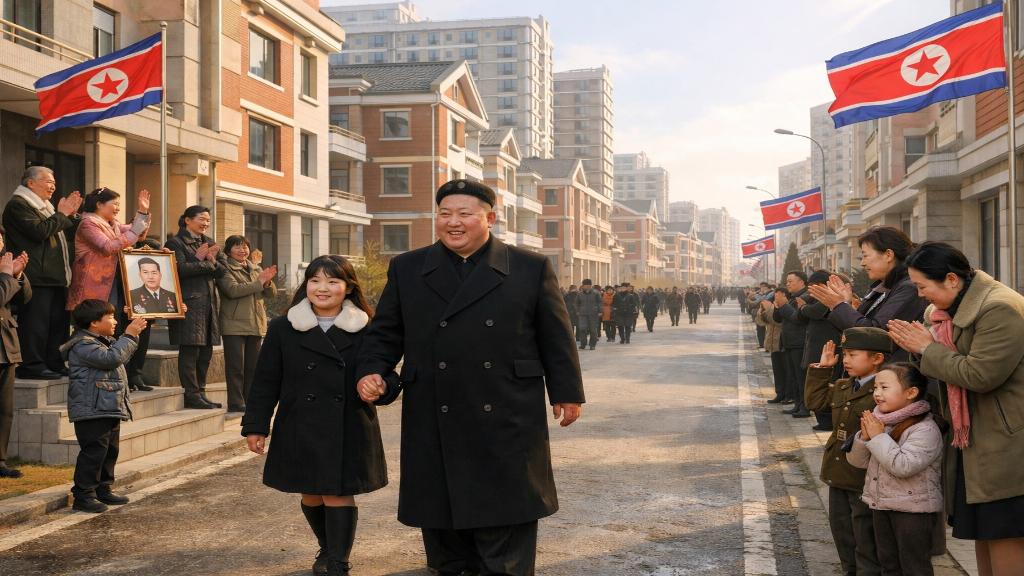
- North Korea inaugurated Saeppyol Street in Pyongyang on 16 February 2026 for families of soldiers killed in overseas operations, implicitly Ukraine.
- Kim Jong-un and daughter Kim Ju-ae visited the homes, pledging to 'repay the young martyrs'.
- Around 14000 North Korean soldiers deployed alongside Russia per Reuters; 6000 killed or wounded per South Korean services.
- Western media stress human cost and anti-Western alliance; RT celebrates heroism; Al Jazeera highlights geopolitical implications.
- Casualty figures remain unconfirmed estimates by Pyongyang.
In the spotless streets of the North Korean capital, a new residential district has emerged. Named Saeppyol Street, it is not for ordinary citizens but for the families of those who 'sacrificed everything for the motherland' in foreign military operations. On 16 February 2026, Kim Jong-un personally presided over the inauguration, accompanied by his increasingly visible daughter Kim Ju-ae, touring the apartments and promising a worthy future to widows and orphans. A staging reminiscent of grand theatrical performances, where the leader embodies the benevolent father of the nation.
Why does Pyongyang choose to commemorate its 'martyrs' through a housing project?
The gesture fits a long North Korean cultural tradition of turning sacrifice into state symbol. KCNA photos show smiling families in modern homes, flags waving. For the regime, it demonstrates that loyalty is rewarded, even after death. Light irony of real socialism: battlefield death becomes the key to a new capital apartment, a rare privilege.
Context of North Korean engagement
According to Reuters, North Korea sent some 14000 soldiers to Ukraine under a mutual defense pact with Russia. South Korean intelligence estimates 6000 killed or wounded, without precise breakdown. Pyongyang releases no official figures.
How do global media cover this event?
Narratives differ sharply. Western sources - Reuters, AP, BBC, The Guardian, New York Times - emphasize high human cost, initially secret deployment and risks of the Moscow-Pyongyang alliance. Al Jazeera focuses on geopolitical implications of an expanded anti-Western axis. Conversely, RT frames the inauguration as legitimate tribute to 'heroes of Kursk', celebrating Russo-North Korean brotherhood in arms. Chinese media, via South China Morning Post, report facts more neutrally, highlighting bilateral ties without dwelling on losses.
Divergences and conflicts of interest
NGOs such as Amnesty International and Human Rights Watch, often funded by Western foundations and states, regularly criticize the North Korean regime for opacity and conscription practices. Their reports are contested by Moscow and Beijing as carrying Western bias. No specific statement from the UN or UNESCO on this precise event. Experts quoted by Western media frequently come from South Korean or American think tanks, which may shape the angle.
Doubtful information: casualty estimates remain unconfirmed by North Korea or Russia and rely on South Korean and Western intelligence sources.

Culturally, the district echoes Soviet 'hero cities' or French war memorials, yet revisited in contemporary socialist realist style. Like a propaganda canvas where each brick tells a story of loyalty. Amateur theater inspires: the staging is flawless, the leader as protective father, the nation as proud yet bereaved family.
What cultural lessons from this commemoration?
In a world of prolonged conflicts, each nation honors its dead in its own way. Pyongyang turns loss into symbolic real-estate capital, reminding that political culture remains an art of staging. Media divergences reflect geopolitical prisms more than bare facts: patriotic honor in the East, human cost in the West.
FAQ
Q: How many North Korean soldiers died in Ukraine?
A: South Korean and Western estimates speak of several thousand out of 14000 deployed; Pyongyang releases no figures.
Q: What is the context of the Pyongyang-Moscow alliance?
A: A 2024 mutual defense pact including troop and material dispatch in exchange for economic and technological assistance.
Q: Are casualty figures reliable?
A: They are intelligence estimates unconfirmed by the parties involved; to be treated with caution.
Sources
- Reuters - North Korea's Kim opens new Pyongyang housing district
- Al Jazeera - North Korea opens new housing area for families of soldiers killed overseas
- The Guardian - Kim Jong-un unveils housing for families of North Koreans killed in Ukraine war
- NPR - North Korea opens a housing district for families of its soldiers killed in Russia-Ukraine war
- RT - North Korea honors troops who fought in Kursk