
 ezna-io
AI Data Centers Targeted: A New Front in Modern Warfare
7 months ago

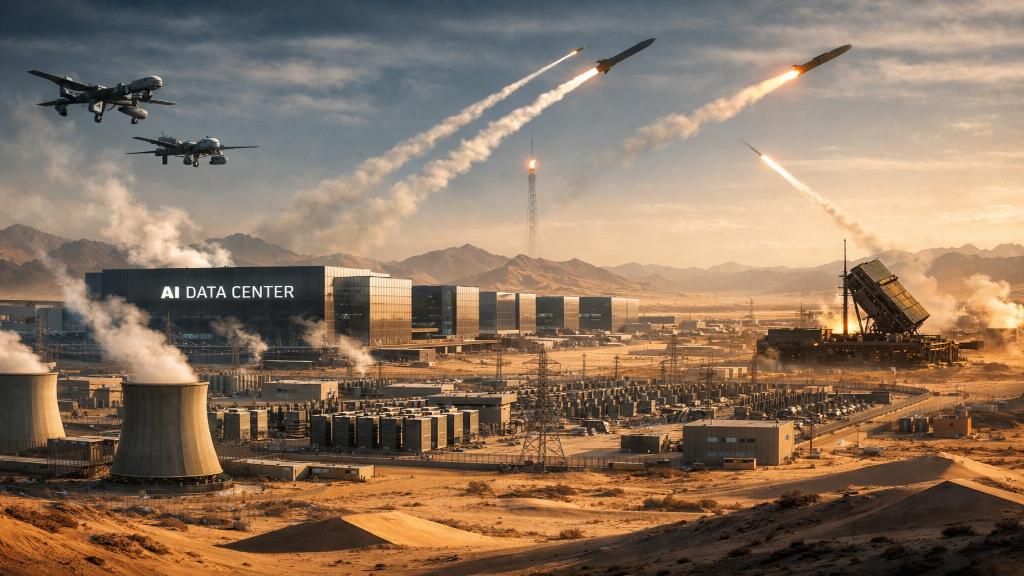
- Drone strikes damaged several Amazon Web Services data centers in the United Arab Emirates and Bahrain.
- The attacks disrupted cloud services used by banks, companies and government systems.
- Analysts say digital infrastructure is increasingly becoming a strategic wartime target.
- The events raise concerns about the physical security of the infrastructure powering global AI.
Digital infrastructure has long remained invisible in armed conflicts. However, the rapid expansion of artificial intelligence and cloud computing is turning data centers into strategic assets comparable to energy networks or transport hubs.
In early March 2026, several Amazon Web Services (AWS) data center facilities in the Middle East were damaged during drone strikes. According to international media including Reuters, two installations in the United Arab Emirates were directly hit, while a third site in Bahrain was affected by a nearby strike.
The incidents temporarily disrupted cloud services used by businesses, financial institutions and public sector systems across the region.
When war reaches digital infrastructure
The strikes occurred amid an escalation of regional military tensions. Thousands of drones and missiles reportedly targeted various economic infrastructures across the Gulf, including technological facilities.
Analysts say the strategy focuses on disrupting economic capabilities rather than targeting only military assets. Digital infrastructure has therefore become part of the potential target landscape.
Data centers host services used daily by millions of people, from online banking to ride-hailing applications and logistics platforms.
During the disruptions, some residents reported being unable to access basic digital services such as financial applications or transport services.

AI infrastructure as a strategic asset
Data centers host the computing infrastructure required to train and operate modern artificial intelligence systems. They concentrate large clusters of GPUs, storage systems and high-speed networks.
Governments and technology companies around the world are investing billions of dollars in building new facilities. The Middle East has emerged as one of the regions attracting such investments as part of broader economic diversification strategies.
Industry projections suggest the data center market in the United Arab Emirates could more than double in value over the next decade.
However, the physical concentration of infrastructure also creates vulnerabilities. Unlike software platforms, data centers exist in specific geographic locations that can be affected by geopolitical events.
A shift in security strategies
Security analysts increasingly view these incidents as evidence of a transformation in modern conflict. Digital infrastructure may become as strategically significant as energy pipelines or power grids.
Technology companies are therefore exploring new approaches to protecting infrastructure. These include geographic diversification of data centers, enhanced physical security systems and integration with national infrastructure protection policies.
The issue extends beyond military strategy. It also concerns the resilience of digital services that underpin large parts of the global economy.
Technology, infrastructure and dependency
Artificial intelligence is often perceived as an abstract field driven by algorithms and data. In reality, it relies heavily on physical infrastructure: computing facilities, fiber-optic networks, electrical systems and specialized hardware.
Recent events highlight how these infrastructures can become points of vulnerability in a geopolitically unstable world.
For technology companies, the challenge is no longer limited to developing more capable AI models. It increasingly involves securing the physical systems that make these technologies possible.
This shift may reshape the relationship between technology development, economic strategy and geopolitical stability in the coming years.
FAQ
Why are data centers critical for AI?
They provide the computing power and storage needed to train and run artificial intelligence models.
Which companies operate these infrastructures?
Major providers include Amazon Web Services, Microsoft Azure and Google Cloud.
Why could data centers become wartime targets?
Because disrupting them can affect banking, communications, logistics and many digital services simultaneously.
To explore related technological developments around AI infrastructure and computing power, you may also read these analyses: