ezna-io
Floating Data Centers: Can Ocean Power Compete on Cost?
an hour ago

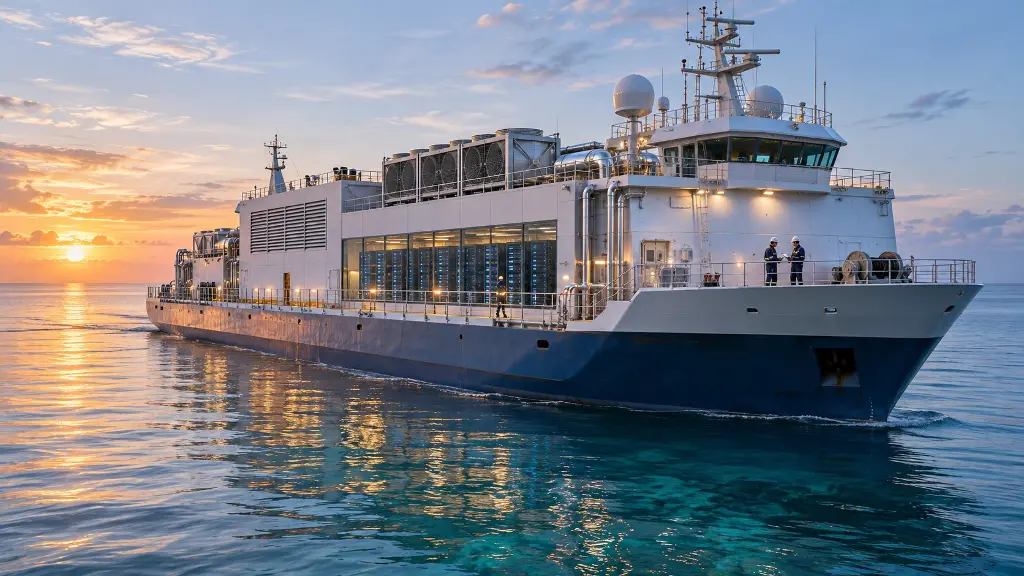
- US startup Drogue says it has raised $20 million to develop floating data centers powered by ocean thermal energy.
- A multi-megawatt prototype is planned for early 2028. The share of electricity actually available to servers after auxiliary consumption has not been disclosed.
- OTEC has been demonstrated experimentally, but low efficiency requires substantial seawater flows and large equipment.
- Commercial viability will depend on power stability, telecommunications, maintenance and server utilization.
Placing computer servers aboard a vessel and powering them with the temperature difference between warm surface water and cold deep ocean water is the proposal unveiled on November 13, 2026, by Drogue, a US startup founded six months earlier in Washington, D.C.
According to TechCrunch, the company says it has raised $20 million from investors including Toyota Ventures, XYZ Venture Capital and Tamarack Global. Founder Sam Sipe plans an initial multi-megawatt prototype aboard a ship in early 2028, followed potentially by permanent floating platforms.
The announced capacity has not been clearly characterized in public: gross generator output, net power after auxiliary consumption and electricity actually available to the servers cannot yet be distinguished.
Drogue says it is acquiring its first vessel and has received approval in principle from the American Bureau of Shipping. This represents preliminary concept review, not certification of electrical performance or commercial viability.
These details largely originate from company statements reported by TechCrunch. No independent results for the integrated system were made publicly available in the sources reviewed. The industrial question is specific: could moving computing infrastructure closer to its energy source avoid some grid connection delays, or would it transfer those constraints to a more demanding offshore environment?
Established technology, new application
Ocean thermal energy conversion, or OTEC, uses the temperature difference between warm surface water and cold deep seawater. In suitable tropical regions, surface water can reach 25 to 30°C, while water at depths of 800 to 1,000 meters may be around 5 to 7°C.
In a closed-cycle system, warm seawater transfers heat to a working fluid, generally ammonia. The fluid vaporizes, drives a turbine connected to a generator and then condenses using cold deep seawater before circulating again. The working fluid remains separate from seawater.
According to the process described to TechCrunch, Drogue intends to use surface water to cool servers before routing the warmed water through the OTEC system. Heat rejected by the computing equipment would therefore contribute to electricity generation.
The concept combines an energy resource that can be continuously available under suitable ocean conditions with a nearby electricity consumer. However, server waste heat originates from electricity already consumed by the hardware. Recovering it does not constitute an additional primary energy supply.
Efficiency remains the first obstacle
A heat engine's maximum efficiency depends on the temperatures of its hot and cold sources. With warm water at 28°C and cold water at 5°C, the ideal Carnot efficiency is approximately 7.6%. Actual systems operate below this limit because heat exchangers, turbines and pumps incur losses.
An illustrative calculation demonstrates the limits of server waste-heat recovery. Suppose servers release 1 MW of heat fully available at a constant 30°C, with a cold source maintained at 5°C. Even an ideal heat engine could convert only about 82 kW of this heat into mechanical work, equivalent to 8.25%.
That figure is neither an estimate of Drogue's additional power output nor a net electrical result. It assumes ideal thermal reservoirs and fully usable heat. In practice, temperature differences required for heat transfer and auxiliary electricity consumption would reduce recoverable output.
The relevant comparison would involve two installations delivering equivalent computing services: one recovering server heat and the other using separate cooling and OTEC generation systems. All electricity consumed by pumping and cooling would need to be included to determine the actual benefit of integration.
Seawater volumes create another constraint. According to Ocean Energy Systems, a conventional OTEC installation requires approximately 2.5 to 3 cubic meters of cold seawater per second for every net megawatt of electricity generated. Warm-water requirements are generally higher.
A hypothetical facility delivering 5 MW net would therefore require roughly 12.5 to 15 cubic meters of cold seawater per second, equivalent to 45,000 to 54,000 cubic meters per hour. This extrapolation does not describe Drogue's prototype, whose hydraulic requirements remain unknown.
Pipe length, pressure losses, biological fouling and pumping electricity consumption directly influence performance. Ocean Energy Systems identifies the strength and durability of large deep-water intake pipes among the principal challenges of scaling the technology.

Japan shares infrastructure costs; South Korea measures performance
OTEC has an international experimental history. On Japan's Kumejima Island in Okinawa Prefecture, a demonstration facility has operated since 2013. The Overseas Environmental Cooperation Center describes a model combining electricity generation with the use of deep seawater for aquaculture, agriculture and other local activities.
This approach distributes some infrastructure costs across multiple applications. On October 28, 2025, Mitsui O.S.K. Lines announced a partnership with Kumejima authorities involving development of intake systems for a megawatt-class OTEC facility. The company targets commercial operation during fiscal year 2031. That timetable remains an industrial objective.
South Korea provides another type of evidence. The Korea Research Institute of Ships & Ocean Engineering tested a barge-mounted OTEC plant in 2019, designed for 1 MW. A scientific conference record published in October 2020 reports an output of 338 kW. Researchers attributed the shortfall partly to an insufficient temperature difference at the test location.
The public record does not clarify whether 338 kW represents gross output or net power after auxiliary consumption. It cannot therefore establish net electrical efficiency.
These experiments highlight different challenges: sharing infrastructure investment in Japan and dependence on thermal conditions in South Korea. They do not validate Drogue's computing architecture.
Commercial viability extends beyond electricity prices
By placing servers next to the power plant, Drogue might avoid a high-capacity submarine electrical connection to the mainland. It would still need to finance digital communications, computer hardware and offshore maintenance.
A study published on May 12, 2025, in Climatic Change by University of Victoria researchers cites earlier estimates of OTEC levelized electricity costs ranging from USD 0.145 to 0.63 per kilowatt-hour in 2023 dollars, or USD 145 to 630 per megawatt-hour.
The broad range reflects different configurations, plant capacities and economic assumptions. It is neither an observed cost for Drogue nor a reliable forecast for its prototype. A European white paper from the PLOTEC project also identifies financing difficulties, heat exchanger costs and unproven economies of scale.
Relatively expensive electricity might nevertheless support a viable business if faster deployment of computing capacity offset some of the additional offshore costs. That proposition requires comparison with equivalent terrestrial infrastructure under consistent availability, security and computing-performance requirements.
Server utilization is critical. A power plant can generate electricity continuously without its computers performing revenue-generating work at all times. If customer demand remains below installed capacity, fixed costs must be spread across fewer paid computing tasks.
High utilization could improve asset economics, but it could also increase cooling requirements and constrain maintenance windows. Cost per delivered computing unit, together with associated revenue, is therefore more informative than electricity prices alone.
No verifiable customer contracts, utilization forecasts or commercial computing tariffs were identified in public information about Drogue.
Continuous generation is not the same as stable power delivery
OTEC could provide relatively steady electricity in suitable ocean conditions. That does not necessarily mean it can respond instantly to every change in server demand.
In its April 2026 report, the International Energy Agency notes that AI model training and use can create large, rapid electricity demand swings. It estimates that around 20 to 25 GW of installed battery storage power capacity could be deployed in data centers worldwide by 2030.
This is an industry-wide estimate, not a design specification for Drogue. Gigawatts measure power, whereas the quantity of energy that batteries can store and their operating duration depend on energy capacity, measured in gigawatt-hours.
Depending on the plant's dynamic response and the servers' load profile, possible measures include batteries, uninterruptible power supplies, generation reserves or workload regulation. Batteries can absorb peaks and provide transitional power, but they cannot sustain an extended outage without sufficient stored energy.
No public system design specifies how Drogue intends to balance generation and consumption continuously. The required equipment would affect platform costs, weight and reliability.
Communications and maintenance remain major dependencies
An offshore data center would need sufficiently fast and redundant digital connections to exchange customer data. Bandwidth, latency, availability and repair times could influence the applications it can support.
Batch processing, where results may be delivered hours later, might tolerate certain distance-related constraints better than interactive services such as real-time conversational assistance. These are possible workload categories, not descriptions of Drogue's announced customers.
The marine environment also introduces corrosion, storms, platform motion, fire-protection challenges and difficulties replacing hardware. Sam Sipe has discussed operating future installations offshore for approximately ten years, but that remains a target rather than a demonstrated service life.
Availability must be assessed across the entire chain: electricity generation, possible storage, cooling, servers and communications. Failure of any critical component could interrupt computing services even if the others remain operational.
Environmental effects depend on deployment scale
OTEC produces electricity without directly burning fuel, but it moves large volumes of seawater between different depths. Intake and discharge may affect local temperatures, nutrient distribution and marine habitats.
In September 2025, Mitsui O.S.K. Lines announced research with several institutions to improve seabed observation and assess cold-water discharges. The work uses underwater imagery and automated analysis of coral coverage.
Two studies published in May 2025 in Climatic Change by the same University of Victoria research team examine the consequences of much wider deployment. The first assesses extractable OTEC resources and climate mitigation potential. The second models environmental effects of worldwide installations reaching several terawatts.
The second study's simulations combine the consequences of OTEC-induced ocean mixing with those of avoided fossil-fuel emissions. Depending on the scenario, they show changes in temperature and biological productivity.
These papers do not constitute two independent confirmations because they come from the same research team. Their results also cannot predict the local effects of a prototype delivering only a few megawatts. Drogue would need a site-specific assessment covering intake conditions, discharge flows and marine ecosystems.
A growing market with changing requirements
According to the International Energy Agency, global data center electricity consumption reached approximately 485 TWh in 2025 and could approach 950 TWh by 2030 in its central scenario published in April 2026, representing around 3% of global electricity demand.
The agency emphasizes that actual demand depends on hardware efficiency, software improvements, application adoption and changing workloads. Simple queries, intensive reasoning and audiovisual generation have very different energy requirements.
Developing additional electricity supplies does not remove the need to optimize server utilization or assess the value of the applications being supported. More generating capacity does not by itself establish the economic or social usefulness of the resulting computing activity.
International OTEC efforts reveal different priorities: sharing infrastructure costs in Japan, measuring performance in South Korea, examining economic barriers in Europe and seeking a new commercial computing application in the United States. These approaches address distinct problems and do not independently confirm Drogue's profitability.
What the prototype must demonstrate
The evidence reflects different interests. Drogue and its investors have a direct commercial stake in the project's success. Mitsui O.S.K. Lines is developing its own OTEC activities. PLOTEC received funding intended to advance the technology. These identifiable institutional interests are not, by themselves, evidence of distorted findings. The Canadian researchers declare no relevant competing interests.
South Korean experiments provide measurements independent of the American startup, but they do not validate its architecture. European and Canadian studies describe broader development constraints rather than Drogue's future performance.
The proposed 2028 prototype should first establish three priority results: net electrical power delivered to servers, computing availability and full cost per delivered computing unit. Power stability, thermal integration and local environmental effects must also be measured to interpret those results.
Drogue is not introducing a new energy source. It is attempting to turn an experimentally established technology into a commercial computing infrastructure. Its viability will depend on a comparison that public information does not yet permit: can avoided grid connection costs and potential deployment advantages outweigh the additional costs of operating computers offshore?
Frequently asked questions
Can a floating data center operate entirely on ocean thermal energy?
OTEC can generate electricity when the temperature gradient is sufficient. However, Drogue has not publicly demonstrated that its system can continuously power all servers and auxiliary equipment required by a commercial data center.
Why might an OTEC-powered data center need batteries?
Servers, particularly those running certain AI workloads, can cause rapid changes in power demand. Batteries or other power-management systems might absorb fluctuations and support service continuity. Their necessity and required capacity remain unknown for Drogue.
Could the model be profitable despite relatively high electricity costs?
Potentially, if faster deployment or other advantages offset offshore expenses. Profitability would require comparing the cost of computing actually delivered, server utilization and service availability with those of an equivalent terrestrial data center. Public data do not yet support a conclusion.
- TechCrunch, November 13, 2026 — Original reporting on Drogue, its funding and floating data center proposal
- Ocean Energy Systems — Engineering and hydraulic challenges of ocean thermal energy conversion
- KRISO, South Korea, 2020 — K-OTEC 1000 experimental results, indexed bibliographic record
- Overseas Environmental Cooperation Center, Japan — Kumejima OTEC demonstration and deep seawater applications
- Mitsui O.S.K. Lines, October 28, 2025 — Kumejima OTEC development partnership
- Mitsui O.S.K. Lines, September 24, 2025 — Research on cold-water discharges and seabed environments
- Climatic Change, May 12, 2025 — OTEC resources, climate mitigation potential and published cost estimates
- Climatic Change, May 10, 2025 — Environmental impacts of widespread OTEC deployment
- Ocean Energy Systems / PLOTEC — White paper on OTEC economics, technology and scaling challenges
- International Energy Agency, April 2026 — Key Questions on Energy and AI: electricity demand, rapid load fluctuations and storage