
 ezna-io
DeepSeek V4 on Huawei: real AI decoupling test
6 months ago

- DeepSeek V4 released April 24, 2026 with Pro and Flash variants.
- Runs on Huawei Ascend chips, reducing Nvidia dependence.
- Up to 1M tokens context and 1.6T parameters.
- Up to 50% lower costs, performance still unverified independently.
On April 24, 2026, DeepSeek released a preview of DeepSeek-V4. This is not just another model update. It is a real-world test: can advanced AI operate outside the Nvidia-dominated ecosystem?
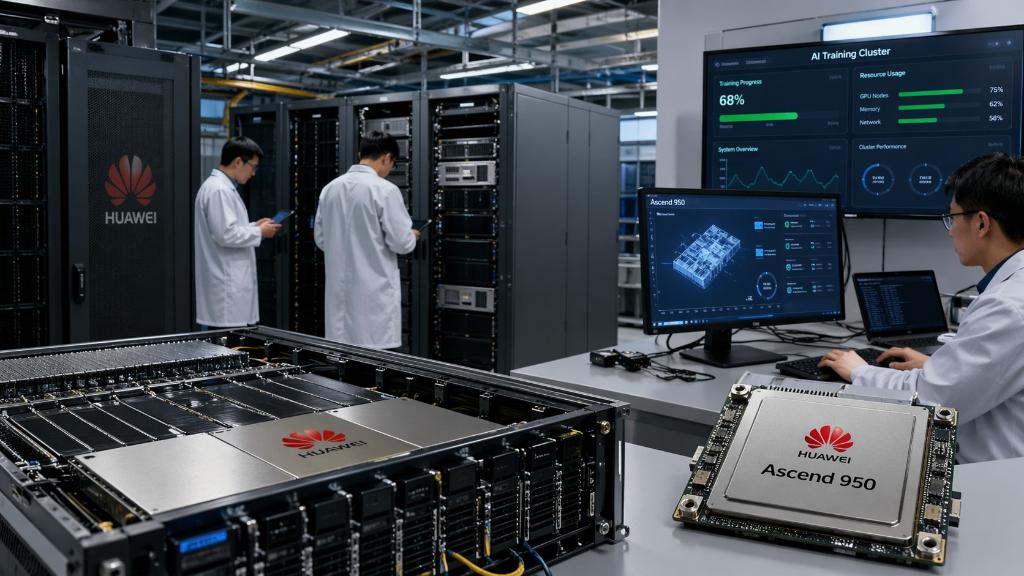
According to Reuters, the model is designed for Huawei Ascend chips, with Huawei claiming its Ascend 950 systems can support these workloads at scale. This turns the release into an industrial demonstration of a non-US AI stack.
DeepSeek reports that V4-Pro reaches 1.6 trillion parameters with 49 billion active parameters and supports up to a 1 million token context window. By comparison, GPT-4 Turbo typically runs around 128k tokens, while Gemini 1.5 Pro can reach 1M tokens in specific configurations. These comparisons remain indicative due to architectural differences.
On benchmarks, DeepSeek claims competitive results in reasoning and coding, with internal estimates placing MMLU performance around 85% to 90%. As Associated Press notes, these results have not yet been independently validated.
Cost is the most immediate differentiator. According to Fortune, pricing could be significantly lower than Western models, with reductions potentially exceeding 50%. In practical terms, this may translate to only a few dollars per million tokens, though real costs depend on deployment conditions.
An industrial test
The South China Morning Post highlights coordination between DeepSeek and Huawei, showing increasing vertical integration across chips and models.
AI competition is shifting from models to systems: compute, cost and dependencies. V4 should be read as a system-level prototype.
As Reuters notes, this reflects broader efforts to reduce reliance on US technology.
Performance remains uncertain
Independent benchmarks are still needed to position V4 against GPT-4, Claude or Gemini. Internal results are not sufficient for real-world validation.
Infrastructure transparency also remains limited, leaving open questions about scalability.

What changes
For companies, the question is not ranking but usability: cost, integration and control.
DeepSeek V4 is not just an alternative. It is a measurable test of AI technological decoupling.
FAQ
Is DeepSeek V4 comparable to GPT-4?
Possibly in some tasks, but independent validation is still required.
Why is Huawei critical?
It provides a non-US infrastructure alternative.
What is the business impact?
Potential cost reduction with uncertainty on reliability.