
 ezna-io
Strait of Hormuz Tensions: Naval Coalition Forms as Iran Crisis Deepens
By Zoé Marquand
7 months ago

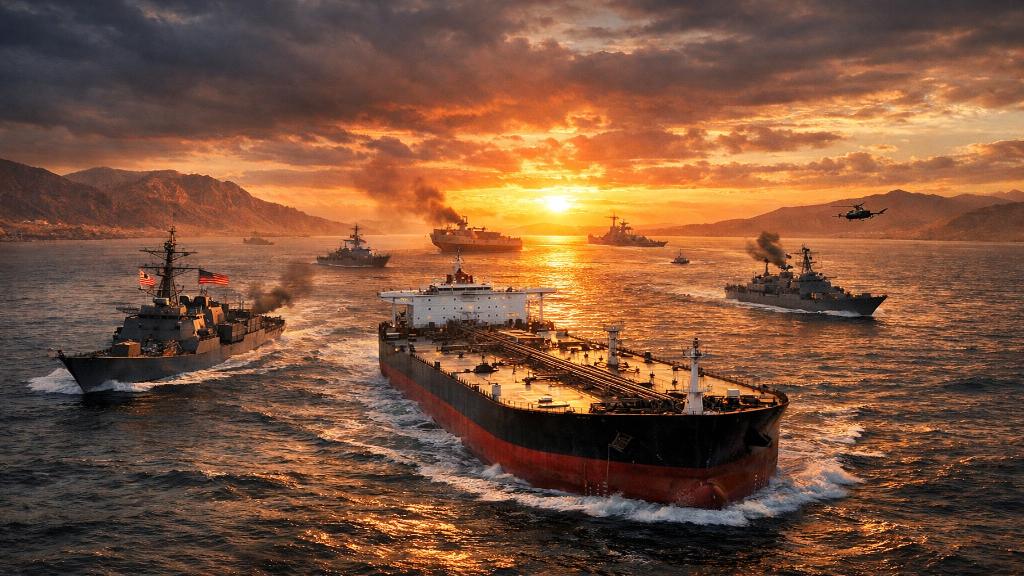
- The United States signaled a potential multinational naval coalition to keep the Strait of Hormuz open.
- The conflict involving Iran, the US and Israel is creating global energy tensions.
- Major powers such as China, France and Japan may be asked to participate.
- The strait remains one of the most critical routes for global oil trade.
At the heart of the Persian Gulf, a narrow maritime corridor has once again become a focal point of international attention. The Strait of Hormuz, through which a major share of the world's hydrocarbons transit, is emerging as a strategic flashpoint amid the ongoing confrontation involving Iran, the United States and Israel.
On March 14, U.S. President Donald Trump stated that 'many countries' could send warships to keep the strait open. According to his comments, powers such as China, France, Japan, South Korea and the United Kingdom could participate in a maritime effort aimed at protecting navigation.
The announcement comes as military tensions in the region have intensified. The conflict has triggered a series of incidents affecting energy infrastructure, military installations and commercial shipping routes. Some early reports suggest that explosive drones or unmanned boats have already targeted vessels in nearby waters.
Within this environment, the idea of a multinational naval presence echoes earlier operations designed to protect vital sea lanes. The primary objective would be to prevent any disruption or attempted blockade of the strait connecting the Persian Gulf to the Indian Ocean.
The economic implications of a closure would be significant. Roughly one fifth of global oil flows and a major portion of liquefied natural gas shipments pass through this maritime corridor. Any sustained disruption could quickly drive energy prices upward and intensify global market volatility.

From a geopolitical perspective, the situation also highlights shifting alignments. Several Asian economies that depend heavily on Gulf energy imports are watching developments closely. China, Japan and South Korea remain among the largest buyers of oil transported through the strait.
European countries also have strong interests in maintaining the free flow of energy supplies. Governments across the continent are cautious about the possibility of another energy shock following years of geopolitical disruptions.
Analysts note, however, that forming an international naval coalition depends on political decisions in each participating country. The U.S. statement did not specify confirmed commitments or operational timelines, leaving uncertainty about the exact scope of the initiative.
Meanwhile, several actors in the Middle East have called for restraint to prevent the conflict from spreading further. Regional movements and organizations have urged Iran not to target neighboring states, reflecting fears of a broader escalation.
Historically, the Strait of Hormuz has often served as a strategic pressure point during regional crises. Iranian authorities have previously suggested that navigation could be disrupted in response to external pressure or sanctions.
The current situation once again demonstrates how seemingly narrow maritime corridors can become central nodes of global geopolitics. Trade routes that operate quietly in times of stability often turn into strategic battlegrounds during periods of conflict.
Several aspects of the current crisis remain uncertain. Some reports regarding maritime attacks or military incidents rely on preliminary information or sources that have not yet been fully verified. Investigations by military authorities are ongoing.
For now, the Strait of Hormuz remains a sensitive barometer of international stability. Between strategic calculations, energy dependence and regional rivalries, this narrow waterway continues to exert a disproportionate influence on the global balance.
FAQ
Why is the Strait of Hormuz strategically important?
It is one of the main routes through which oil and gas exported from Gulf countries reach global markets.
Which countries could join the naval coalition?
According to U.S. statements, major maritime powers such as China, France, Japan and the United Kingdom could potentially participate.
Is the strait currently closed?
No official closure has been announced, but military tensions are increasing risks for commercial navigation.