
 ezna-io
Strait of Hormuz: Iran-US truce and chokepoint cost
By Zoé Marquand
5 months ago

- On May 11, 2026, Donald Trump rejected Iran’s answer to the US plan and said the ceasefire was on life support.
- Reuters reported Brent at $104.46 a barrel, with an intraday high of $105.99, as markets priced risk around Hormuz.
- The IEA estimates that about 20 million barrels per day of oil and oil products crossed Hormuz in 2025, with nearly 80% bound for Asia.
- Pakistan, Qatar, Turkey and China are each playing a diplomatic card shaped by energy, maritime or strategic interests.
The Strait of Hormuz is more than a maritime passage. It is a gauge of international trust: a few navigable channels between Iran and Oman, slowed tankers, insurers reassessing premiums, governments calibrating language and markets translating anxiety into dollars per barrel. On May 11, 2026, after Donald Trump rejected Iran’s response to a US peace proposal, this narrow Gulf route again became the practical center of a wider crisis: regional war, sanctions, Iran’s nuclear programme, maritime trade security, energy prices and US-China rivalry.
The main fact is strongly corroborated. Reuters reports that the US president said the ceasefire with Iran was on life support after rejecting Tehran’s response to an American proposal. The Associated Press describes the same impasse and says Iran’s answer had been delivered through Pakistani mediators. Al Jazeera cites Iranian Foreign Ministry spokesman Esmaeil Baghaei accusing Washington of making unreasonable and one-sided demands. Anadolu also reports that the Iranian spokesman called Tehran’s answer a generous and responsible offer, while saying Pakistan remained the official mediator. The wording differs, but the factual convergence matters more: the diplomatic channel still exists, yet it is not producing an agreement.
Iran’s response has not been published in full by the parties. Established facts must therefore be separated from reported elements. Reuters says Tehran is demanding an end to hostilities, sanctions relief, compensation for war damage, an end to the US naval blockade, the resumption of Iranian oil sales and recognition of its sovereignty around the Strait of Hormuz. AP reports that the Iranian proposal would also include partial concessions on the nuclear file, including enriched uranium. Their exact scope cannot be publicly verified. This is the most sensitive uncertainty: calling it a solid nuclear compromise would be premature; saying no margin exists would be just as imprudent.
Hormuz, a measurable energy lock
The strait matters first because of volumes. The International Energy Agency estimates that in 2025 nearly 20 million barrels per day of oil and oil products moved through Hormuz, around one quarter of global seaborne oil trade. The IEA says about 80% of those flows were bound for Asia. Alternative routes exist, notably Saudi pipelines to the Red Sea and Emirati pipelines to Fujairah, but available capacity is estimated at only 3.5 to 5.5 million barrels per day. In plain terms, the world can route around part of the problem; it cannot replace Hormuz.
The vulnerability also concerns liquefied natural gas. The IEA says more than 110 billion cubic metres of LNG crossed Hormuz in 2025, close to one fifth of global LNG trade. Around 93% of Qatar’s LNG exports and 96% of the UAE’s LNG exports pass through this corridor. That figure explains the caution of Gulf monarchies: a prolonged crisis would not only affect motorists and refineries, but also Asian power grids, factories, long-term contracts and the public finances of importing countries.
Markets reacted quickly. Reuters reported that Brent rose more than 3% on May 11 to $104.46 a barrel at 12:15 p.m. in New York, after touching $105.99 during the session. WTI stood at $98.32. The same report notes that prices had fallen the previous week on hopes of easing tensions before rising again after the US rejected Iran’s response. The move is not merely psychological: when the Gulf’s main energy chokepoint becomes a political variable, the market immediately prices even partial disruption risk.

Ships as diplomatic signals
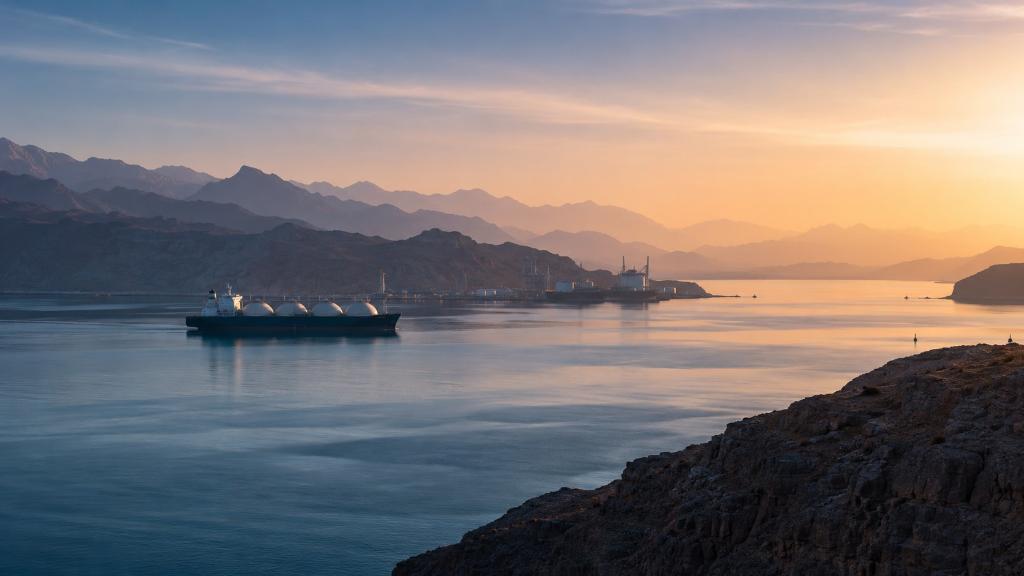
In this crisis, maritime exceptions are more revealing than broad announcements. Reuters reported the passage of the Qatari LNG tanker Mihzem toward Pakistan’s Port Qasim after the Al Kharaitiyat had already moved through. Arab News, citing an unnamed Pakistani petroleum ministry official, says the Al Kharaitiyat, with capacity of 211,986 cubic metres, used an Iran-approved northern route and reached Pakistan. The Mihzem, with capacity of 174,000 cubic metres, was expected at Port Qasim on May 12 according to LSEG data cited by the same outlet. These details do not prove a general reopening of the strait. They show a diplomacy of punctual passage: open enough to move gas, controlled enough to retain strategic leverage.
Pakistan therefore occupies a double position. AP reports that the Iranian response was delivered through Pakistani mediators. At the same time, the Qatari cargoes are heading to Port Qasim, an essential destination for Pakistan’s energy supply. Pakistan’s Foreign Ministry had already said in an April 30 briefing that Islamabad remained engaged with both Iran and the United States to seek a resolution. Le Monde describes Pakistan as a self-interested mediator able to talk to Washington, Tehran, Riyadh and Beijing while seeking greater regional weight. That does not negate Islamabad’s role; it clarifies it. Pakistan is not an abstract referee. It is an energy-importing state exposed to prices, shortages and regional balances.
Qatar is not a mere observer either. Its international power rests heavily on LNG, and therefore on the security of Hormuz. Qatar’s Foreign Ministry states that Prime Minister and Foreign Minister Mohammed bin Abdulrahman Al Thani spoke with Abbas Araghchi on May 10 about peace efforts, the need to respond to mediation initiatives and respect for international law. Dawn, citing Qatar’s ministry, reports that he also warned that using Hormuz as a pressure tool would deepen the crisis. That position matches Qatar’s interest: keeping navigation open and protecting a gas-export model. It does not make Qatari mediation useless; it makes it legible.
Marine insurance, the cold barometer of crisis
Shipowners do not only read presidential statements. They watch premiums, coverage exclusions, escort protocols, seizure risks and the practical credibility of proposed corridors. Lloyd’s List, a specialist maritime outlet, reported a few days before May 11 that the Hormuz crisis had cut very large crude carrier volumes and lengthened some voyages. According to Vortexa data cited by Lloyd’s List, global crude and condensate exports on VLCCs fell by about 36% in the eight weeks ending May 3 compared with prewar levels, while VLCC exports in the Pacific basin, including the Gulf, reportedly fell by 49%. These figures are recent but not within the strict past-24-hour window; they are used here as market indicators, not official statistics.
The same source indicates that some shipowners want concrete proof of safety before resuming transits: actual exit of trapped vessels, clear protocols, credible escorts and insurance cover. This is a useful reminder. A ceasefire does not mechanically reopen a shipping route. It must also convince those who insure hulls, finance cargoes and send crews to sea.
Washington, Tehran, Beijing: three clashing priorities
The US position, as reflected by Reuters and AP, rests on the view that Iran’s offer does not meet Washington’s core demands, especially on the nuclear file. Trump is also trying to limit the domestic effect of the energy shock. AP reports that he mentioned suspending the federal gasoline tax to soften price increases. The Iran file therefore plays on two stages: Gulf security and American domestic politics, where fuel prices turn geopolitics into a daily cost.
The Iranian position reverses the order of priorities. According to Al Jazeera, Anadolu, Iran International and Xinhua, Tehran presents its demands as legitimate rights: an end to attacks, sanctions relief, the release of assets, removal of US naval pressure, safety in the strait and nuclear discussions in a less coercive framework. This reading turns the nuclear question into a consequence of the balance of power rather than the single origin of the crisis. Each side places the beginning of the problem exactly where the other side’s concession would be most costly.
China is the third angle. Reuters reports that Beijing opposes US sanctions targeting three Chinese companies accused by Washington of supporting Iranian military operations. The official Chinese Foreign Ministry press conference of May 11 confirms Beijing’s line: rejection of unilateral sanctions, defence of Chinese companies’ rights and a call to prevent renewed conflict. AP also notes that Trump is expected to seek Xi Jinping’s help in pressing Iran, while Beijing remains a major buyer of sanctioned Iranian crude. China therefore has real leverage, but not disinterested leverage: it wants to avoid a lasting energy spike, contest US extraterritoriality and protect its companies.
Turkey, the UN and systemic effects
Turkey is also trying to position itself. Reuters says Turkish Foreign Minister Hakan Fidan is due to visit Qatar to discuss the war, its impact on the Gulf and navigational safety in Hormuz. Ankara is a NATO member, Iran’s neighbour, Qatar’s partner and an actor used to contradictory balances. Its role alone cannot unlock the crisis, but it adds one more channel at a moment when keeping channels open is already a strategic resource.
The United Nations adds wider economic context. UN Trade and Development warned in March 2026 that disruptions around Hormuz were increasing risks for energy, fertilizers, maritime freight, insurance and vulnerable economies. This is not an event source from the past twenty-four hours; it is used here as structural reference. It reminds us that the Hormuz shock does not stop at oil: it moves into fertilizers, food costs, freight rates, war-risk premiums, balance-of-payments pressure and the fiscal stability of importing states.
Critical reading of the sources
Reuters and AP provide the densest factual frame: US statements, Pakistani mediation, market reactions, ship movements and diplomatic context. Their strength is rapid cross-checking; their limit lies in a natural dependence on government, financial and Western sources in a fast-moving crisis. Al Jazeera and Anadolu give more space to Iranian and regional framing; the former is funded by Qatar, while the latter belongs to Turkey’s public media ecosystem. Arab News and Dawn add Pakistani and regional angles, useful for cargo arrivals and Doha’s position, but sometimes reliant on anonymous officials or agency material. Xinhua and China’s Foreign Ministry clarify the Sino-Iranian reading; the former belongs to China’s state media ecosystem, while the latter is official, indispensable but not independent. The Qatari and Pakistani foreign ministries add useful primary positions, though they remain institutional sources. Lloyd’s List offers a specialist maritime view; some figures come from private providers such as Vortexa and should be understood as market indicators. The IEA and UNCTAD do not narrate minute-by-minute news, but they anchor the energy and trade scale of the risk.
Cross-checking these sources leads to a cautious conclusion. The ceasefire is not formally dead, but it survives in fragments. Some ships move, prices rise, insurers hesitate, Washington hardens its language, Tehran refuses to put the nuclear file before security guarantees, Beijing defends its interests and Islamabad tries to preserve a transmission channel. The crisis does not move in a straight line. It advances through partial permissions, public refusals and signals sent through cargoes.
The best-established points are the US rejection of Iran’s answer, the fragility of the truce, the rise in oil prices, the systemic role of Hormuz, the passage of at least one Qatari cargo toward Pakistan and Asia’s dependence on Gulf flows. The still uncertain points concern the exact nuclear content of Iran’s response, the real scope of concessions mentioned by diplomatic sources, each vessel’s final real-time trajectory and the ability of mediators to turn ship passages into a political agreement. On the current evidence, announcing imminent peace would be imprudent; declaring diplomacy entirely dead would be equally excessive.
FAQ
Why is the Strait of Hormuz central?
Because it carries about 20 million barrels per day of oil and oil products according to the IEA, as well as a major share of Qatari and Emirati LNG. Alternative routes are not sufficient to absorb a prolonged closure.
Is the Iran-US ceasefire over?
Not formally, according to the sources consulted. It is, however, highly fragile: Washington has rejected Iran’s answer and maritime flows remain constrained or negotiated case by case.
Can China unlock the crisis?
China has significant economic leverage as a buyer of Iranian crude and a rival of Washington, but there is no evidence it can impose a settlement alone. Its interest is to avoid a lasting energy spike while contesting US sanctions pressure.
Sources
- Reuters — Trump says Iran ceasefire on life support after rejecting Tehran response
- Associated Press — Trump says ceasefire is on life support as Iran standoff deepens
- Al Jazeera — Iran says US making unreasonable demands in negotiations to end war
- Anadolu Agency — Iran says its response to US proposal to end war generous, responsible
- Iran International — Iran calls proposal to end war with the US reasonable and generous
- Reuters — Oil prices rise as Trump says Iran ceasefire is on life support
- Reuters — Second Qatari LNG tanker heads through Hormuz to Pakistan
- Arab News — Pakistan receives one LNG cargo from Qatar, another on the way
- Dawn — Qatar warns against using the Strait of Hormuz as a pressure tool
- Qatar Ministry of Foreign Affairs — Prime Minister and Minister of Foreign Affairs holds phone call with Iranian Foreign Minister
- Pakistan Ministry of Foreign Affairs — Transcript of press briefing, April 30, 2026
- Le Monde — Pakistan emerges as a self-interested mediator in the Iran conflict
- Reuters — China opposes US sanctions over Iran and pledges to protect firms
- Chinese Foreign Ministry — Regular Press Conference, May 11, 2026
- Reuters — Turkey foreign minister to visit Qatar for talks on Iran war
- International Energy Agency — Strait of Hormuz
- International Energy Agency — The Middle East and global energy markets
- UN Trade and Development — Hormuz disruptions raise risks for energy, fertilizers and vulnerable economies
- Lloyd’s List — Hormuz crisis slashes VLCC volumes by 36 percent but voyages are longer
- Xinhua — Iran says proposal to US seeks only legitimate rights