
 ezna-io
AI debt: data centers, bonds and power bills
By Léo Piquemal
4 months ago

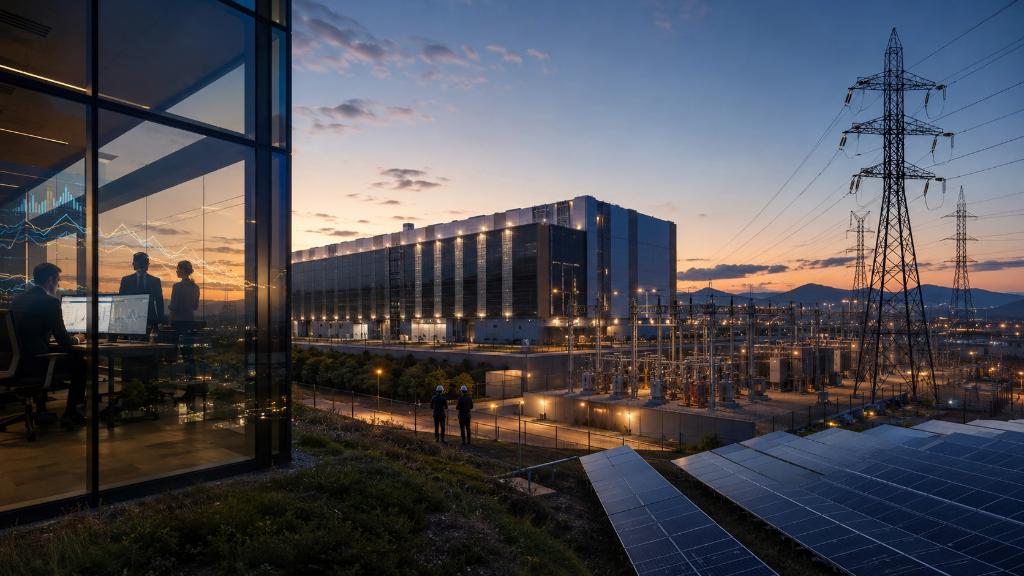
- Nvidia launched a $25 billion bond sale in mid-June, its first corporate bond issue since 2021.
- Amazon, Alphabet and Microsoft are committing AI and cloud capex close to major public infrastructure programmes.
- The IEA estimates data centers could consume slightly more electricity than Japan does today by 2030.
- The risk is shifting toward bonds, power grids, local communities and cloud-service prices.
The artificial-intelligence boom is changing shape. It is no longer visible only in model performance or semiconductor valuations, but also in bond markets, grid-connection queues and infrastructure budgets. The clearest recent signal came from Nvidia: on June 15, 2026, the company launched a $25 billion bond sale, its first since 2021. Reuters reported that investor demand reached $85 billion, with maturities extending to 2056.
This does not mean Nvidia is short of cash. The proceeds are described as being for general corporate purposes, including debt refinancing. But the financial signal is clear: AI is becoming a long-capital industry. Even the most profitable players are setting a thirty-year credit cost as hyperscalers buy chips, secure land, build facilities, finance transformers and lock in available electricity.
The trend extends beyond the United States. Reuters described in early June a wave of euro, sterling, Swiss franc, yen and Canadian dollar issuance by major US platforms. This multi-currency debt helps finance data centers closer to deployment areas, diversify the investor base and sometimes lower borrowing costs. It also broadens investors’ exposure to the cloud and AI investment cycle.
Capital-expenditure figures show the scale of the shift, although they do not all translate into new debt. Amazon said it expects more than $200 billion in 2026 capex, mainly for AWS, data centers and AI chips. Alphabet said it was targeting $175 billion to $185 billion in 2026 capex, after spending $91.45 billion in 2025. Microsoft had announced about $80 billion for AI-enabled data centers in fiscal 2025. Bridgewater, cited by Reuters, estimates AI investment by large US technology companies at around $650 billion in 2026, up from $410 billion in 2025.

The physical constraint is as important as the financial one. The International Energy Agency estimates that data centers consumed about 415 TWh of electricity in 2024, close to 1.5% of global demand. In its base case, consumption would reach about 945 TWh by 2030, just under 3% of global demand. In other words, data centers would then consume slightly more electricity than Japan does today. The comparison gives a clear order of magnitude: a global digital infrastructure would, on its own, reach the annual electricity consumption of a major industrial economy.
In the United States, the pressure is already visible in grid regulation. Federal regulator FERC has asked grid operators, excluding Texas, to review connection rules for large power users such as data centers. The aim is to accelerate projects able to bring their own power or reduce load during peaks, while preventing reinforcement costs from being passed uncontrolled to consumers. The EIA also expects US electricity consumption to set new records in 2026 and 2027, driven in part by AI data centers and electrification.
In China, the approach is more planned but no less constrained. Reuters reports that Beijing wants renewable electricity to supply 80% of AI projects by 2030, up from 11% in 2023. Experts cited in the report warn that costly GPUs often run around the clock, making AI loads less flexible than in other industries. Chinese data-center electricity demand could rise by 300 billion to 500 billion kWh between 2026 and 2030; that projection depends on construction speed, chip efficiency and operators’ ability to shift some computing away from peak hours.
In Europe, the issue has a regulatory and territorial form. The European Commission is preparing a data-center energy-efficiency package, with a rating scheme, analysis of reported data and possible minimum performance standards. Reuters says European capacity could rise from about 12 GW last year to 28 GW by 2030. For local authorities, that means more requests for grid connections, transformers, land, cooling water and high-voltage lines, sometimes in already constrained regions.
For households, small businesses and local authorities, the transmission is indirect. A data center does not mechanically raise every electricity bill. But when a local grid must be reinforced to absorb a concentrated load, costs can be shared among operators, consumers, taxpayers and municipalities. For a local authority, that can mean an upgraded substation, a reinforced power line or less available capacity for other industrial projects; for a small business, a higher software, storage or automation bill.
The source comparison shows different priorities. Reuters emphasizes bond issuance, yields and investor reactions. The IEA provides a global energy framework built on scenarios. The European Commission focuses on efficiency, transparency and digital sovereignty. China-related sources highlight security of supply and renewable integration. These differences mainly reflect local constraints: financing in the United States, regulation in Europe, energy planning in China and physical capacity for grids.
Three reservations remain necessary. Announced capex is not the same as net new debt; electricity-demand figures remain scenarios; private compute agreements, such as those reported by Reuters about Meta and Crusoe based on Bloomberg, are not always independently verified. The core question is return: will AI revenues sustainably cover the cost of capital, electricity, chips, buildings and grids?
In the short term, investors still treat much Big Tech debt as high-quality paper. Over the medium term, AI is becoming a macroeconomic test: if its infrastructure requires more capital and electricity, its cost will not remain only on corporate balance sheets. It will move through bond yields, grid tariffs, local public budgets and the prices of digital services used every day.
FAQ
Why is there talk of AI debt?
Because data centers, chips, power contracts and grid connections require huge capital. Large companies are using bonds, loans and sometimes private financing to smooth that spending.
Can households end up paying part of the cost?
Yes, indirectly. Costs can pass through grid tariffs, local taxes funding infrastructure, electricity prices in constrained areas, or cloud and software subscriptions.
Is this similar to a bubble?
The risk exists if AI revenues do not cover the cost of capital, electricity and equipment replacement. For now, it is visible as much in debt and energy as in stock prices.
- Reuters – Nvidia to raise $25 billion in first corporate bond sale in five years
- Reuters – AI debt sales reshape global corporate bond markets
- Reuters – Amazon sees 50% boost to capital spending this year
- Reuters – Alphabet forecasts sharp surge in 2026 capital spending
- Reuters – Big Tech to invest about $650 billion in AI in 2026, Bridgewater says
- Microsoft – The golden opportunity for American AI
- International Energy Agency – Energy demand from AI
- Reuters – Top US energy regulator pushes grids to overhaul data center power rules
- Reuters – US power use to beat record highs in 2026 and 2027 as AI use surges, EIA says
- Reuters – China’s push for green power use in AI projects faces hurdles
- European Commission – Energy performance of data centres
- Reuters – EU plans energy standards for data centres
- Reuters – Meta signs new AI computing deals with Crusoe, Bloomberg reports