
 ezna-io
Romania drone: the cost of a NATO interception
By Zoé Marquand
a month ago

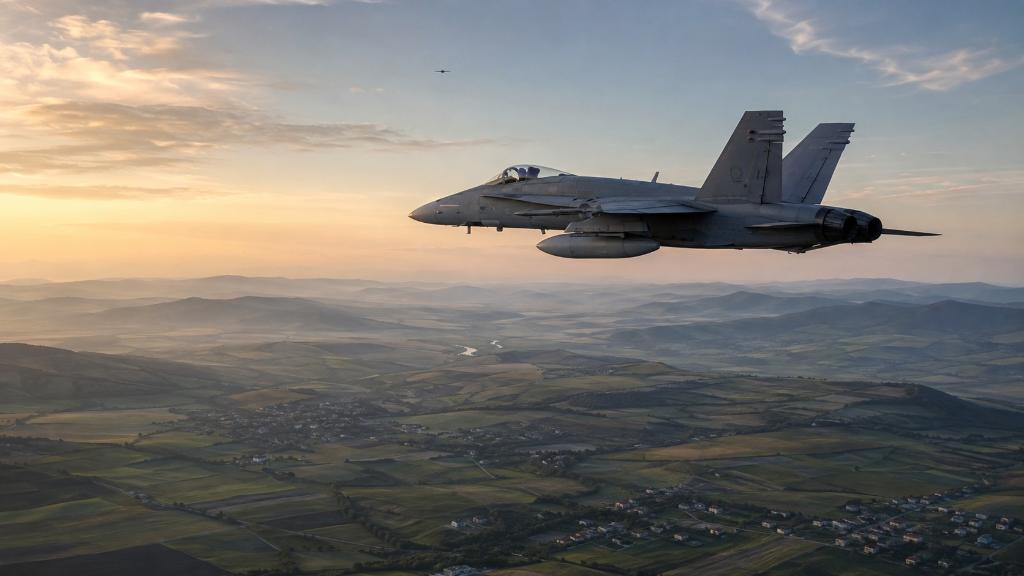
- A Spanish F-18 operating for NATO shot down a drone on August 16, 2026 after it entered Romania from the direction of Moldova.
- The drone’s model, origin and value remain unknown, as does the weapon used by the fighter, so the precise cost of the interception cannot be calculated.
- Ukraine and Russia both employ and adapt layered defences against mass drone attacks; interception rates claimed by either side require the same caution.
- NATO plans more than $40 billion in counter-drone investment over five years to develop responses better matched to different threats.
At 5:01 a.m. on Sunday, August 16, a Spanish F-18 serving on a NATO air-policing mission shot down a drone that had entered Romanian airspace. According to Romania’s Defence Ministry as cited by Reuters, radars detected the aircraft entering from Moldova about 24 kilometres north of Galați. The pilot established radar contact, received permission to engage and destroyed the target. Fragments appeared to have fallen in an uninhabited area between two villages.
The incident is tactically limited, but it concentrates a question that has become central to modern air defence: how much should a country spend to neutralise a machine that may be far cheaper than the system sent against it? The Russia-Ukraine war now allows the same equation to be observed on both sides of the front. Each side launches waves of drones and develops ways to detect, jam or destroy them.
In Romania’s case, however, a direct numerical comparison would be misleading. The drone type has not been disclosed, its origin is unconfirmed and the weapon used by the F-18 remains unknown. It is therefore impossible to state reliably that a missile worth a given amount destroyed a drone worth another.
An unidentified drone in a heavily charged environment
Reuters, Al Jazeera and the Times of India agree on the essential facts: the drone entered Romanian airspace from the direction of Moldova, the Spanish F-18 was operating on a NATO mission and permission to engage was granted before it was destroyed. Romania’s Defence Ministry did not attribute the aircraft to any country.
That distinction matters. In late July, Bucharest said Russian drones had entered its airspace without permission 33 times since Russia’s full-scale invasion of Ukraine began. Reuters also reports that Romanian F-16s shot down three Russian drones in July. Those precedents explain the alert posture but do not automatically identify the August 16 drone.
On August 11, Romanian forces also destroyed two Gerbera-type drones drifting in the Black Sea near the Neptun Deep offshore gas project. Their origin had not been established. Romania’s defence minister said Ukraine had confirmed that they did not belong to its forces. The accumulation of incidents therefore explains Bucharest’s caution without resolving the identity of every aircraft.
What did the F-18 intervention actually cost?
The public information available does not allow the exact cost of the August 16 operation to be calculated. The full mission duration, fuel consumption, maintenance generated by the flight and, above all, the weapon used would be required. Accounting methods for fighter flying hours also differ between armed forces. Applying an old US operating-cost figure to a Spanish F-18 would create more apparent precision than reliable information.
The marginal cost of a sortie must also be separated from the cost of maintaining the capability. Fighters, pilots, mechanics, radars and command chains must remain available whether or not a target appears. NATO Air Policing operates continuously, 24 hours a day and 365 days a year. The F-18 is therefore not merely an expensive firing platform: it is also a fast mobile sensor able to reach and identify an unknown target.
The economic problem becomes sharper as incursions multiply. A fighter sortie can be rational against an isolated object of unknown capability. Repeating that response dozens or hundreds of times creates a strong incentive to develop cheaper interception layers.

Ukraine: lowering the cost of interception
Ukraine has become a major testing ground. Reuters reported in March that most Ukrainian interceptor drones cost a few thousand dollars or less. SkyFall was charging Ukraine’s military about $1,000 for some versions of its P1-SUN, while Wild Hornets’ STING cost roughly $2,000 or less.
The target’s price also varies by model and estimate. Reuters valued a Shahed at roughly $20,000 to $50,000 in a March report on the STING, while another report that month put a Shahed-136 at $50,000 to $100,000. Such variation is itself a reason not to treat one price as a fixed industrial constant.
In late April, a Ukrainian air-force commander told Reuters that interceptor drones were accounting for about 40% of the destruction of Russian Shaheds and other long-range attack drones, up from roughly 25% during the winter. An air-force spokesperson said electronic warfare could neutralise nearly half of incoming aircraft during some attacks. These are statistics supplied by a belligerent. Reuters said Ukraine’s overall interception figures could not be independently verified, so they should be treated as Ukrainian estimates rather than independent measurements.
The same caution applies to commercial performance claims. Ukrainian manufacturers report thousands of interceptions by certain models, but those totals are not always independently audited. The experience is nevertheless significant in scale: interceptor drones, electronic warfare, automatic weapons, fighters and missiles are now used together rather than as mutually exclusive solutions.
Russia faces the same equation
Russia also faces large waves of Ukrainian drones and is adapting several defensive layers. On August 11, its Defence Ministry said it had intercepted or destroyed 396 Ukrainian drones over 15 regions. Two days earlier, it reported more than 150 interceptions during another wave. TASS separately relayed a Defence Ministry tally of 285 drones destroyed between 8 a.m. and 8 p.m. on August 9.
Those figures demonstrate the scale of the attacks, but they do not establish an interception rate by themselves. They largely originate with Russia’s Defence Ministry and cannot be exhaustively verified independently. Calculating the actual share of drones reaching their intended targets would also require a reliable count of aircraft launched, decoys, drones jammed or lost and confirmed impacts. The public evidence reviewed here is therefore insufficient to establish a general Russian interception rate of 95% or 96%.
Documented impacts simultaneously show that some Ukrainian drones penetrate those defences. On August 12, an attack on Novorossiysk struck the naval base and grain terminals, according to officials and industry sources cited by Reuters. Farther east, the Orsk refinery, about 1,900 kilometres from the Ukrainian border, stopped processing after an August 11 drone attack. Reuters puts the site’s capacity at about 115,200 barrels per day and later reported that some repairs could take several months.
Orsk illustrates why a high interception rate is not sufficient to measure actual territorial protection: only a few aircraft penetrating the defensive network may still disable a high-value facility. That does not prove that Russia’s overall air defence is ineffective either, because its actual interception rate remains impossible to establish independently from the available public data.
Two sides, several defensive layers
Russia does not rely solely on surface-to-air missiles. Reuters reported in July that Russian forces were deploying powerful jamming equipment to disrupt some Ukrainian medium-range drones using Starlink. That account was based in part on Ukrainian commanders and pilots interviewed in the Zaporizhzhia region; they too are directly involved in the conflict, and their assessments of Russian countermeasures require context.
The broader logic observed on both sides is similar: combine radar, electronic warfare, conventional weapons and specialised counter-drone systems to avoid routinely using a high-end interceptor against every cheap target. Jamming can defeat some aircraft but becomes less useful against more autonomous or interference-resistant systems. Guns offer a lower cost per engagement but require the target to enter their range. Interceptor drones remain constrained by speed, endurance, weather and the time available to catch a threat.
The cheapest solution can become obsolete within months
Interceptor economics remain constrained by physics. Reuters reported that an early Ukrainian interceptor effective against Shaheds in early 2025 became inadequate about four months later after Russian drone speeds rose from roughly 170 km/h to more than 200 km/h, according to a Ukrainian specialist from the Come Back Alive foundation.
The race continued. In July, Reuters reported that jet-powered Shahed variants could approach 500 km/h. Manufacturers were developing faster interceptors, some still targeting costs of only a few thousand dollars and others priced below $10,000 for Ukraine. Those performance figures and several prices come from the manufacturers themselves and should be treated as declared specifications.
The conclusion is less dramatic than the technology: the cheapest interceptor produces no saving if it can no longer catch the target.
A high interception rate does not mean complete protection
The fog of war makes comparisons between Ukrainian and Russian interception rates particularly fragile. Kyiv regularly publishes the number of Russian drones it says were shot down or neutralised. Moscow does the same for Ukrainian drones. In both cases, the source has an interest in demonstrating the effectiveness of its defence, while detailed counting methodologies are not always public.
Observable damage provides useful but incomplete corroboration. A refinery strike proves that at least one weapon penetrated the defences; it does not reveal how many others were destroyed. Conversely, an announcement of hundreds of interceptions does not reveal how many targets were genuine, how many were decoys or how many drones failed for unrelated reasons.
Military effectiveness therefore cannot be reduced to a single percentage. If 95 aircraft out of 100 are destroyed but the remaining five hit a refinery or ammunition depot, the interception rate looks excellent while the operational result may still be costly. Conversely, launching hundreds of drones to obtain a handful of impacts imposes industrial and logistical costs on the attacker as well.
NATO acknowledges the economic problem
On June 17, 2026, during a press conference in Latvia, NATO Secretary General Mark Rutte acknowledged that in the long term the Alliance could not continue shooting down drones with very expensive interceptors. He explicitly pointed to Ukrainian experience and the need for systems whose costs are closer to those of the attacking drones.
On July 7, that evolution became financial. Allies announced more than $40 billion in counter-drone investment over the following five years. NATO also intends to train five times as many drone operators by the end of 2027 and develop a marketplace for counter-drone systems compatible with Alliance standards.
Those amounts and objectives are verifiable institutional announcements. They are not, however, independent evidence of how effective future systems will be: NATO is itself the organisation defining, financing and presenting the policy. Just as Russian and Ukrainian ministries are primary sources when assessing their own operational results, NATO is a primary source when describing its own capabilities.
Romania is already part of a wider pattern
Two days before the Romanian incident, on August 14, an Italian Eurofighter under NATO command shot down another drone of unknown origin over Latvia. Reuters reported that Italian Eurofighters had launched from Lithuania and Turkish F-16s from Estonia as part of the response.
The Latvian case illustrates why rapid attribution is risky. It occurred while Ukraine was attacking Russian ports, and Reuters noted that Ukrainian drones had previously strayed into Baltic airspace. A Latvian military spokesperson nevertheless attributed some such deviations to Russian electronic warfare. A drone’s origin, intended destination and reason for its final trajectory can therefore be three separate questions.
The repetition of such incidents is gradually changing air policing. An architecture structured around more capable aerial threats increasingly has to deal with smaller, more numerous objects that may be cheap enough for their operators to treat as expendable.
How different sources frame the sequence
Reuters gives the August 16 incident a narrow treatment: the interception chronology, caution over the drone’s origin and reminders of documented previous Russian violations. Al Jazeera places it more directly in the context of Russian and Ukrainian strikes occurring over the weekend. The Times of India focuses more heavily on repeated violations and NATO’s growing response.
Xinhua’s coverage of Romania’s July interceptions relied mainly on statements from Bucharest and placed less emphasis on wider NATO strategy. No Xinhua article on the specific August 16 incident is used here; the source serves only to compare coverage of the preceding Romanian sequence.
The Russian framing differs more sharply. In an August 8 press review, TASS relayed an Izvestia article describing the deployment of Spanish F-18s and NH-90 helicopters in Romania as mainly aimed at countering drones, while citing experts who argued that greater NATO presence could increase the risk of military incidents in the Black Sea. This is a media interpretation rather than an independently established fact. As TASS is a Russian state news agency, its institutional status should be considered when reading its coverage of NATO.
The same rule applies in the other direction. Ukrainian operational figures frequently originate with Ukraine’s military or government, while assessments of NATO capabilities often originate with the Alliance itself. Reuters provides additional reporting and flags claims it cannot independently verify, but publication by a news agency does not transform a belligerent’s original statistic into independent data.
The defender also pays for uncertainty
A cheap drone can create an advantage without destroying anything more expensive: it may simply force an opponent to detect, identify, scramble, jam or fire. But looking only at unit prices ignores the opposite risk.
When an unidentified object crosses a border close to an active war, the defender initially does not know whether it is a reconnaissance platform, a decoy, an explosive munition or simply a drone that has gone astray. The defender therefore also pays for uncertainty. Nothing in the available evidence establishes that using the Spanish F-18 was disproportionate in this specific case.
The more revealing question appears when the same scene is repeated a hundred times. Russia and Ukraine show that effective defence against mass attacks requires several layers and that even very high interception rates, when genuine, do not guarantee that no aircraft will reach a valuable target. NATO’s announced planning increasingly appears to reflect the same reality.
The lesson of August 16 is therefore not that an F-18 was too expensive to destroy a drone whose price and model remain unknown. It is that modern air defence can no longer rely on a single category of response. In this new arithmetic, the advantage may increasingly belong to whoever can maintain a high level of protection while reserving the most expensive defensive assets for threats that genuinely justify their cost.
FAQ
How much did the Romanian drone interception cost?
The precise cost is unknown. Authorities have not disclosed the full mission duration or, crucially, the weapon used by the F-18. Any precise numerical estimate for this operation would therefore be speculative.
Does Russia really intercept 95% of Ukrainian drones?
Russian authorities regularly claim to destroy very large numbers of Ukrainian drones, but the public evidence does not establish a reliable general interception rate of 95%. As with Ukrainian statistics, figures published by a belligerent should be distinguished from independently verified results.
Can interceptor drones replace fighter aircraft?
Not in every situation. They can cost only a few thousand dollars and work well against certain targets, but speed, range, weather and identification requirements limit them. Their main value is as another layer alongside fighters, missiles, guns and electronic warfare.
Sources
- Reuters — Romania shoots down drone breaching its airspace, August 16, 2026
- Al Jazeera — Russian strikes kill Ukrainian woman as NATO jet downs drone over Romania, August 16, 2026
- Times of India — Spanish F-18 shoots down drone breaching Romanian airspace, August 16, 2026
- Xinhua — Romania shoots down 2nd drone violating airspace in 2 days, July 25, 2026
- TASS — Russian media framing of NATO’s expanded Black Sea presence, August 8, 2026
- Reuters — Inside Ukraine’s drive to defeat the dreaded Shahed drone, April 29, 2026
- Reuters — Inside the Ukrainian interceptor drones wanted around the Gulf, March 17, 2026
- Reuters — Faster interceptors against jet-powered Shaheds, July 21, 2026
- Reuters — Russia says it intercepted or destroyed 396 Ukrainian drones, August 11, 2026
- Reuters — Russian authorities report more than 150 Ukrainian drones intercepted, August 9, 2026
- TASS — Russian Defence Ministry reports 285 Ukrainian drones intercepted, August 9, 2026
- Reuters — Ukrainian attack hits Novorossiysk naval base and grain terminals, August 12, 2026
- Reuters — Orsk refinery halted after drone attack, August 12, 2026
- Reuters — Orsk refinery repairs may take months, August 13, 2026
- Reuters — Russian electronic warfare adapts against Ukrainian drones, July 8, 2026
- Reuters — Italian NATO fighter shoots down drone in Latvia, August 14, 2026
- NATO — NATO Air Policing
- NATO — Mark Rutte on counter-drone interception costs, June 17, 2026
- NATO — Drone Edge: more than $40 billion over five years, July 7, 2026