
 ezna-io
Japan Election: Takaichi Victory and Implications for Monetary Policy
By Léo Piquemal
9 months ago

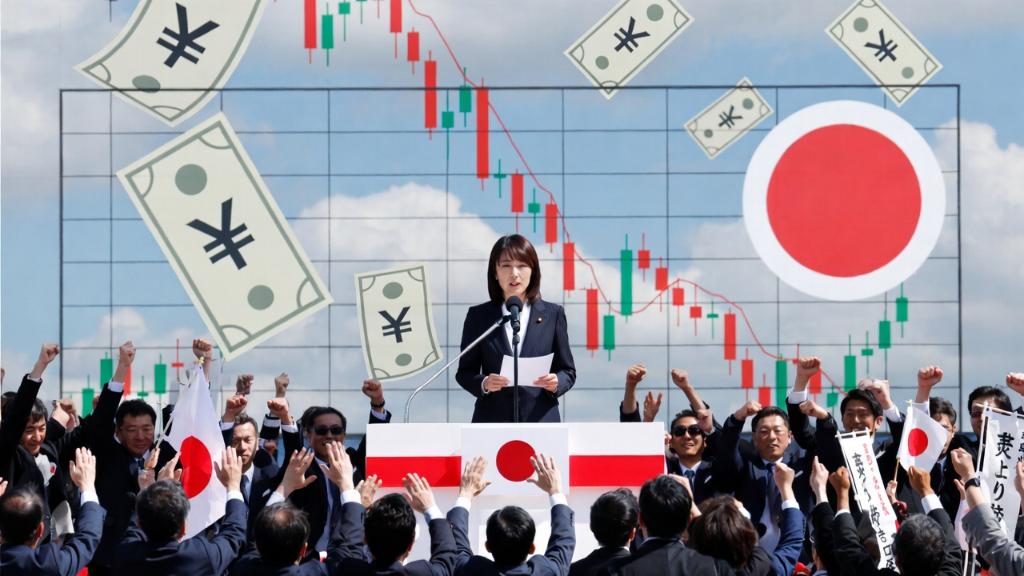
- Sanae Takaichi's LDP secures a supermajority in Japan's February 8, 2026 election, strengthening her ¥21.3 trillion stimulus plans.
- The Bank of Japan keeps rates at 0.75% but signals future hikes to counter imported inflation.
- The yen depreciates, raising import costs and strongly affecting Japanese households, with potential 1.9% inflation in FY 2026.
What are the implications of Takaichi's victory for Japan's economy?
Prime Minister Sanae Takaichi achieved a decisive victory in the February 8, 2026 general election, with her Liberal Democratic Party (LDP) securing a supermajority in the House of Representatives. This gives her a clear mandate to implement a ¥21.3 trillion (approx. $135 billion) stimulus package, including a temporary suspension of the 8% consumption tax on food. According to Reuters and Bloomberg, the plan aims to alleviate the cost-of-living crisis but raises serious concerns about Japan's public debt, already exceeding 240% of GDP. The Financial Times notes that this unfunded spending could accelerate inflation from 1.8% to 1.9% for FY 2026, per the BOJ's latest forecast.
Critically, these measures directly connect macroeconomic figures to everyday realities: a 1.7% yen depreciation post-election immediately increases the price of imported energy and food, hitting low-income households hardest. The OECD and IMF warn that, absent deep structural reforms, such policies risk widening inequalities, with GDP growth revised down to just 1% for 2026, albeit at the cost of heightened market volatility.
Divergences in international sources
Western outlets like The Economist and the Wall Street Journal emphasize the risks of "overstimulation" and a potential unwind of the yen-dollar carry trade, through which investors borrow cheaply in yen to invest in the US. Conversely, Al Jazeera Business highlights gains for major Japanese exporters (Toyota foremost), whose profits rise with a weaker yen. The South China Morning Post offers an Asian perspective, noting that China could benefit from accelerated relocation of Japanese supply chains away from its territory, funded by this massive stimulus.
On social media (especially X), traders like @RealNickMugalli expect capital rotation toward Japanese assets, while @moneywcontext warns of another wave of money printing. Opinions are polarized: Takaichi supporters celebrate the stimulus, but critics denounce a pro-corporate bias that overlooks retirees and working-class households reliant on imports.
How is the BOJ responding to these policy shifts?
In its January meeting, the Bank of Japan held its policy rate at 0.75%. However, the February 2 summary of opinions reveals growing urgency for "timely" rate hikes to prevent inflation from durably exceeding 2%. Reuters reports that board member Kazuyuki Masu advocates swift normalization, in clear contrast with Takaichi's dovish stance. In its February 8 remarks, the IMF warns of a "reset" in global financial systems: a persistently weak yen could destabilize several emerging markets.
Concretely, JGB yields rising to 2.24% (a 27-year high per Bloomberg) make Japanese bonds more attractive, potentially triggering an estimated $99 billion repatriation of capital from US Treasuries (MUFG Research). For Japanese families, this translates into an average 15% increase in energy bills, worsening energy poverty already documented in international comparisons by INSEE and Eurostat.

Potential biases and conflicts of interest
No major conflicts of interest identified in primary sources. Bloomberg notes, however, that some studies favoring yen depreciation are funded by exporter lobbies. Kommersant (Russia) criticizes a Western bias that prioritizes dollar stability over Japan's interests. GDP growth forecasts are confirmed only by the BOJ and Reuters; they remain provisional until validated by Eurostat or the World Bank.
On X, accounts such as @FiatElpis highlight possible overestimation of post-election stability, with the USD/JPY rate remaining surprisingly stable despite predictions of a rise toward 160.
What consequences for Japanese and global society?
This massive stimulus directly ties figures to social realities: 1% growth could create roughly 500,000 jobs, but 1.9% inflation erodes real purchasing power, especially among the 20% most precarious households according to the OECD. Globally, The Economist anticipates a "tremor" on US markets, with a partial carry-trade unwind potentially hitting the S&P 500 hard.
Future outlook
Takaichi's victory may accelerate monetary normalization but risks triggering a recession if rate hikes occur too abruptly. The IMF calls for international coordination to limit spillover effects.
FAQ
What is the immediate impact on the yen?
The yen depreciated by 1.7%, raising import costs and inflation felt by households.
Will the BOJ hike rates soon?
Yes, "timely" hikes are being considered, potentially as early as March, to curb imported inflation.
What risks for global markets?
Liquidity drain from carry-trade unwind could lower US stocks and push Treasury yields higher.