
 ezna-io
Aesthetic Excellence: Traditional Heritage in Current Cultural News
8 months ago

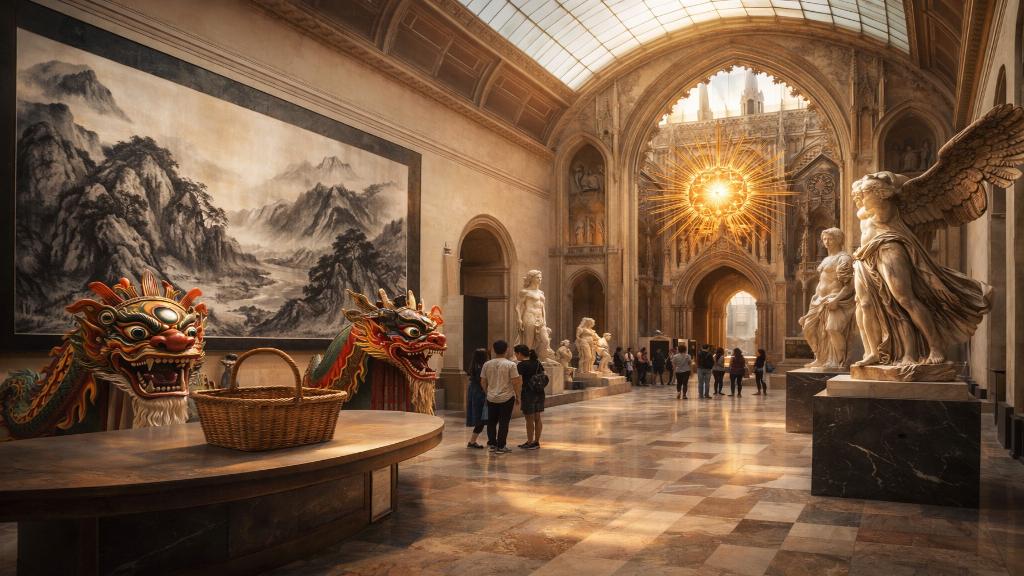
- Reopening of the seohwa gallery at the National Museum of Korea featuring Jeong Seon exhibition on majestic landscapes.
- Shehuo gala in Urumqi celebrating traditional Chinese folk art.
- Helios sculpture installation lighting the historic Grimsby minster.
- Appointment of Christophe Leribault as president of the Louvre for heritage stability.
In the last twenty-four hours, cultural initiatives from several continents have drawn attention to traditional artistic heritage. The seohwa gallery at the National Museum of Korea has reopened after renovation. It features works by Jeong Seon, Joseon dynasty painter, whose landscapes with fluid ink strokes capture the essence of Korean lands.
In China, the Shehuo gala in Urumqi brought together large crowds for folk performances rooted in history. In the United Kingdom, the Helios sun sculpture will light up Grimsby Minster from April 9, in dialogue with the heritage site. In France, Christophe Leribault has taken the helm at the Louvre following Laurence des Cars’ resignation, to ensure continuity at this major institution.
These events, reported by Korean, Chinese, British and French sources, focus on preservation and enhancement. Korean press stresses historical context. Xinhua highlights public appeal and tradition maintenance. The BBC notes artistic integration. Le Monde links the appointment to heritage stability.

These phenomena fit into broader social evolutions. As changes accelerate, such actions recall the observable role of historical roots as landmarks. Jeong Seon’s lines follow an improvised rhythm, close to a jazz session, and cross time with tangible depth. Shehuo dances sustain aesthetic continuity. The Helios sculpture dialogues with medieval forms. At the Louvre, the transition seeks to preserve the classical collection amid societal shifts.
No conflicts of interest appear in the sources. Some details on dates or attendance await further cross-checking. These elements show how the search for beauty still structures cultural practices today.
Through these expressions, a fluidity emerges that invites observation of what endures in our changing societies.
FAQ
Q: What is seohwa?
R: Traditional Korean art form combining painting and calligraphy, appreciated during the Joseon dynasty for its aesthetic excellence.
Q: How do these initiatives link art and social evolutions?
R: They illustrate a valuation of heritage in the face of rapid changes, centered on facts and their concrete consequences.
Q: Are there uncertain pieces of information?
R: Some secondary details on attendance have not yet been cross-verified by multiple sources.