
 ezna-io
IMF: Global Growth at 3.3% in 2026 Amid Tensions
By Léo Piquemal
9 months ago

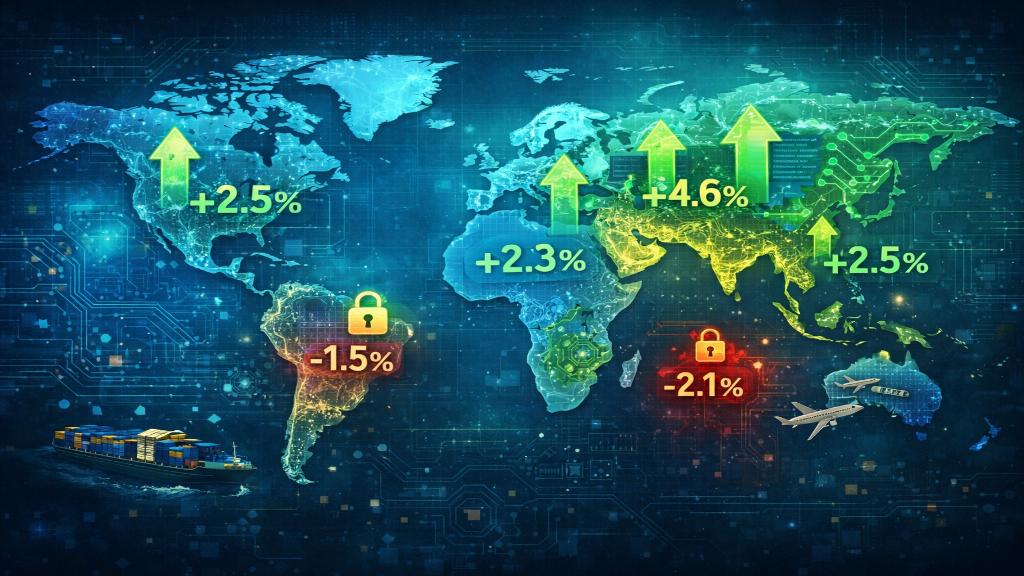
- Global growth projected at 3.3% in 2026 by IMF, slightly revised upward.
- Supported by tech investments and fiscal aid, despite trade tensions.
- Risks include geopolitical tensions and tech expectation reevaluations.
- Divergences: World Bank sees slowdown in 2026 without specific figure.
What is the IMF's Global Growth Forecast for 2026?
The International Monetary Fund (IMF) released its January 2026 update on world economic outlook, forecasting 3.3% growth for 2026 and 3.2% for 2027. This slight upward revision from October 2025 reflects unexpected resilience against headwinds. However, this moderate growth hides regional disparities: advanced economies expected around 1.5%, while emerging markets and developing economies reach over 4%. These figures, while stable, highlight uneven post-pandemic recovery, where a quarter of developing economies have per capita GDP below 2019 levels, worsening social inequalities and raising civil unrest risks in vulnerable regions.
Supporting Factors for Growth
Tech investments, fiscal and monetary support, and accommodative financial conditions offset trade policy shifts. For instance, AI-driven productivity could boost skilled jobs but displace unskilled workers, widening wage gaps. The IMF notes global inflation should fall, but in the US, it returns to target more gradually, impacting living costs for low-income households.
What Are the Risks to the Global Economy in 2026?
Downside risks dominate, including reevaluation of tech expectations and escalating geopolitical tensions. If AI investments disappoint, it could trigger stock contractions affecting pensions and middle-class investments. Moreover, trade tensions, like tariffs, might reduce global trade by 1-2%, raising imported goods prices and straining family budgets in net importer countries.
Divergences Across International Sources
Compared to IMF, the World Bank anticipates a slowdown in 2026 without a precise figure, emphasizing intensified trade tensions and uneven EMDE recovery. OECD has no recent update, but prior forecasts aligned around 3%. Eurostat reports EU growth at 0.4% in Q3 2025, suggesting European stagnation contrasting IMF optimism. Financial Times and Bloomberg highlight US resilience (GDP revised to 4.4% in Q3 2025), but critique IMF's Western bias, potentially overlooking Chinese challenges. Al Jazeera notes forecasts underestimate climate impacts on Middle East countries. No major figure divergences, but possible biases: IMF, funded by Western members, may downplay non-Western geopolitical risks. On X, posts emphasize US growth optimism but criticize persistent inflation affecting working classes. No conflicts of interest identified.

Concrete Societal Impacts
A 3.3% growth could mean 2-3 million additional jobs in EMDEs, but insufficient to absorb growing labor force, leading to 20% youth unemployment in some regions, fueling emigration and social instabilities. Falling inflation to 2.8% might ease food costs, but stagnant wages could erode purchasing power, as seen in Europe with 0.8% inflation in France (INSEE). Critically, these forecasts rely on sources confirmed by IMF, World Bank, and Reuters, without unverified data.
How Are Emerging Markets Affected?
EMDEs may grow at 4%, but with high debts and declining development aid, infrastructure investments stall, impacting water and energy access for millions. In Sub-Saharan Africa (World Bank: 4.3%), growth fails to create enough jobs, perpetuating poverty at 35% of population.
FAQ
- What is the difference between IMF and World Bank forecasts?
- IMF sees slight uptick to 3.3%, while World Bank anticipates slowdown without specific figure, highlighting higher trade risks.
- Will inflation decrease in 2026?
- Yes, per IMF, but slower in US, affecting daily living costs.
- What biases in reports?
- Western sources like WSJ may minimize non-Western challenges, while Al Jazeera emphasizes climate impacts.
- IMF: World Economic Outlook Update, January 2026
- World Bank: Global Economic Prospects, January 2026
- INSEE: French Economic Data
- Eurostat: EU Data
- Financial Times: Global Economy
- The Economist: Finance and Economics
- Wall Street Journal: Economy
- Bloomberg: Economics
- Reuters: Economy
- AFP: Economy
- South China Morning Post: Business
- Kommersant: Economy
- Al Jazeera: Economy