
 ezna-io
French Fractures in 2025: A Nation’s Malaise Seen Through the World’s Mirror
By Hugo Delorme
a year ago

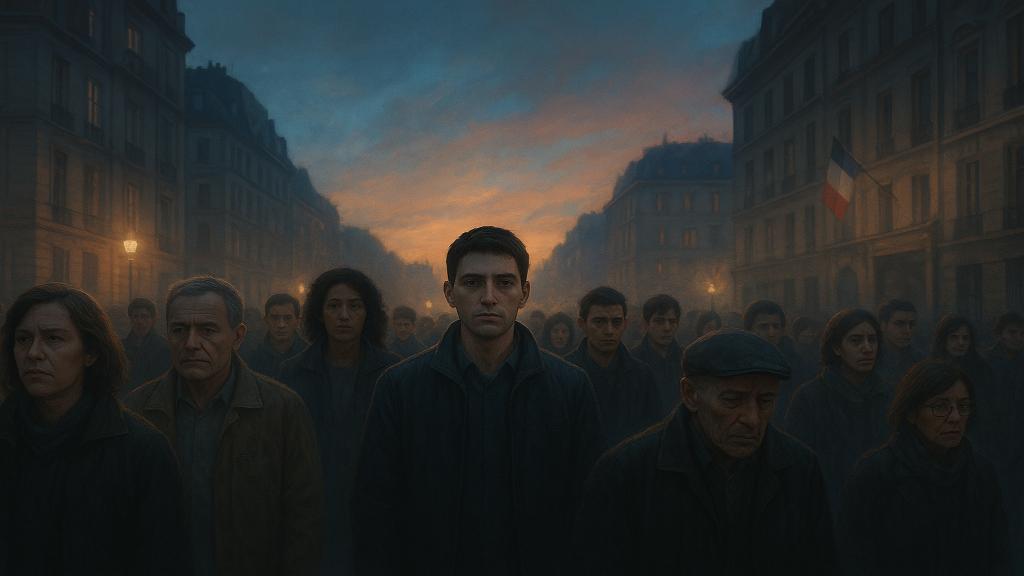
- The 2025 “French Fractures” survey reveals deep unrest: almost 96% of French people describe themselves as dissatisfied or angry, only 4% as “satisfied and at ease”. :contentReference[oaicite:22]{index=22}
- Collapse of trust in national institutions (parliament, presidency, parties), while trust remains high in local institutions, schools, the army, mayors. :contentReference[oaicite:23]{index=23}
- Fear of downward mobility, nostalgia for a supposedly better past, and the sentiment that “France was better before,” shared even among young people. :contentReference[oaicite:24]{index=24}
- European comparison: France shows stronger political distrust than Germany, Italy, or the Netherlands according to the 2025 barometer by CEVIPOF with Institut de l'Entreprise. :contentReference[oaicite:27]{index=27}
- Growing confidence in the business world as a source of stability — more than in public institutions. :contentReference[oaicite:28]{index=28}
In a country where you can wake up in the morning, go to work, pay for your coffee — and yet feel like the whole system is crumbling beneath your feet — that is the image of France in 2025. The 2025 edition of the French Fractures survey, conducted by Ipsos for the Fondation Jean-Jaurès, CEVIPOF, Institut Montaigne and the newspaper Le Monde, lays bare a public stuck between anger, resignation and nostalgia. :contentReference[oaicite:29]{index=29}
When the “I” still holds — but not the “We”
On a personal level, many French people do not describe themselves as miserable. The “life satisfaction” score remains stable around 6.1/10 in 2025, as it was in 2024. But at the scale of the collective, optimism melts away. :contentReference[oaicite:30]{index=30}
Almost 36% of respondents think their personal situation will deteriorate in the coming years, while only 12% expect improvement — a pessimism especially strong among 35-59 year-olds. :contentReference[oaicite:31]{index=31}
Another telling sign of the gap between personal life and national outlook: 75% say that “France was better before”, a record since the survey began — and notably, 68% of those under 35 share that view. :contentReference[oaicite:32]{index=32}
Widespread distrust, but localized trust
The political verdict is harsh: in 2025, only 20% of French people trust the national parliament, 22% trust the presidency, and 10% trust political parties. :contentReference[oaicite:33]{index=33}
In contrast, institutions seen as “close” — mayors, schools, army, police, local small businesses — enjoy very high trust levels (between 68% and 82%). :contentReference[oaicite:34]{index=34}
This reflects what some analysts call a split between a discredited “central state” and a trusted grassroots network — the local, concrete, everyday world where people still feel seen and heard.
Turning to business — a shift in landmarks
Against this backdrop of political disenchantment, many respondents show growing trust in the business world as a source of stability. According to a 2025 article, 61% of French people say they would prefer ministers drawn from the business world rather than from traditional politics. :contentReference[oaicite:35]{index=35}
This shift is significant: it signals not only a loss of faith in public institutions — but also hope that pragmatic, perhaps technocratic, leadership might better respond to expectations (cost of living, employment, security) than traditional career politicians.
A European and international mirror: France in negative relief
The 2025 barometer from CEVIPOF — in partnership with Institut de l’Entreprise — compares France to Germany, Italy and the Netherlands. The result: France appears as the most distrustful country regarding politics. :contentReference[oaicite:36]{index=36}
In 2025, only 28% of French respondents say democracy is working well, compared to 51% in Germany and 37% in Italy — widening the gap between France and some of its European neighbours. :contentReference[oaicite:37]{index=37}
This sweeping political disillusionment in France stands out in a Europe that also faces crises, but where institutions often remain perceived as relatively stable — raising the question: is France an outlier, or an early indicator of a broader crisis in Western democracies?

What is rarely said (or often forgotten)
Strikingly, despite the depth of the malaise, few studies explore the financial or interest-driven connections behind the institutions of opinion, think-tanks and media. Who really pays for the “surveys”, the polls, the “trust barometers”? What role do companies, local authorities, interest groups play in producing these data? These crucial questions remain largely at the margins.
Likewise, the granularity of the data is often insufficient: we know little about fractures by origin, gender, health, fine-tuned geography. We risk flattening reality into national averages — hiding stark disparities and very different lived experiences depending on place or social background.
And in a context of “information fatigue”, the voices on social networks — more spontaneous, immediate — try to fill the void. But these sources often escape rigorous methods of validation or weighting. One finds exasperation, theories, anger — sometimes useful to gauge collective mood… but also biases, exaggerations, and hard-to-verify claims. That makes analysis bumpier, more uncertain. We must therefore approach social-media-born “sentiment data” with caution when using them to draw general conclusions.
An uncertain future — but clear possible paths
France in 2025 resembles an old building: cracked, fissured — but still standing. The individual continues to live: working, eating, paying bills. But the social cement — the we — is cracked.
To rebuild that foundation, several paths emerge: restore trust through transparency, bring decision-making closer to local levels, give back meaning to citizenship, re-empower citizens. And maybe, learn from our European neighbours — not to copy, but to draw lessons from systems where democracy seems less battered.
Yet a final danger looms: that of a simplistic narrative — painting France as a country “in terminal decline”, “beyond repair”. That would be to throw away the baby — the people, the local ties, the solidarities — with the political bathwater.