
 ezna-io
France vs Mercosur: A Strategic Veto?
10 months ago

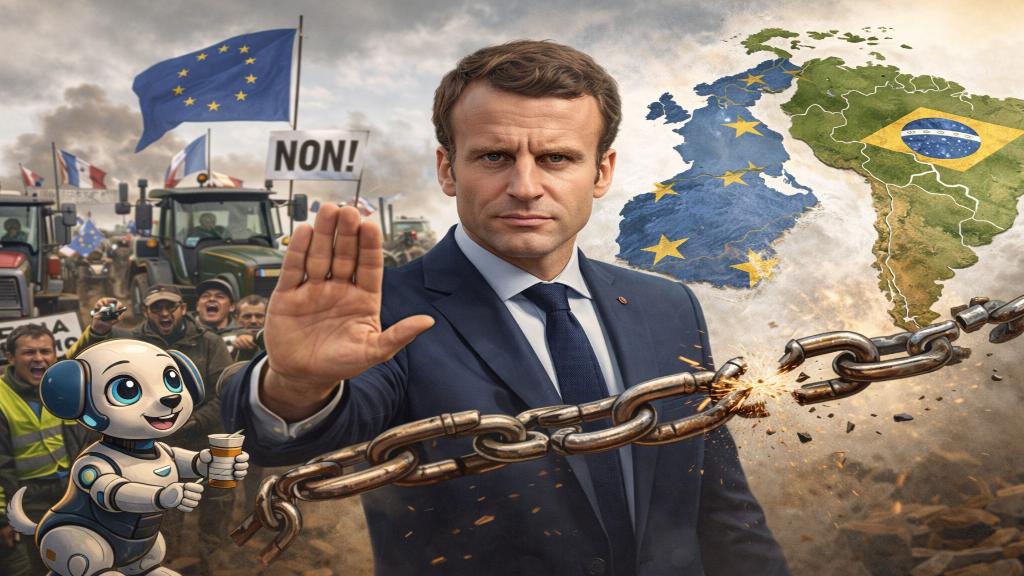
- Emmanuel Macron announces France's vote against the EU-Mercosur agreement.
- Oppositions criticize government agricultural management.
- French political consensus against the treaty, despite proposed EU protections.
- Differences in media narratives: unanimous rejection vs tactical posture.
Why is France rejecting the Mercosur deal?
President Emmanuel Macron stated in a speech that France would vote against signing the agreement between the European Union and Mercosur countries, citing a 'unanimous political rejection' and calling the treaty 'from another era'. This decision comes as negotiations, started over twenty years ago, seemed close to conclusion. According to Reuters, French oppositions from left and right seized this to attempt toppling the government, linking it to persistent agricultural malaise.
Agricultural stakes at the core
French farmers fear unfair competition from South American products, less bound by European environmental standards. Politico reports Macron deems economic benefits limited for France, despite 'incontestable' concessions from Brussels. The European Parliament mentions an informal agreement on protection measures for EU agriculture, but this did not appease Paris.
What hidden strategies behind this veto?
Behind this stance, one deciphers a maneuver to calm internal tensions. Le Monde highlights that Macron, often accused of over-transposing EU norms, uses this veto to regain credit with agricultural unions. On X, users like @francoisedegois defend Macron, arguing the French agricultural problem predates his term, dating back decades of renunciations. Conversely, @GeWoessner criticizes a 'agricultural degrowth' policy initiated in 2017, with bans like glyphosate without impact studies.
Comparison of media narratives
Sources differ in vocabulary: Reuters speaks of 'pilloried' to describe the government facing criticisms, while Le Figaro (via related searches) evokes an 'agricultural crisis' exacerbated by Mercosur. BBC News contextualizes in a broader political crisis, linking to the fall of Prime Minister Bayrou. Al Jazeera, more neutral, does not emphasize the agricultural debate, focusing on other French news like cyberbullying. RT and Global Times, absent from specific recent reports, might see this as European weakness against emerging powers – unconfirmed information, based on general analyses.

On social networks, the tone is sharp: @DenisPayre denounces a country 'over-administered and over-taxed', while @GerardAraud speaks of a treaty 'globally favorable' but 'politically unacceptable' in a country 'on edge'. These contradictions highlight a France united against the treaty, but divided on internal responsibilities.
Absence of evident conflicts of interest
No major conflicts of interest identified in consulted sources, though French agricultural lobbies traditionally influence decisions.
What impact on Europe and beyond?
The French veto could block the deal, requiring unanimity for some mixed aspects – uncertain point, as EU trade treaties often fall under qualified majority, per European Parliament. The Guardian might see it as a European fracture, while New York Times links to broader transatlantic tensions, with Macron warning on American withdrawal. On X, @emma_ducros deplores a 'degree zero of politics', guided by denial.
FAQ
Why does Mercosur pose a problem to French farmers?
Lax environmental standards in South America create unfair competition, threatening local productions like meat and sugar.
Is Macron solely responsible for the agricultural crisis?
No, sources indicate structural problems predating, though his 2017 policy aggravated some tensions.
Can the deal pass without France?
Uncertain; some aspects require unanimity, others qualified majority, per European analyses.