
 ezna-io
Shipping: a hidden shock under global pressure
By Léo Piquemal
6 months ago

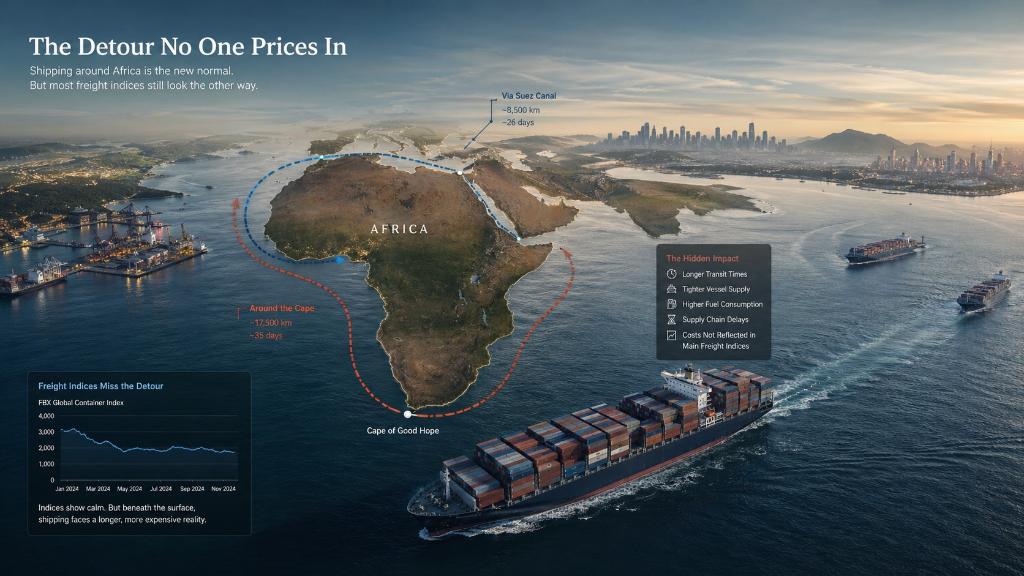
- Drewry index falls to $2,232 despite geopolitical tensions.
- Asia-Europe routes decline while US routes rise.
- Distances up 48% and travel times up 45% according to the World Bank.
- Surcharges reach up to $4,000 per container.
Global shipping markets in April 2026 reveal a paradox not seen since the pandemic: price indices suggest easing conditions, while operational constraints indicate an ongoing logistics shock. This divergence between visible data and real costs defines the current environment.
Drewry reports its World Container Index at $2,232 per 40ft container on April 23, 2026, down 1%. Key Asia-Europe routes declined, including an 8% drop to Genoa and a 4% drop to Rotterdam. These figures reflect structural pressure from moderate demand and increased capacity after years of fleet expansion.
However, indices only capture part of reality. Freightos shows market fragmentation: prices rose 7% to the US West Coast and 4% to the East Coast, while declining toward Europe. This segmentation reflects shifting trade flows rather than a uniform trend.
The real shock lies in hidden costs. The World Bank estimates that rerouting linked to Red Sea tensions increased shipping distances by 48% and travel times by up to 45%. These factors generate indirect costs such as capital tied up in transit, additional storage, logistical inefficiencies and uncertainty.
Companies therefore face higher costs than indices suggest. Reuters reports surcharges ranging from $1,500 to $3,300 per container, reaching up to $4,000 on some routes. These are not universal, but they significantly affect cost structures.

Financial markets reflect this ambiguity. Reuters notes that Maersk expects lower freight rates due to overcapacity and potential route normalization. The company forecasts lower EBITDA in 2026, indicating that markets do not expect sustained high pricing. A return of Red Sea routes could free 6% to 7% of global capacity, increasing downward pressure on rates.
This divergence extends into financial markets. A partially hidden logistics inflation could delay rate-cut expectations, particularly in the United States and Europe. This interpretation reflects sensitivity in bond markets to underlying inflation signals, even when they remain diffuse.
This gap between indices and real costs complicates macroeconomic interpretation. Central banks rely on aggregate indicators that may underestimate logistical pressure. Freight-driven inflation does not disappear; it spreads slowly through delays, storage costs and margin adjustments.
Transmission to the real economy is delayed. Existing inventories absorb short-term shocks, but new flows incorporating these costs may gradually impact consumer prices. This inflation is likely to remain targeted rather than broad-based.
Compared with 2021, the current shock is less visible but more diffuse. Price increases are not uniformly reflected in indices, reducing perceived risk while complicating anticipation. The global logistics system is functioning, but with degraded efficiency.
Combined source analysis shows convergence: Drewry and Freightos measure spot pricing, the World Bank captures structural constraints, and Reuters documents corporate strategy. Together, they indicate that the 2026 freight shock is not absent, but partially hidden.
The central thesis is therefore clear: freight indices underestimate part of the global logistics shock. This creates a gap between macro perception and operational reality. For households, the impact is less an immediate spike and more a gradual pressure on imported goods.
FAQ
Why do freight indices not reflect full reality?
They track spot prices but not indirect costs like delays and surcharges.
Is there an inflation risk?
Yes, but it is delayed and selective.
Is this similar to 2021?
No, it is more diffuse and less visible.