
 ezna-io
Laser fusion: Inertia speeds targets, but 10 Hz remains unproven
a month ago

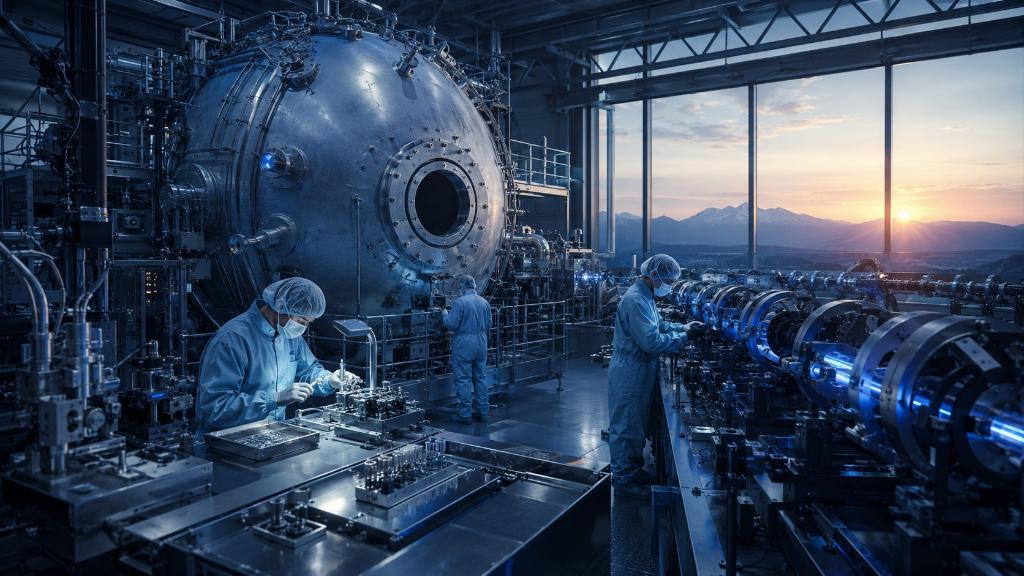
- Inertia Enterprises says it has cut formation of the crystalline fuel layer to about 30 minutes and preparation of a complete target to two or three hours.
- Those figures were provided by the company to TechCrunch and are not yet supported by a peer-reviewed publication or independent reproduction.
- A future plant would target ten fuel pellets per second, or 864,000 per day, while DOE still lists Inertia's injection and mass-manufacturing facilities as planned.
- NIF has achieved ignition eleven times, but no inertial-fusion power plant has yet demonstrated industrial repetition, tritium self-sufficiency and positive net electrical output together.
The latest advance claimed by Inertia Enterprises is not another fusion-yield record. It concerns a much more industrial problem: manufacturing fuel fast enough to supply a power plant. On August 20, 2026, the startup told TechCrunch that it had reduced formation of the crystalline deuterium-tritium layer inside an inertial-fusion target to about 30 minutes. A complete target, it says, can be prepared in two to three hours.
The contrast with experimental processes at the National Ignition Facility is significant. Lawrence Livermore National Laboratory says current ignition targets can take months to manufacture and that, for some target designs, formation of the highly uniform cryogenic fuel layer can itself take up to a week.
The announcement should nevertheless be separated from independent validation. The 30-minute and two-to-three-hour figures currently come from Inertia through an exclusive demonstration provided to TechCrunch. At the time of publication, Nezna found no peer-reviewed paper detailing the process and no independent reproduction confirming those times. The claimed result therefore remains to be confirmed outside the Inertia-NIF partnership.
864,000 targets per day
Inertial-confinement fusion works in pulses. At NIF, a small capsule containing deuterium and tritium sits inside a cylinder known as a hohlraum. NIF's 192 laser beams heat its walls, producing X-rays that compress the capsule until fusion conditions are reached.
Its geometry must be extremely uniform. Surface imperfections, an asymmetric fuel layer or perturbations associated with filling can degrade the implosion. That degree of precision is manageable in a laboratory where each shot is prepared individually; it becomes much harder in a factory.
Inertia is targeting roughly 4.5 mm pellets, ten shots per second and manufacturing costs below one dollar per unit. At that rate, one plant would consume 864,000 targets every day. LLNL similarly discusses inertial-fusion concepts requiring as many as roughly one million units per day.
The economics quickly become sensitive to unit cost. At 10 Hz in continuous operation, every 10 cents per target corresponds to roughly $31.5 million per year. This is not a forecast of a plant's operating cost; it illustrates why a consumable produced nearly one million times per day can materially affect overall economics.
LLNL is exploring technologies including 3D printing and wetted-foam capsules to simplify slow manufacturing steps. The objective is no longer simply to make an exceptional experimental object, but a consumable precise enough for automated production at acceptable cost and defect rates.
Inertia's bet: shift some precision toward the laser
Inertia is not only trying to accelerate manufacturing. TechCrunch reports that the company plans a laser system about four times more powerful than the one currently used at NIF. Its disclosed architecture includes around 1,000 laser modules rated at 10 kJ and designed to operate at 10 Hz.
The company hopes the additional energy margin will allow it to tolerate less-perfect pellets. This is an engineering trade-off: relax some specifications on a mass-produced consumable in exchange for a more powerful and repetitive laser system.
The economics of that trade-off remain unproven. More laser modules shift part of the cost toward equipment, electricity and maintenance. The relevant metric will therefore not be pellet price alone but the performance and cost of the complete plant.

Eleven ignitions still do not make a power plant
The scientific foundation has nevertheless strengthened. LLNL says NIF had achieved ignition eleven times by June 20, 2026. Its record remains the April 7, 2025 shot: 8.6 MJ of fusion energy, with a reported uncertainty of ±0.45 MJ, from 2.08 MJ of laser light delivered to the target, corresponding to a target gain of 4.13. The June 20, 2026 shot produced 7.9 MJ with a gain of about 3.8.
Those results show that ignition is no longer a one-off event. They do not mean NIF generates net electricity. Target gain compares fusion output with laser energy reaching the capsule; it excludes much of the electrical energy required to generate the pulse and operate the facility.
A power station will have to offset those losses, operate its auxiliaries and still export surplus electricity. NIF was not designed for that objective: its missions include high-energy-density physics and U.S. nuclear stockpile stewardship.
DOE still lists scale-up infrastructure as planned
The Department of Energy's Fusion Science and Technology Roadmap, published in June 2026, provides a useful counterweight to Inertia's commercial objectives. It lists Thunderstruck, a facility intended for target injection, tracking and engagement testing, as privately funded and « planned » in the near term. Thunderbolt, a prototype mass-manufacturing production line, is also « planned », on a mid-term horizon.
That classification clearly locates the project: the facilities specifically intended to demonstrate industrial repetition are not yet operating at their target capability. Accelerating one preparation step is therefore distinct from demonstrating a 10 Hz production chain.
Japan has tested 10 Hz on one subsystem
Hamamatsu Photonics and EX-Fusion demonstrated another part of the problem in 2025. The Japanese partners announced that they had continuously irradiated simulated targets for one hour using a pulsed laser operating at 10 Hz, delivering 10 joules per pulse while tracking the targets.
The experiment shows that an irradiation and tracking system can run repetitively for tens of thousands of cycles. It is not a fusion power demonstration: the irradiated objects were simulants, and 10 J per pulse is far below the energy levels associated with ignition experiments.
It mainly confirms that ignition and reliable repetition are separate engineering problems.
China illustrates another path toward industrialization
In China, the most visible programs currently focus more heavily on magnetic confinement. Xinhua reports that the BEST tokamak in Hefei is targeting, among other goals, net fusion gain and an electricity-generation demonstration around 2030. A direct technical comparison with Inertia would be misleading because the architectures and operating constraints are fundamentally different.
The industrial parallel remains useful: Chinese programs also emphasize the transition from scientific records toward integrated equipment and supply chains. BEST's dates remain program targets. As China's official state news agency, Xinhua naturally emphasizes national achievements and ambitions, so prospective schedules should be distinguished from measured results.
Tritium remains a separate bottleneck
Faster target preparation could reduce the amount of tritium tied up between filling and use, but it does not solve supply. The International Atomic Energy Agency notes that tritium has a half-life of about twelve years, is not naturally abundant and will require efficient breeding, extraction and recirculation in future deuterium-tritium plants.
Among its development metrics, the IAEA identifies a tritium breeding ratio above one, efficient recirculation and high-repetition-rate operation for inertial-fusion systems while maintaining acceptable component lifetimes. It also identifies simultaneous demonstration of fuel sufficiency and net energy gain in one fusion plant as an essential milestone. Faster manufacturing therefore does not demonstrate a closed tritium cycle or long-term chamber durability.
Commercial and scientific interests overlap
Inertia raised $450 million in February 2026 and directly develops the technology whose progress it is reporting. TechCrunch also reports that the company licenses nearly 200 patents originating from LLNL. Its co-founder and chief scientist Annie Kritcher played a central role in NIF's ignition work and retains a position at LLNL. That continuity provides unusual expertise, but it also means company statements and some institutional evidence from the laboratory are not fully independent validations.
This does not undermine NIF's separately published fusion yields and uncertainties. Claims about Inertia's manufacturing times, future costs and scale-up, however, should remain identified as company data until independently reproduced.
The next test is throughput
A 10 Hz factory will need parallel or continuous shell production, cryogenic filling, quality control and injection. The decisive metric therefore becomes compliant targets produced per hour, together with defect rate and actual unit cost.
The industrial question is ultimately one of system optimization. A power plant does not need the most perfect target technology can manufacture; it needs a target precise, repeatable and inexpensive enough for the whole plant to perform. Inertia is betting that greater laser margin will allow some target tolerances to be relaxed.
The decisive proof will need to be integrated: continuous target production at documented cost, high-rate injection and tracking, repeatable fusion performance, tritium recycling and sustained operation long enough to establish credible energy and economic balances. No organization has yet demonstrated that complete chain.
FAQ
Is Inertia already manufacturing ten fusion targets per second?
No. The company says it can prepare a complete target in two to three hours and plans for ten shots per second in a future power plant. DOE still lists its injection-test and mass-manufacturing facilities as planned.
Does NIF already produce more energy than it consumes?
Not at the facility level. Its record is 8.6 MJ of fusion energy from 2.08 MJ of laser light delivered to the target, a target gain of 4.13. That calculation does not include all electricity consumed by the laser system and site.
Why is the jump from a few hours to 10 Hz so difficult?
Because the time required for one target is not the throughput of a factory. Many targets must be manufactured in parallel, inspected and injected with consistent quality and reliability.
- TechCrunch — Inertia Enterprises finds a way to make its fusion fuel fast, August 20, 2026
- TechCrunch — Inertia raises $450 million and details its laser architecture, February 11, 2026
- Lawrence Livermore National Laboratory — Official history of NIF's eleven ignition experiments and measured yields
- Lawrence Livermore National Laboratory — Target manufacturing, 3D printing and future power-plant requirements
- U.S. Department of Energy — Fusion Science and Technology Roadmap, June 2026
- Hamamatsu Photonics / EX-Fusion — One-hour continuous simulated-target irradiation at 10 Hz
- Xinhua — BEST and China's transition from fusion research to engineering, January 16, 2026
- IAEA — Fusion Key Elements: repetition rate, tritium cycle, net energy and commercialization milestones