
 ezna-io
Military AI: Pentagon tests private cloud reliance
6 months ago

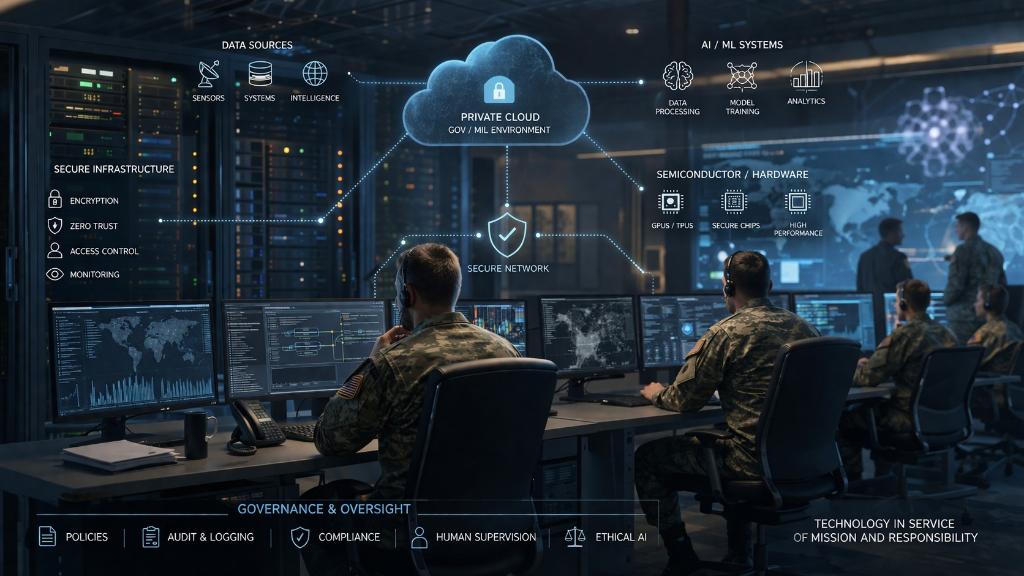
- The Pentagon confirmed agreements with eight AI vendors for classified networks.
- The official list includes SpaceX, OpenAI, Google, Nvidia, Reflection, Microsoft, AWS and Oracle.
- Reuters says GenAI.mil was used by more than 1.3 million personnel in five months, without specifying real usage intensity.
- The Anthropic dispute shows that usage limits remain a central issue.
The U.S. Department of Defense announced, on May 1, 2026, agreements with eight artificial intelligence companies: SpaceX, OpenAI, Google, Nvidia, Reflection, Microsoft, Amazon Web Services and Oracle. According to the official release on defense.gov, these vendors may deploy advanced AI capabilities on classified department networks for operational uses described as lawful.
The announcement does not prove an immediate transformation of military operations. It points instead to a clear direction: integrating AI tools into secure environments where analysis, synthesis and data management already matter. The issue is less a single model than the combination of AI models, secure cloud, compute capacity and control procedures.
An official count of eight vendors, after initial reports of seven
Reuters, AP, The Guardian, Al Jazeera and The Verge initially reported seven companies. The institutional source now lists eight vendors, with Oracle included in the official list. This discrepancy appears linked to the rapid evolution of the announcement. This article therefore uses the figure of eight, while noting that several early reports still used seven.
Reuters also reports that GenAI.mil, the Pentagon’s main AI platform, was used by more than 1.3 million Defense Department personnel after five months of operation. That figure should be read carefully. It indicates broad diffusion, but does not specify whether it refers to regular active users, occasional access, tests, administrative use or training sessions. It does not measure operational effectiveness either.
What these agreements may change
The use cases described by sources include intelligence analysis, document synthesis, logistics, predictive maintenance, cybersecurity, planning and support for target identification. AP specifically mentions maintenance, logistics and target identification. These applications do not automatically imply lethal autonomy, but they move AI closer to sensitive decision chains.
The core issue is technical and organizational. Nvidia contributes a critical compute layer; Microsoft, AWS, Google and Oracle operate cloud environments already used in institutional contexts; OpenAI, Reflection and other vendors provide models capable of processing text, code, data and complex instructions. The challenge is therefore not only the model, but its integration into a secure and controlled system.
Deploying AI on classified networks: constraint, not slogan
A classified military network is not equivalent to the public web. Deploying a model there requires secure inference, access control, data separation, logging, latency management, response auditing and resistance to adversarial manipulation. It also requires distinguishing model training, which is expensive and often performed in specialized infrastructure, from inference, meaning the operational use of a model to produce responses.
Depending on the case, AI may run in cloud environments, in strongly compartmentalized systems or closer to operational units. Each option involves trade-offs: compute power, security, response time, cost, maintenance and supervision. These constraints explain why military AI integration remains gradual, even when public announcements sound fast.
Anthropic, or the question of contractual limits
Anthropic’s absence remains one of the most significant elements. Reuters, AP and The Verge report that the dispute concerns usage terms, especially domestic mass surveillance and autonomous weapons. The Pentagon labeled Anthropic a supply-chain risk, a decision the company is challenging.
The debate is therefore not only technical. It is about governance: who sets usage limits, who verifies them and who carries responsibility in case of error? In a classified environment, this question is difficult to audit publicly because detailed operational clauses are not fully accessible.

Contrasting international coverage
Reuters emphasizes vendor lists, GenAI.mil usage, Anthropic’s exclusion and faster integrations. AP focuses more on operational uses and human-oversight safeguards. The Guardian highlights concerns around autonomous weapons and defense AI budgets. Al Jazeera notes the Pentagon’s language around an AI-oriented fighting force. SCMP and Xinhua, from Asian perspectives, report the announcement with emphasis on vendors, classified networks and U.S. strategic positioning.
These treatments are not identical, but they converge on one point: the announcement is not a simple software purchase. It sits within a wider competition over military capability, technological sovereignty, industrial dependence and control of digital infrastructure.
China, semiconductors and the compute race
Nvidia’s presence is a reminder that military AI depends on hardware resources. Models must be trained, adapted, executed and supervised on compute infrastructure. GPUs, advanced memory, data centers and supply chains therefore become strategic factors. In the context of U.S. restrictions on advanced semiconductors bound for China, the competition is not only about algorithms, but also about access to compute.
Reflection is presented by several sources as a young company that could respond to the rise of Chinese models. That reading remains partly interpretive because each vendor’s exact role is not public. It nevertheless fits the visible logic of the announcement: multiplying suppliers to avoid excessive dependence on a single actor, model or cloud.
Useful promises, concrete limits
The expected benefits are credible in bounded tasks: report synthesis, document comparison, anomaly detection, maintenance, cybersecurity, planning support and reduction of information overload. These uses respond to real human needs when operators face too much data moving too quickly.
The limits remain significant. Models generate probabilistic responses. They can be useful without being reliable in every context. They depend on available data, access policies, training choices, safety settings and validation procedures. In a military setting, error can influence a decision, delay an alert or reinforce a wrong interpretation.
The most credible short-term use is therefore supervised assistance, not autonomy. Applications related to surveillance, targeting and lethal systems require a much higher level of evidence, traceability and control than administrative or analytical uses.
Source bias and conflicts of interest
The identifiable conflicts of interest are mainly structural. The companies involved have a direct commercial incentive to open classified networks to their models, cloud infrastructure and hardware. The Pentagon has an institutional incentive to present the agreements as useful, controlled and lawful modernization. Some reports also rely on unnamed officials or sources close to the matter to describe internal tensions, which requires separating confirmed facts from interpretation.
The official source confirms the vendor list, but is not sufficient to assess risk. General news outlets provide political and ethical context; defense-specialist publications add operational detail; Asian sources place the announcement in a broader technological competition. No public document reviewed provides the full clauses of each agreement.
What remains uncertain
The exact role of each vendor is not fully public. Based on available sources, it is not possible to confirm which models will be used for which missions, which datasets they will access, what shutdown mechanisms will be required or what level of human supervision will apply to each use case.
The 1.3 million figure should also remain qualified. It does not specify usage frequency, task type or measurable outcome. Finally, the Anthropic dispute remains open: the government’s final position and the industrial consequences may still evolve.
Conclusion: controlled efficiency or shifted dependency?
The May 1, 2026 announcement does not demonstrate that AI immediately changes the military balance. It confirms instead that the Pentagon now treats AI as strategic infrastructure, dependent on cloud, semiconductors, models and human supervision.
The main question is not whether these tools are powerful, but whether they make decisions more robust and verifiable. The most useful innovation will not be the one that replaces human judgment, but the one that helps humans exercise it with more precision, restraint and responsibility.
FAQ
Will the Pentagon use AI for autonomous weapons?
The reviewed sources mention safeguards and human oversight, but the exact clauses are not public. The main risk concerns the gradual integration of AI into targeting and decision chains.
Why is Anthropic absent from the list?
According to Reuters, AP and The Verge, the dispute concerns usage terms, especially domestic mass surveillance and autonomous weapons. The Pentagon later labeled Anthropic a supply-chain risk, a decision the company is challenging.
What is the most credible short-term impact?
The most credible impact concerns document analysis, cybersecurity, logistics, predictive maintenance and information synthesis. Uses related to targeting or lethal autonomy remain the most controversial.
- U.S. Department of Defense – Classified Networks AI Agreements
- Reuters – Pentagon reaches agreements with top AI companies, but not Anthropic
- AP – U.S. military reaches deals with 7 tech companies to use their AI on classified systems
- The Verge – Pentagon strikes classified AI deals with OpenAI, Google and Nvidia
- The Verge – Google and Pentagon reportedly agree on deal for lawful use of AI
- The Guardian – Pentagon inks deals with seven AI companies for classified military work
- Al Jazeera – Pentagon announces deal with seven AI companies for classified systems
- South China Morning Post – U.S. Pentagon signs AI deals with Google, Nvidia and SpaceX
- Xinhua – Pentagon announces deals with AI companies for classified networks
- Defense One – AI firms cleared to provide tools for classified Pentagon networks
- Breaking Defense – Pentagon clears tech firms to deploy AI on classified networks