
 ezna-io
Le Bristol Paris fire: luxury, safety and a sensitive zone
By Hugo Delorme
7 months ago

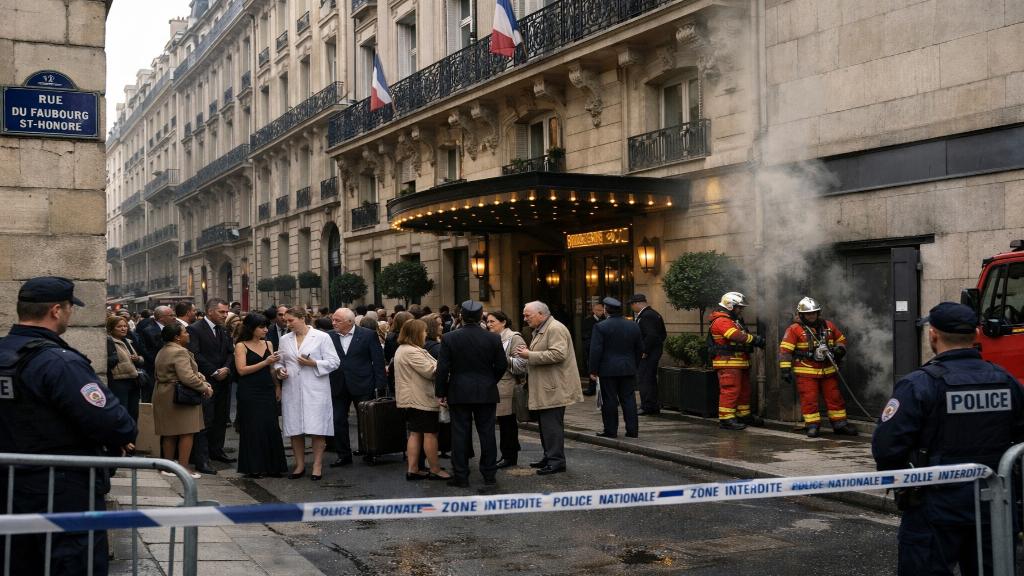
- A fire broke out on March 25, 2026 at Le Bristol, a Paris luxury hotel near the Elysee Palace.
- About 400 people were evacuated and the human toll remains limited, with light or moderate injuries depending on the source.
- Reports broadly agree the blaze started in the basement or kitchen area, but the exact cause has not been established.
- The incident highlights the operational fragility of prestige venues located inside highly sensitive political and diplomatic zones.
French news in the past few hours has briefly shifted toward Rue du Faubourg Saint-Honore. On Wednesday, March 25, 2026, a fire broke out at Le Bristol, one of Paris's best-known palace hotels, only a short walk from the Elysee Palace. The event did not turn into a major tragedy, which is of course the first point that matters. But it was serious enough to turn part of central Paris into a controlled emergency zone, with evacuations, cordons and disrupted circulation.
The basic facts are solid and cross-checked. Reuters reports that around 400 people were evacuated and says the fire started in the basement kitchen at about 10:20 GMT. TF1 Info says the blaze broke out at basement level and highlights the deployment of around one hundred firefighters. Le Parisien points to the kitchens of the 'Faubourg 114' restaurant in the lower levels of the building. Anadolu carries the same broad account while stressing that the exact circumstances remain to be determined. Xinhua, meanwhile, relays a toll of three moderate injuries based on local media. On the hard core of the story, the gap is small: fire, large evacuation, rapid intervention, secured perimeter, no catastrophic casualty count.
The differences begin in the details, which is exactly where this story becomes more revealing. Some sources mention one injured person, others two, and others three. The wording around the injuries also changes, depending on the publication time and each newsroom's caution. In the first hours of a developing incident, that is normal. It should not be read as a deep contradiction but as the routine effect of rolling updates. At this stage, the most accurate wording is that the blaze caused a limited number of injuries, described as light or moderate in interim reports, and no deaths are reported in the sources reviewed.
What stands out beyond the fire itself is the location. Le Bristol is not just another hotel. It is a prestige venue embedded in a street where political power, diplomatic representation, luxury retail and permanent security routines overlap. In a city like Paris, some incidents change scale not because of their physical size but because of their address. A kitchen fire in an ordinary district stays local news. The same kind of fire within sight of one of the French state's nerve centers becomes a sensitive urban management episode.
Seen from abroad, the sequence is familiar in a way that goes beyond France. London, Rome and Washington all know this pattern. Sites built to project calm, continuity and control often depend on hidden layers of logistics, maintenance, fire protection, access filtering and public coordination. When one of those layers briefly fails, the real city appears behind the polished facade. Suddenly there is no palace narrative, only a complex building with kitchens, service corridors, basements, ducts, procedures and possible blind spots.
The way different regions covered the story also says something about their media habits. Reuters uses the classic international wire style: essential facts, precise timing, strategic location, restrained casualty language. TF1 Info keeps the rolling-news tone, emphasizing the emergency response and the operational state of the fire at publication time. Le Parisien adds local texture, with more detail on the street, the neighborhood environment and the hotel itself. Xinhua condenses the story into a short public-order driven summary. Anadolu, the Turkish public news agency, stays close to an official and careful framing with fewer side details. None of these accounts overturns the main facts, but each reflects its editorial model: global wire, TV news outlet, local daily, state-backed agency, international public agency.
So the visible bias here is mostly structural rather than ideological. Xinhua and Anadolu, both linked to state media systems, privilege an official and stable narrative frame. Reuters, as a global wire service, seeks a version of the event that travels well across markets. TF1 privileges immediacy. Le Parisien privileges local proximity. In this specific case, no clear conflict of interest appears in the reviewed reporting, but the ranking of what matters most plainly changes according to audience and newsroom culture.
Another important point is that the exact cause of the fire is not publicly established at the time of writing. Several sources converge on the kitchens or the basement area. Some reports already mention technical checks and a future investigation. It would therefore be excessive to go further. The honest formulation is that the fire appears to have started in that operational zone of the building, without any official conclusion yet on the cause. This matters because large hotels combine heavy technical constraints: intensive kitchens, dense electrical systems, ventilation, uninterrupted supply flows, constant staff circulation and the expectation of near-continuous service.
Economically and symbolically, such a fire touches a very specific part of France's brand: luxury hospitality. This is not only about high-end tourism. Such venues are also showcases for the country, reception sites and sometimes temporary bases for delegations, executives, diplomats or political figures. When a palace hotel is evacuated in such a district, the image projected abroad is not just that of a local incident. It also becomes a test of urban reliability. The good news so far is that the emergency response appears to have been rapid and structured, which is exactly the kind of signal a capital city wants to send in this sort of moment.

The episode also says something about France in 2026: a country where prestige venues coexist with a highly developed risk-management culture, though never fully invisible. In many major cities, luxury depends on making operations disappear from view. A fire does the opposite. Kitchens become the subject, basements become the headline, traffic management becomes the issue. It is mundane and almost philosophical at the same time: top-tier hospitality often depends on the smooth functioning of the most ordinary infrastructures.
The contrast with the municipal election cycle, which dominated the French agenda until last weekend, is telling. On Sunday, the country was watching town halls and political balances. By Wednesday, a non-ideological hard-news story reminded people that a capital is also judged by its capacity to handle the unexpected without panic and without excessive opacity. It is less theatrical than a party confrontation, but more concrete on the ground. Who evacuates, who secures, who informs, who reopens the street, who determines the cause: that chain of responsibility is immediately legible to the public.
For now, the story remains in a waiting zone. Some sources say the blaze was brought under control, others say it was extinguished, but the precise material consequences for the hotel are not yet fully detailed. Publicly stabilized information is still missing on the exact extent of the damage, the operational impact on the property and the full timeline for a return to normal. According to reporting that is not yet exhaustively cross-checked across all outlets, technical sampling may already be under way to document the origin of the fire. That caution is not style. It is method.
In the end, the story is not just 'a fire in a palace hotel'. It is a small but revealing snapshot of how Paris works. It brings together luxury, civil security, the geography of power and crisis communication. It is neither a state affair nor a society-page anecdote. It is a very French urban incident in its setting, but a very global one in its implications. In every attractive capital, the real question is not whether an incident can happen. The real question is how fast and how credibly the system responds.
FAQ
What is confirmed at this stage?
A fire broke out on March 25, 2026 at Le Bristol in Paris, around 400 people were evacuated and the human toll remains limited according to available reporting.
Why does this matter beyond a routine incident?
Because it affected a luxury hotel located inside a zone where political power, diplomatic presence and Paris's international image overlap.
What remains uncertain?
The exact cause of the fire, the final consolidated injury count and the full extent of material damage have not yet been publicly established.
Sources:
Further reading on Nezna: