
 ezna-io
Europe Wildfires: Delayed Aircraft, Strained Response
By Zoé Marquand
a month ago

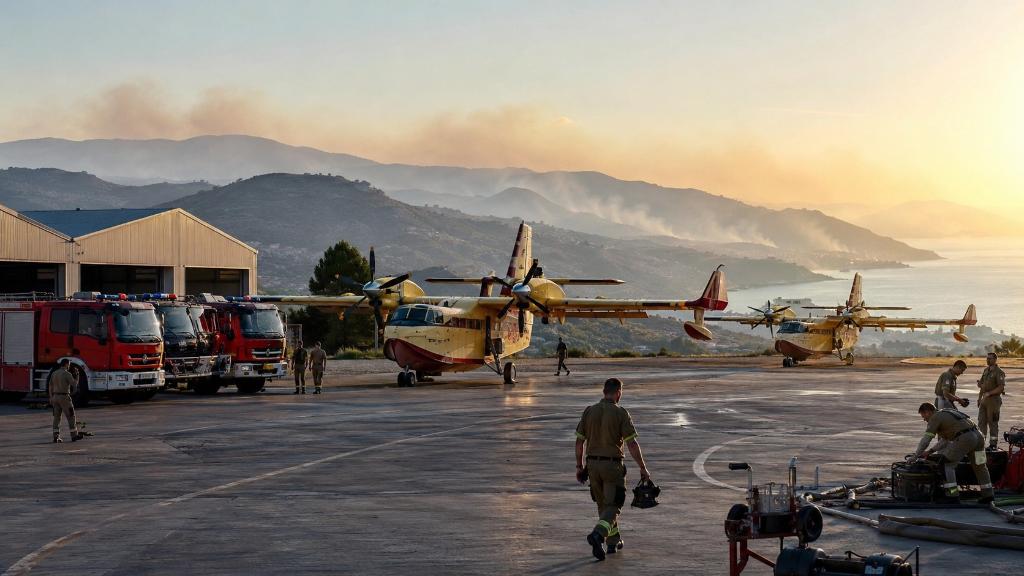
- France and Spain received substantial reinforcements coordinated through the European mechanism: 13 aircraft, four helicopters, 134 responders and 41 vehicles.
- A €52.8 million budget reduction in 2024 contributed to delaying the purchase of two French firefighting aircraft, eventually ordered in June 2026 under a programme worth close to €200 million.
- In Spain, sanctions and the suspension of the Kamov Ka-32 certificate reduced access to helicopters that are difficult to replace in some operating conditions.
- French MPs have reported possible AdBlue-related risks for fire engines, without national data showing how frequently they occur.
Major wildfires often produce a simple narrative: temperatures rise, vegetation dries, flames advance and aircraft arrive. Operational reality also depends on budgets approved years earlier, industrial schedules, maintenance chains, spare parts, technical regulations and solidarity agreements that must work when several countries request the same resources.
In late July 2026, that system is undergoing a severe test. France and Spain are simultaneously fighting major fires, while the danger extends towards Italy, Greece and central Europe. More than 2,200 firefighters and around 20 aircraft have been mobilised in Gironde and Landes. In Spain, fires have triggered mass evacuations. Two firefighters died in Crete.
France: two firefighting aircraft postponed after a budget cut
After the 2022 fires, Emmanuel Macron announced an expansion of a French fleet then composed of 12 CL-415 amphibious firefighting aircraft. The current official target is 16 aircraft by 2032: two DHC-515s co-funded through rescEU, the European civil-protection reserve, and two directly funded by France.
A decree dated 21 February 2024 removed €52.8 million from France’s civil-security budget programme. An Interior Ministry response and a parliamentary amendment indicate that the reduction affected planned DHC-515 purchases.
France did not terminate an existing contract. It did not proceed in 2024 with the planned national order for two aircraft. They were eventually ordered on 4 June 2026 under a programme worth close to €200 million.
France placed the national order two years after the 2024 budget decision, in an industry where production slots are scarce. The DHC-515 line had been closed for more than a decade before its relaunch. The two rescEU aircraft assigned to France are now expected in April and November 2028. The aircraft funded directly by France are expected in the early 2030s.
According to Le Monde and the parliamentary documents it cites, the 12 current aircraft have an average age of around 30 years. Maintenance reduces operational margins, even if it does not make every aircraft unavailable at the same time. Availability reportedly improved in 2025 after maintenance was reorganised and spare parts purchased.
rescEU: a strategic reserve under pressure
European solidarity provided significant reinforcements in July 2026. France received seven planes and four helicopters from countries including Croatia, Czechia, Germany, Portugal, Slovakia, Sweden and Türkiye. Spain received six aircraft from Greece, Italy and Türkiye, as well as 134 Portuguese responders and 41 vehicles.
These reinforcements totalled 13 aircraft of different types and deployment durations. They did not all come from rescEU: the European mechanism first coordinates national offers and then mobilises common capacities when those offers are insufficient.
The future permanent capacity is expected to include 12 DHC-515s financed by the Union with €600 million and distributed among France, Spain, Portugal, Italy, Greece and Croatia. The Commission initially expected the first delivery in late 2027. France now expects its two rescEU aircraft in 2028, highlighting the vulnerability of the industrial timetable.

The aircraft will be hosted and operated by member states while forming part of the rescEU strategic reserve. European rules require a rapid-response aircraft to be able to depart within three hours after an offer is accepted and to operate within a 2,000-kilometre radius in less than 24 hours.
Brussels cannot mechanically remove an aircraft from a country that is itself threatened. The host state declares which assets it can make available, while the European coordination centre organises offers. The potential tension therefore concerns political arbitration rather than automatic seizure: will a government offer an aircraft when its own territory remains exposed?
Spain: Kamovs grounded and difficult to replace
Spain has long operated Russian-designed Kamov Ka-32 heavy helicopters. These aircraft can carry approximately 4,500 to 5,000 litres of water and have been used for operations in difficult terrain.
After Russia’s invasion of Ukraine, the European Union Aviation Safety Agency suspended the Ka-32’s European type certificate. Sanctions also complicated access to spare parts, maintenance by Russian manufacturers and certification of technical work.
A Spanish procurement document concerning the 2024 campaign indicates that Kamovs were removed from a contract initially covering 50 aircraft, reducing it to 47. The Spanish press, including El País, also reports that eight contracted Ka-32s are grounded, although no consolidated official operational inventory dated July 2026 confirms the total.
It is established that sanctions and certification suspension reduced their availability. According to material reported by El País, replacement aircraft do not always offer the same payload, particularly when heat, altitude or terrain degrade performance. There is still no evidence that Kamovs would, by themselves, have controlled the 2026 fires.
The resulting reduction in availability for European emergency services is documented; the tangible effect of the grounding on Russia is much less clear. The reviewed sources do not show that a tightly controlled exemption for civilian spare parts and maintenance received a detailed public assessment.
AdBlue: a reported risk that remains poorly quantified
Two written questions published in the French National Assembly on 14 July 2026 warn about AdBlue systems in emergency vehicles. Heavy vehicles complying with Euro VI standards use selective catalytic reduction to limit nitrogen-oxide emissions. When the tank is empty or a sensor detects a fault, onboard software may restrict power, trigger a degraded mode or prevent certain restarts.
The parliamentary questions refer to warnings from departmental fire-service officials, including in Gironde. They mention vehicles potentially having to leave an operation temporarily for refilling, diagnosis or repairs.
They do not, however, establish the frequency or operational impact of such incidents. The most substantiated concern is not ordinary AdBlue consumption, which is generally slower than diesel consumption, but the possibility that an emissions-control system or sensor may electronically restrict a vehicle that remains mechanically capable of continuing its mission.
The MPs call for an emergency exemption or temporary traceable mode to be considered, followed by restoration of normal settings after the operation.
Brazil: when responsibility centres on one leader
The way responsibility is assigned also varies across countries and leaders. In 2019, international coverage often linked Amazon fires to Jair Bolsonaro. That framing relied on evidence: conflict with the National Institute for Space Research, weakened environmental enforcement, rising deforestation and rhetoric favouring exploitation of the Amazon. At times, it reduced a complex chain of causes to a story centred on one leader.
Under Luiz Inácio Lula da Silva, however, fires reached exceptional levels in 2024. Reuters recorded 11,434 Amazon hotspots in July, the highest for that month since 2005. El País criticised insufficient preparation by the federal government and Brazilian states.
It would therefore be inaccurate to describe a media silence under Lula. The cited reports nevertheless devote more attention to drought, criminal fires and shortcomings by federal and local authorities than to the president’s personal responsibility.
A vulnerability built through accumulation
Delayed purchases, a limited common reserve, grounded aircraft and technical rules not fully adapted to emergency operations collectively reduce operational margins.
Each choice has its own rationale. Together, however, they weaken the response when several regions burn simultaneously.
Europe recognises the growing risk, but still takes years to manufacture the required aircraft. It pools resources as disasters become synchronised, while some aviation sanctions and emissions rules were not designed around the specific constraints of civil-protection missions.
Wildfires have an administrative peculiarity: within hours, they force policies designed in separate departments to confront the same emergency.
FAQ
Why describe the French decision as a postponement?
France did not terminate a signed contract. The removal of €52.8 million in funding in 2024 contributed to delaying the commitment of two nationally funded aircraft, eventually ordered on 4 June 2026.
Do rescEU aircraft remain available to their host countries?
They are stationed and operated by member states but form part of the European reserve. The host country declares which assets it can make available according to its own operational situation.
What AdBlue problem has been reported?
Low fluid levels or an emissions-system fault may restrict power or prevent certain restarts. Fire-service officials have reported the risk, but no national statistics yet measure how often it occurs.
Sources
- Associated Press — Southern European wildfires, 29 July 2026
- Reuters — Europe must adapt its wildfire response, 29 July 2026
- European Commission — Assistance deployed to France and Spain, 27 July 2026
- European Commission — European wildfire-response resources for 2026
- European Commission — Production of 12 permanent rescEU aircraft
- EUR-Lex — Deployment requirements for rescEU firefighting aircraft
- French Interior Ministry — Order for two nationally funded firefighting aircraft, 5 June 2026
- French Senate — Cancellation of civil-security funding
- French National Assembly — Cancelled funding and delayed DHC-515 purchases
- Le Monde — Age and availability of the French fleet, 6 August 2025
- EASA — Suspension of the Kamov Ka-32A11BC European certificate
- El País — Kamovs and Spanish aerial resources, 14 August 2025
- French National Assembly — AdBlue and wildfire-response vehicles, 14 July 2026
- Reuters — July 2024 Amazon fires reach their highest level since 2005
- El País — Preparation by Lula’s government and Brazilian states, 20 September 2024