
 ezna-io
India liquidity deficit tightens credit across the economy
By Léo Piquemal
7 months ago

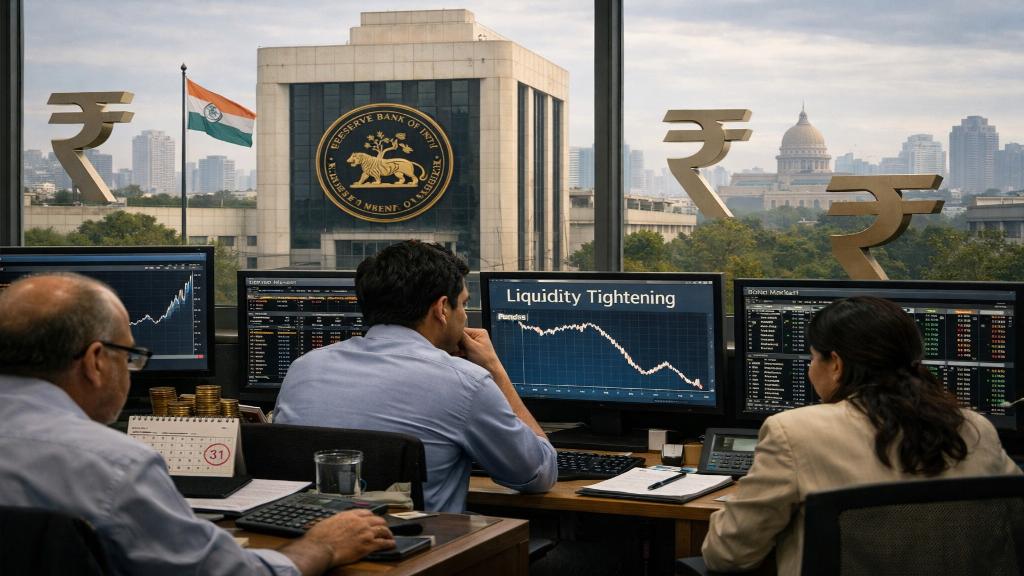
- India's banking system moved into a liquidity deficit on March 23, 2026, at around 659 billion rupees.
- Year-end tax outflows and RBI dollar sales reduced the amount of rupee liquidity available to banks.
- Overnight rates moved above the policy rate, increasing banks' short-term funding costs.
- The shock looks technical and potentially temporary, but it can still pass through quickly to credit conditions.
On March 23, 2026, India's banking system slipped into its first significant liquidity deficit of the year. Reuters reported a shortfall of about 659 billion rupees after several weeks of sizeable surplus conditions between early February and mid-March. At first sight this may look like a technical money-market story, but its implications are much wider. When banks have less cash available inside the system, they refinance at a higher cost and tend to lend on tougher terms to companies and households.
The immediate trigger is relatively clear. Reuters, Outlook Business and The Economic Times broadly agree on the two main drivers: large fiscal year-end tax outflows, especially related to GST and advance corporate tax payments, and Reserve Bank of India interventions in the foreign-exchange market to support the rupee. When the central bank sells dollars and absorbs rupees, domestic liquidity tightens. The result is a banking system with less short-term cash available.
That mechanism has already shown up in market pricing. Reuters said overnight borrowing rates were trading about 10 basis points above the RBI policy rate, at 5.35 percent. In plain terms, the price of the shortest money moved higher. This is not yet a full-blown funding crisis, but it is a meaningful signal that reserves have become scarcer and that banks are paying more to meet their day-to-day liquidity needs.
The story also needs to be placed in a broader funding context. Three days earlier, Reuters reported that Indian lenders were paying the steepest premium in six years for short-term funds through certificates of deposit, with outstanding CDs at a record 6.64 trillion rupees at the end of February. That matters because it suggests the March 23 liquidity squeeze did not emerge in isolation. It arrived on top of a pre-existing imbalance in which credit growth has been running ahead of deposit growth, forcing banks to rely more heavily on expensive wholesale funding.
For banks, the immediate challenge is liability management. A lender financing medium-term and long-term assets with increasingly costly short-term resources will either accept weaker margins or pass the cost on to customers. This is where the issue becomes macroeconomic. If interbank refinancing, certificates of deposit and other market-based funding become more expensive, loans to SMEs, mortgages, working-capital lines and some consumer credit products can also become more expensive or harder to obtain.
Small and mid-sized firms are especially exposed. In India, a large part of the productive economy still depends heavily on bank credit to finance inventories, payroll, working capital and routine investment. A liquidity squeeze does not automatically cause a sudden collapse in lending, but it can gradually tighten terms through shorter maturities, wider spreads, stricter collateral requirements and greater selectivity. For a smaller manufacturer, trader or construction-related business, even a limited rise in borrowing costs can quickly affect cash flow and hiring decisions.
Households also feel the consequences. India has seen a strong expansion in access to credit over recent years, including mortgages, vehicle finance and personal loans. If banks start defending margins in a costlier funding environment, the transmission may come through higher lending rates, tighter underwriting or lower appetite for weaker borrower profiles. In an economy where domestic demand is a major engine of growth, even a moderate tightening in credit conditions can eventually weigh on consumption.
Different sources frame the same episode from slightly different angles. Reuters focuses on the facts of the deficit, overnight-rate moves, RBI actions and economists' expectations. Outlook Business gives more weight to the year-end 'cash crunch' narrative tied to the fiscal calendar. The Economic Times highlights the possibility that conditions may improve before month-end. Another Reuters report published on March 23 adds an important external layer: India's foreign-exchange reserves remain substantial, but the RBI has been using them to cushion rupee volatility after the currency weakened sharply earlier this year. That helps explain why supporting the rupee can drain domestic rupee liquidity at the same time.
This link between exchange-rate management, liquidity and credit is central to the story. The RBI faces a difficult balancing act. Selling dollars to support the rupee can help contain imported inflation and limit disorderly market moves, but it also absorbs rupees from the banking system. Injecting liquidity, by contrast, can calm money markets, yet it may complicate currency management if external pressure persists. Reuters had already noted on March 17 that demand for some RBI cash-infusion operations was muted, suggesting that the design of liquidity tools did not always perfectly match banks' preferences.
The possible fallout extends beyond the banking sector. If liquidity remains tight for several sessions or weeks, trade finance, exporter working-capital needs and investment lending can all slow down. In the short run that may appear manageable given the size and growth momentum of the Indian economy. But in a system where bank credit remains a core transmission channel, prolonged tightness eventually feeds into prices, volumes and employment. Rate-sensitive sectors such as real estate, retail distribution and parts of manufacturing therefore have good reason to watch the central bank's response closely.
At the same time, the episode should not be overstated. Several economists cited by Reuters expect conditions to improve by the end of March as government spending returns to the system and as the RBI keeps the option of additional operations open. The current deficit therefore looks more like a timing and flow shock than proof of an immediate structural deterioration in the banking system. Even so, it remains important because it reveals how sensitive Indian finance can be to tax outflows, currency management and the persistent gap between credit growth and deposit mobilisation.
One point should still be treated carefully. Some market commentary assumes that the RBI could soon expand open-market support or refine its repo operations. That is plausible, but until further official action is announced it remains an expectation rather than a confirmed fact. Likewise, the idea that the deficit will fade automatically within days is reasonable but not guaranteed if external volatility or pressure on the rupee continues.

What makes the Indian story especially compelling is that it connects an apparently abstract monetary indicator to daily economic life. A liquidity deficit is not just a number followed by bond traders. It can shape the rate at which a bank lends to a property developer, a textile exporter, a household buying a home or a company refinancing inventory. This is how a money-market disruption can become a broader issue of purchasing power, investment and activity.
As for source bias or conflicts of interest, no major conflict stands out in the selected material. Reuters and local business outlets describe the same core mechanisms. The main difference lies in framing: market-focused sources devote more attention to rate signals and investor implications, while general business coverage emphasizes the consequences for credit and the real economy.
FAQ
Why did banking liquidity suddenly tighten in India?
Because fiscal year-end tax outflows removed cash from the system while RBI foreign-exchange intervention also withdrew rupees from domestic liquidity.
What is the clearest early sign of the squeeze?
Overnight funding rates moved above the policy rate, showing that banks were paying more for immediate short-term cash.
Does this automatically mean a lasting economic slowdown?
Not necessarily. The shock appears partly technical and seasonal, but it can still temporarily tighten credit for firms and households.
Sources used for this article:
- Reuters - India bank liquidity sees first big deficit of 2026 on tax outflow, lack of RBI support
- Reuters - India forex reserves adequate to cushion against external shocks, cenbank report says
- Reuters - Indian lenders pay steepest premium for short-term funds in 6 years as borrowings hit record
- Outlook Business - Cash Crunch Hits Banks as Tax Outflows, RBI Dollar Sales Drain Liquidity
- The Economic Times - India bank liquidity sees first big deficit of 2026 on tax outflow, lack of RBI support
To continue reading on Nezna, here are published articles that can help place this story in a wider context of monetary policy, currencies and international economic choices: