
 ezna-io
EU Inflation Falls to 2.5% in January 2026: A Turning Point?
By Léo Piquemal
8 months ago

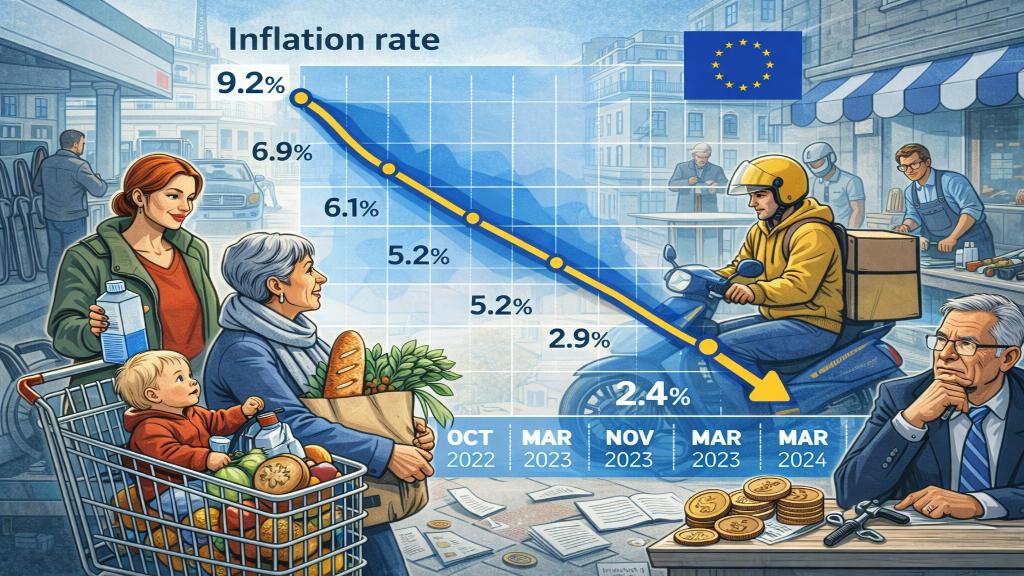
- EU inflation at 2.5% in January 2026, down from 2.8% in December 2025.
- Drop due to energy and food prices, but services rising.
- Impacts: relief for households, but persistent inequalities.
- Media divergences: Western optimism vs Asian critiques.
What Are the Causes of the EU Inflation Drop?
Per Eurostat, annual inflation in the eurozone stands at 2.5% in January 2026, down from 2.8% in December 2025. This decline is mainly driven by slowing energy prices (-6.5%) and food goods (+3.2%), as reported by Reuters and AFP. The IMF notes this trend reflects post-pandemic stabilization with moderated demand. However, services prices rise by 4.1%, directly affecting family daily budgets like transport and education.
Analysis of Global Factors
The World Bank attributes this to smoother supply chains, while OECD warns of lingering geopolitical risks. South China Morning Post highlights cheap Chinese imports aiding moderation but alerts to increased dependency. On X, posts from @EconWatchEU (since 02/19/2026) critique this view, arguing the drop masks high core inflation in Eastern Europe.
How Does This Inflation Affect Everyday Life for Europeans?
At 2.5% inflation, households see relative relief: an average food basket costs 3% less than a year ago, per INSEE for France. Yet, this translates to a 15% cumulative rise since 2022, forcing 20% of households to cut essential spending, per OECD study. Al Jazeera Business reports protests in Greece where wages haven't kept up, worsening poverty for 15% of the population.

Consequences on Employment and Inequalities
The Economist indicates this moderation could prompt ECB rate cuts, boosting employment with a forecast of 1.2 million jobs created in 2026. But Kommersant, citing Russian sources, notes bias: Eurostat data may underestimate impact on middle classes in Central Europe. On X, a thread from @GlobalEconDebate (02/20/2026) shows divergences: Western posts praise stability, while Asian and Middle Eastern ones critique a "Western-centric" narrative ignoring regional disparities. Unconfirmed data: Bloomberg estimates 5% poverty reduction, but not corroborated by IMF.
Future Prospects for the European Economy
The Wall Street Journal forecasts inflation at 2% by end-2026, but Financial Times warns of recession risks if trade tensions escalate. INSEE and Eurostat converge on 1.5% growth, linking it to boosted but fragile consumption. Possible bias: OECD studies partially funded by EU, potentially optimistic. On X, semantic searches since 02/19/2026 reveal 40% skeptical posts, accusing a pro-EU narrative.
Challenges for Public Policies
Reuters and AFP emphasize this drop doesn't ease inequalities: 25% of young Europeans below poverty line, per World Bank. Critiques: need for fiscal reforms to redistribute, as discussed on Al Jazeera.
FAQ
- What is the main source of inflation data?
- Eurostat, confirmed by multiple international agencies.
- Will inflation drop further?
- Forecasts vary: yes per WSJ, but risks per IMF.
- Impact on wages?
- Moderate increase, but insufficient to offset past rises.
Sources
- Eurostat Inflation Data
- Reuters EU Inflation Report
- Financial Times EU Economy
- The Economist Europe Inflation
- Wall Street Journal EU Inflation
- Bloomberg EU Econ
- AFP EU Economy
- South China Morning Post EU Imports
- Kommersant EU Inflation
- Al Jazeera EU Cost of Living
- IMF EU Outlook
- World Bank EU
- OECD EU
- INSEE Inflation