
 ezna-io
Satellite internet: Russia launches Rassvet vs Starlink
7 months ago

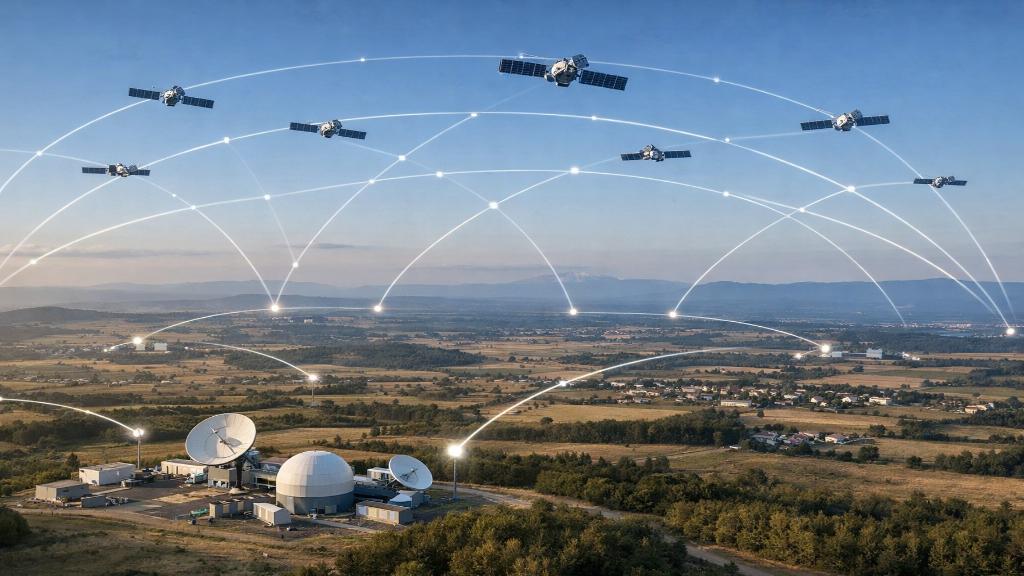
- Global race for sovereign satellite internet.
- Russia has launched 16 Rassvet low Earth orbit satellites.
- Starlink has more than 5,000 operational satellites.
- Europe and China aim for full deployments by 2030.
Russia has launched 16 communication satellites into low Earth orbit as part of the Rassvet program. According to Reuters and Xinhua, this marks an initial step toward a national satellite internet constellation.
Key figures:
- 16 satellites launched by Russia
- More than 5,000 satellites in the Starlink network
- Latency between 20 and 40 ms for Starlink
- Several billion euros required for a full constellation
- European and Chinese deployments expected by 2030
The Rassvet program aims to reduce reliance on foreign infrastructure. No full deployment timeline or total satellite target has been publicly disclosed.
The gap with Starlink remains significant. Operated by SpaceX, Starlink already provides commercial coverage across multiple regions with thousands of satellites in orbit. A fully operational constellation typically requires hundreds to thousands of satellites to ensure continuous service.
With only 16 satellites, Russia remains in an early development phase. This configuration does not allow for global coverage or high network capacity, but it represents a necessary technical step.
Building a constellation involves multiple components: satellite manufacturing, launch cadence, ground infrastructure and user terminals. These aspects have not yet been detailed for the Russian program.
Costs remain substantial. Low Earth orbit constellations require several billion euros in initial investment, along with ongoing costs for satellite replacement and network operations.
In Europe, the IRIS2 program aims for gradual deployment by 2030 with a multi-billion-euro budget. In China, constellations such as Guowang are also under development, with timelines spanning several years.

Technical constraints are similar across all actors: high satellite density, precise orbital coordination and regular replacement due to limited lifespan in low Earth orbit.
User terminals are another key factor. Their cost and availability directly influence adoption. Starlink’s model includes hardware sales combined with a monthly subscription.
Deployment timelines are long. Several years are typically required between initial launches and stable service. Uncertainties remain regarding Russia’s ability to sustain high production and launch rates.
Beyond connectivity, these constellations are tied to digital sovereignty, infrastructure resilience and control over data flows. They may also raise strategic considerations related to spectrum management and potential interference between competing systems, although such aspects remain largely undocumented publicly.
Conclusion: the Rassvet program marks Russia’s entry into the low Earth orbit constellation race, but it remains at an early stage. The gap with established systems such as Starlink is still considerable. At this point, the key issue is less immediate competition than the long-term ability to build an autonomous infrastructure. The multiplication of projects suggests a gradual transformation of the space landscape, where coexistence, complementarity and technological rivalry are likely to continue evolving.
FAQ
How many satellites has Russia launched?
16 satellites as part of the Rassvet program.
How does it compare to Starlink?
Starlink operates more than 5,000 satellites with active commercial coverage, while Russia is still in an early phase.
When will the system be operational?
No precise timeline has been announced for full deployment.