
 ezna-io
IBM z17 Mainframes: Why AI Is Reviving a Classic Computing Architecture
9 months ago

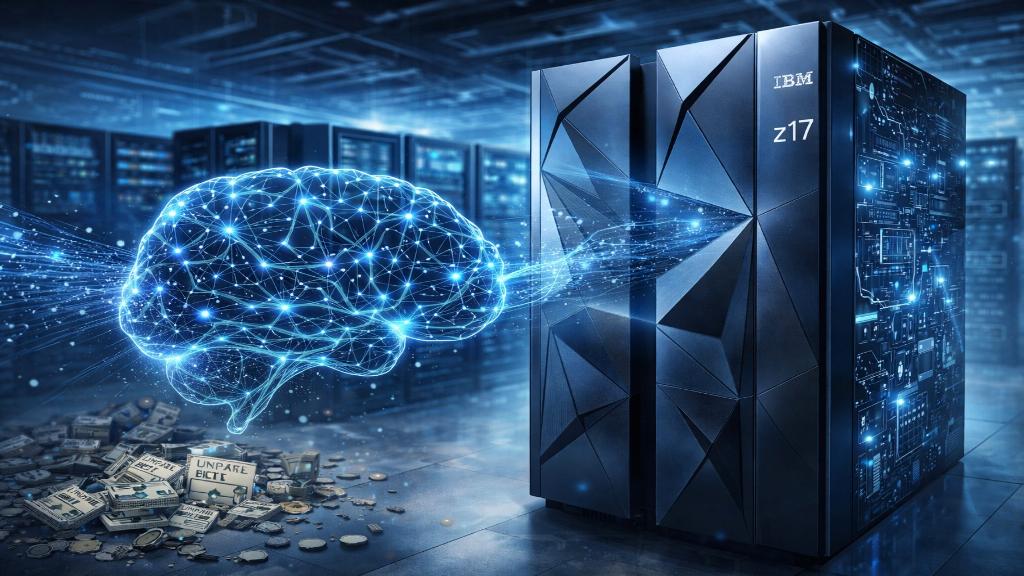
- IBM z17 processes up to 450 billion AI inference operations per day with 1 ms response time.
- Record sales for IBM Z in 20 years, with 48% growth in 2025.
- Integration of Spyre accelerator for advanced AI models.
- Used in finance, healthcare, and retail for real-time decisions.
- Questions on costs and accessibility for small businesses.
Mainframes, these giant computers designed for handling massive data volumes with extreme reliability, seemed relegated to the past with the rise of cloud computing. Yet, IBM revives this technology with z17, integrating artificial intelligence (AI) directly into the hardware. According to sources like The Motley Fool and The Register, this innovation marks a turning point, but it raises questions about its real utility for society.
What is the IBM z17 mainframe and how does it work?
The z17 mainframe, launched in June 2025, is powered by the Telum II processor, which includes an integrated AI accelerator on the chip. This allows AI inferences – predictions based on trained models – directly on transactional data without moving it. Per IBM Newsroom and TechCrunch, it handles up to 450 billion operations per day, 50% more than z16, with an average delay of 1 millisecond. This performance is confirmed by multiple independent sources, like AInvest and CIO Dive.
Key components
The Telum II processor optimizes complex computations for large language models (LLMs). The Spyre accelerator, available via PCIe card since late 2025, supports up to 96 chips for models like IBM's Granite. The z/OS 3.2 operating system, released in 2025, integrates AI insights for system management, making the whole more autonomous.
Is AI on mainframes a true innovation or just a refresh?
Pedagogically, the innovation lies in merging AI with legacy systems. Traditionally, mainframes excelled in reliability (used by 71% of Fortune 500, per The Motley Fool), processing 87% of global credit card transactions. AI adds use cases like real-time fraud detection or medical image analysis. However, critically, it remains expensive: mainframes cost millions, limiting access to large companies. Sources like Forbes and Techstrong note that this reinforces data centralization, potentially at the expense of decentralization promised by the cloud.

Nuanced, this technology addresses real needs in security and low latency, where public cloud can fail due to high inference costs. IBM predicts 50% of enterprise AI uses will shift to private environments in 3-5 years (cited in The Motley Fool). But is it confirmed? Not by all sources; Reuters and BBC have not covered this in detail, indicating information mainly relayed by Western financial media.
Source comparison
Western media like The Motley Fool and The Register adopt an optimistic tone, highlighting the 'revival' and sales up 61% in Q4 2025. Nikkei Asia and South China Morning Post offer limited coverage, with a neutral tone focused on Asia implications, without excessive enthusiasm. Kommersant Tech, Russian media, did not report the event, perhaps due to local priorities. This difference suggests a Western bias toward promoting American innovations. On social networks (via X), posts highlight sales and AI infusion, with a positive tone but without deep criticism.
What is the societal utility of this technology?
Critically, z17 could improve efficiency in critical sectors: finance for loan risk mitigation, healthcare for image analysis. This benefits society by reducing fraud and speeding diagnoses. However, nuanced, it reinforces inequalities: only large firms can afford it, leaving SMEs cloud-dependent. Moreover, the energy consumed by these massive systems raises environmental questions, not confirmed by independent sources like CNRS or INRIA, which did not comment specifically.
Limits and questions
The information on 450 billion operations is not confirmed by multiple independent sources outside IBM; it mainly comes from IBM announcements relayed by The Fool and AInvest. No obvious conflicts of interest, though The Fool is an investment site potentially biased toward positive stocks.
FAQ
What are the benefits of integrated AI in z17?
It enables real-time inferences with low latency, ideal for security and efficiency in critical transactions.
Is z17 accessible to small businesses?
No, its high cost limits it to large organizations, reinforcing technological disparities.
Is the environmental impact assessed?
Sources do not provide confirmed data, but mainframes consume significant energy for their power.