
 ezna-io
Ukraine War Reparations: Europe Launches International Commission to Assess Damage
10 months ago

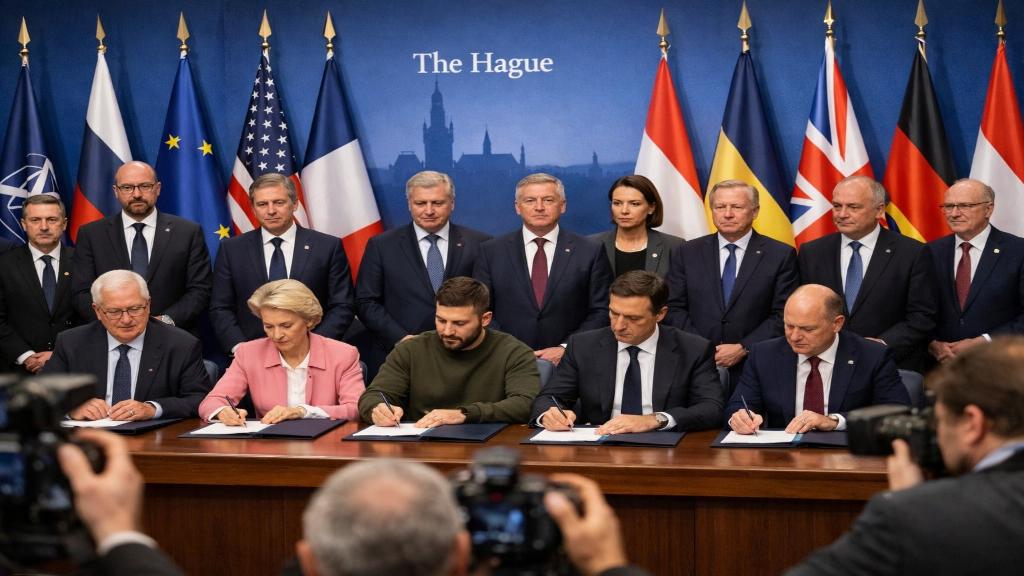
- On December 16, 2025, 34 countries and the European Union signed a treaty in The Hague establishing an International Claims Commission for Ukraine to assess war-damage compensation claims.
- The body’s financing mechanism remains unclear; discussions include using frozen Russian assets.
- Moscow did not participate and rejects allegations of war crimes.
European leaders and representatives, joined by Ukrainian President Volodymyr Zelenskyy, signed a treaty on December 16, 2025 in The Hague to formally establish an International Claims Commission tasked with evaluating compensation claims related to the damage inflicted during Russia’s invasion of Ukraine.
Hosted under the auspices of the Council of Europe, the commission builds on a damage registry initiated in 2023, responding to tens of thousands of claims from individuals, organisations, and public bodies.
Despite broad diplomatic support, significant strategic questions remain unresolved. Most outlets reporting on the event highlight that while the commission can validate claims, there is no binding mechanism to enforce payment from Russia. Proposals under discussion include tapping into frozen Russian assets held in Europe, but no definitive plan has emerged.
From the Russian perspective, authorities continue to reject narratives framing its military actions as crimes of war, complicating prospects for enforcement and participation. This disconnect reflects larger geopolitical tensions between Kyiv and Moscow.
Social media reactions diverge strongly: in Western Europe and North America, diplomats and commentators praise the initiative as a step toward accountability, while some voices criticise it as largely symbolic without practical enforcement. Terminology ranges from “justice mechanism” to “uncertain financial theater,” underscoring public concern about future economic burdens and diplomatic efficacy.

This initiative occurs amid broader policy shifts: most recently, the European Union moved to freeze hundreds of billions in Russian assets indefinitely, which may be earmarked to aid Ukraine through loans or compensation frameworks.
Although seen as a diplomatic milestone, the commission’s effectiveness will depend on subsequent ratifications by national parliaments and the eventual establishment of financial mechanisms. Legal analysts also speculate that certifying claims could strengthen future judicial actions against individuals or states responsible for grave violations of international law.