
 ezna-io
Macron Strengthens French Nuclear Deterrence
8 months ago

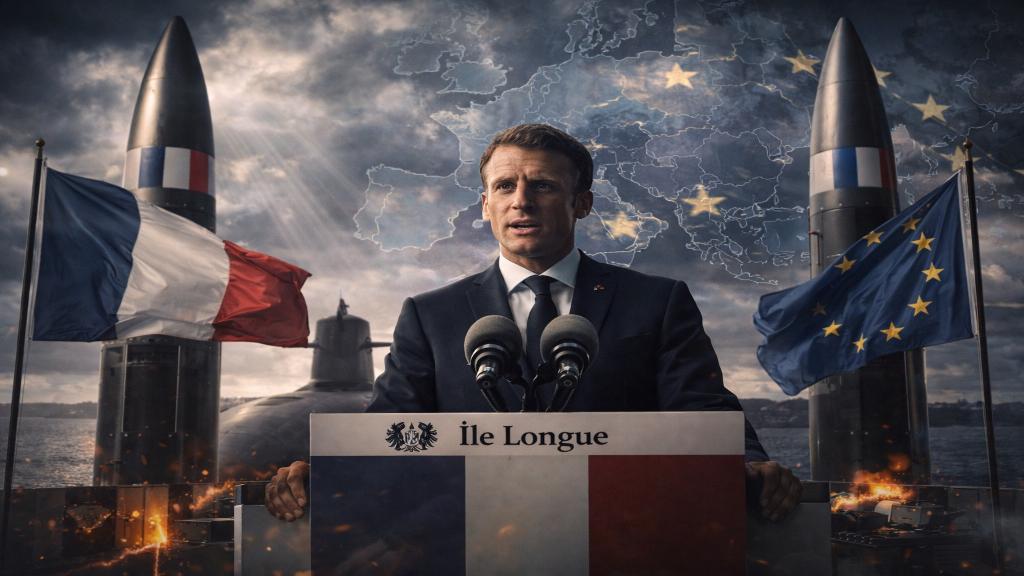
- Increase in the number of French nuclear warheads to strengthen deterrence credibility.
- Implementation of 'advanced deterrence' allowing European allies to participate in exercises without sharing the final decision.
- Creation of a Franco-German nuclear steering group and cooperation with other countries like Poland and the UK.
- Response to Russian threats and American isolationist stance.
On March 2, 2026, at the Île Longue submarine base in Brittany, President Emmanuel Macron delivered a speech marking a major evolution in French nuclear doctrine. This intervention, reported by multiple international sources, aims to adapt the deterrence strategy to contemporary challenges, including Russian aggressiveness and tensions in the Middle East related to the Iranian conflict.
Analyzing the underlying strategies reveals a clever power play. Macron positions France as the pivot of European defense, maintaining strict autonomy on nuclear use while inviting partners to joint exercises. This evokes the subtleties of diplomatic negotiations in Southeast Asia, where informal alliances allow balancing regional influences without ceding sovereignty, much like capturing the essence of an urban scene in photography: focusing on details that reveal hidden social dynamics.
The comparison of treatments by sources shows varied perspectives. The New York Times, from the United States, highlights the American retreat and the step toward an independent European deterrent, underscoring how this redraws continental security contours against Russia. Al Jazeera, with a Middle Eastern view, emphasizes the distinction from NATO and the temporary lending of nuclear aircraft to allies, perceiving this as a response to regional instability without full alignment on Atlantic structures. Xinhua, the Chinese outlet, factually reports the addition of a European dimension to French deterrence, without ideological emphasis, focusing on announcements of warhead increase and cooperation with Germany. Reuters, global, details the creation of a Franco-German steering group, seeing this as a significant shift in European defense policy. The BBC, British, notes that France extends its protection to up to eight countries while retaining exclusive control, a cautious approach that strengthens cohesion without power dilution.
No obvious biases or conflicts of interest were identified in these sources; they remain factual, though their angles reflect their respective geopolitical contexts.

The institutional implications are profound. The progressive implementation of this advanced deterrence, as announced, includes an increase in the number of warheads – the first growth in decades – and the construction of a new submarine. This consolidates budgetary and technological means, translating into acts the strategic continuity since 2017. On the European level, this could alter dynamics within the Union, strengthening the role of France and Germany as a driving duo, while integrating countries like Poland or Sweden, reminiscent of how, during travels in Latin America, regional pacts emerge to counter external threats with cultural curiosity for differences.
Some details remain uncertain: according to an unverified source in initial POLITICO reports, the exact number of additional warheads is not disclosed, marking a departure from past transparency. Additionally, discussions with the UK on long-range missiles, mentioned by AFP, are in an exploratory phase.
In decrypting the intentions, this announcement comes as the Macron era approaches its end, as noted by POLITICO, suggesting an attempt to bequeath a durable framework to 'Le Pen-proof' France before 2027. It is a maneuver to anchor foreign policy in a European vision, avoiding ideological pitfalls while making accessible the complexities of power games, like an urban photo that captures daily interactions to reveal societal structures.
Overall, this concrete decision impacts European institutions, potentially complementing NATO, and highlights an adaptation to geopolitical realities, with observable consequences on continental stability.
FAQ
- What is the advanced deterrence announced by Macron?
- It is a doctrine allowing European allies to engage in French nuclear exercises without influencing the use decision, maintaining national sovereignty.
- What countries are potentially beneficiaries of this cooperation?
- Germany, Poland, Netherlands, Belgium, Greece, Sweden, Denmark, and the United Kingdom are mentioned in the announcements.
- Why this evolution in nuclear doctrine now?
- It responds to Russian aggressiveness, Middle East instability, and a more withdrawn American posture, strengthening European collective security.
- Le Monde - French nuclear deterrence takes a big step towards Europe
- New York Times - Macron Expands French Nuclear Arsenal and Vows Protection for Neighbors
- Al Jazeera - France to increase nuclear warheads, lend nuclear aircraft to Europe allies
- Xinhua - Macron orders increase of France's nuclear warheads
- Reuters - France and Germany move closer on joint nuclear deterrence