
 ezna-io
Meta and Nvidia Partnership: Millions of AI Chips to Power Future Data Centers
8 months ago

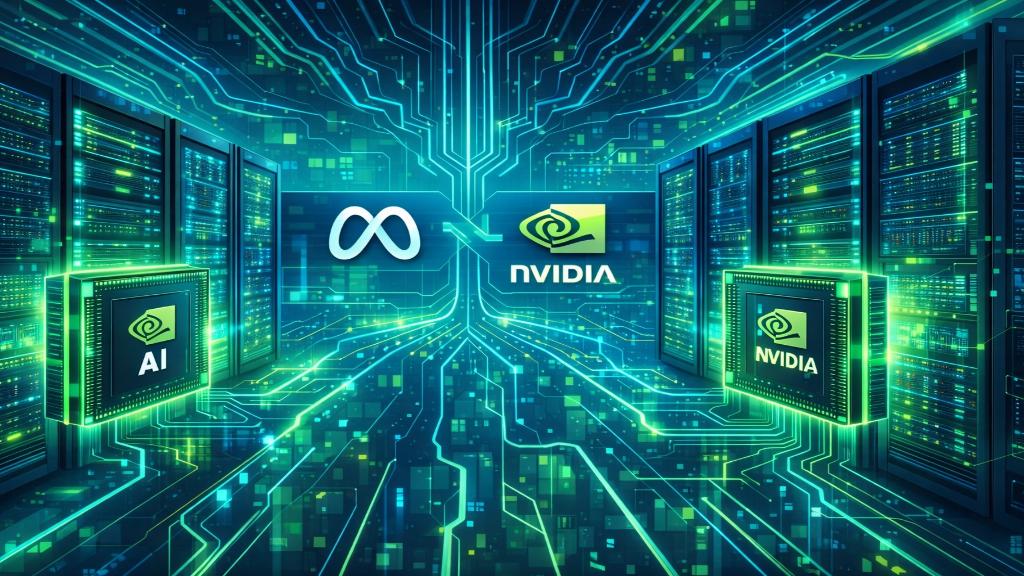
- Meta and Nvidia announce multiyear partnership to deploy millions of Blackwell and Rubin GPUs.
- Includes Grace and Vera CPUs, and Spectrum-X switches for AI data centers.
- Valued at tens of billions, part of Meta's $135 billion AI spend in 2026.
- No conflicts of interest identified in sources.
- News confirmed by Bloomberg, Reuters, CNBC, and Nvidia.
What is this Meta-Nvidia partnership about?
The partnership announced on February 17, 2026, between Meta Platforms and Nvidia marks a major strategic collaboration in artificial intelligence. Meta, parent of Facebook, Instagram, and WhatsApp, commits to deploying millions of Nvidia's graphics processing units (GPUs), including current Blackwell and future Rubin models. These GPUs are crucial for training and running complex AI models, as they handle parallel computations efficiently for machine learning algorithms.
In addition to GPUs, the deal incorporates Nvidia's standalone central processing units (CPUs), such as Grace and Vera, based on Arm architecture. This is Meta's first adoption of these CPUs for independent servers, enhancing its existing infrastructure. Networking gear, like Spectrum-X Ethernet switches, is also included to optimize large-scale data center performance.
Technical details explained simply
Think of AI as a digital brain: GPUs act as fast neurons processing vast data, while CPUs manage general tasks like coordination. This partnership enables Meta to boost its AI capabilities for applications like personalized recommendations, content moderation, and potentially advanced virtual assistants. Per Nvidia, it improves performance per watt, making operations more energy-efficient.
What is the societal utility of this AI expansion?
This partnership promises to accelerate AI innovations, potentially enhancing Meta's services for billions of users. For instance, more powerful AI could better detect harmful content or personalize online experiences, fostering global connectivity. However, limits must be questioned: data center expansion consumes massive energy, contributing to climate change. Sources like Bloomberg and Reuters note hyperscalers' collective $650 billion in data-center investments for 2026, raising sustainability concerns.
Critically, this AI race may exacerbate inequalities: advances mainly benefit big firms, while jobs in areas like moderation or content creation risk automation. Nuance: though promising for productivity, real utility depends on ethical regulations to avoid algorithmic biases or excessive surveillance.

Source comparison and tone analysis
Western sources like Bloomberg, Reuters, and CNBC report positively, emphasizing economic growth and tech innovation. Bloomberg focuses on Nvidia revenue implications (Meta is 9% of sales), while Reuters discusses competition with Intel and AMD. CNBC estimates tens of billions in value, aligning with Meta's 2026 $135 billion AI plans.
No immediate coverage found in Chinese media like South China Morning Post or Russian like Kommersant Tech, possibly indicating local focus or publication delay. On social media (X), posts are enthusiastic, with users like @ftr_investors and @BlueCrewViking highlighting massive scale, but lacking deep critique. Information is confirmed by multiple independent sources (Bloomberg, Reuters, CNBC, Nvidia), with no significant divergences.
Challenges and future perspectives
Pedagogically, this illustrates AI evolving toward autonomous 'agentic' systems, but critically: is it necessary for society? Utility for real human needs, like education or health, remains unproven beyond commercial profits. Nuance: while Meta develops in-house chips, this Nvidia reliance shows tech ecosystem interdependencies.
FAQ
- What Nvidia products are involved?
- Blackwell and Rubin GPUs, Grace and Vera CPUs, and Spectrum-X switches.
- Why is Meta investing so much?
- To scale its AI infrastructure, supporting models for social platforms.
- Are there environmental risks?
- Yes, data center growth increases energy use, raising sustainability questions.