
 ezna-io
Mercedes axial motor: compact power, uncertain costs
a month ago

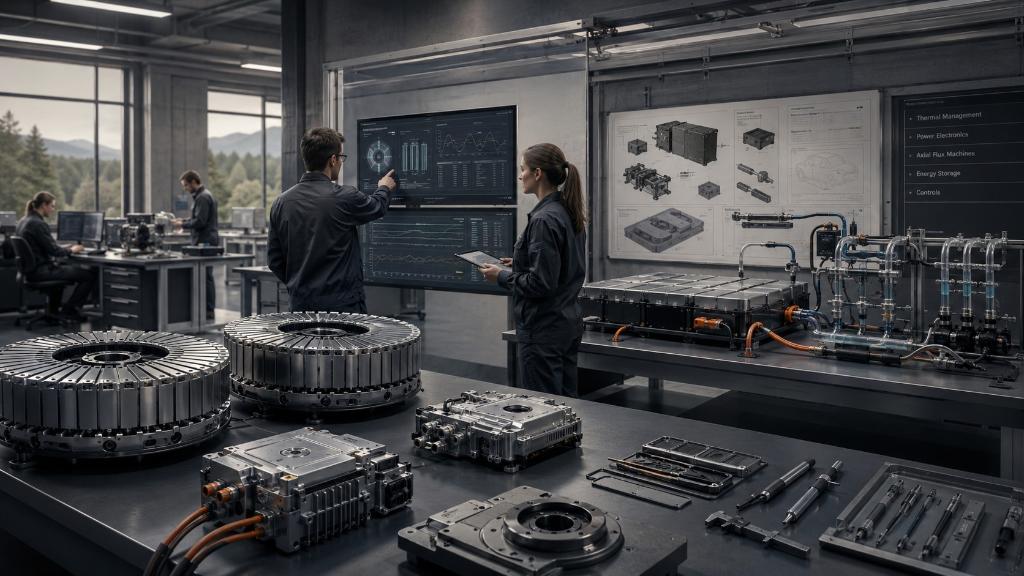
- Mercedes-Benz started series production of an axial-flux electric motor on June 9, 2026 at Berlin-Marienfelde for future Mercedes-AMG vehicles.
- The core promise is density: a flatter motor, tighter integration, more repeatable performance and less mass at comparable output.
- The most spectacular figures come from Mercedes-AMG and YASA: they should be read as manufacturer or demonstrator data, not independent measurements.
- Unit cost is not public; real value will depend on manufacturing processes, magnets, cooling, inverters and diffusion beyond high-end vehicles.
Mercedes-Benz has chosen a less visible but potentially decisive angle for the next phase of electric vehicles: the motor itself. On June 9, 2026, the German group announced series production of an axial-flux electric motor at its Berlin-Marienfelde plant, its oldest industrial site. Reuters also reported that the lightweight motor will equip the next generation of Mercedes-AMG vehicles, with a first application in the electric Mercedes-AMG GT 4-Door Coupe.
The innovation is not the invention of the axial motor. The architecture has existed for years and has already appeared in high-performance hybrids and hypercars. The important point is industrialization. Mercedes says production includes 98 process steps, 65 of which are being used for the first time at the company and 35 of which are described as new worldwide, with more than 30 patent applications. That detail shows the scale of the challenge: producing an axial motor is not only a design problem, but also a manufacturing precision problem.
An axial-flux motor differs from a conventional radial-flux motor by the direction of magnetic flux. In a radial machine, it travels from the center toward the outer diameter; in an axial machine, it follows the axis of rotation more closely, enabling a flatter shape. This geometry can reduce packaging volume, place the drivetrain closer to the axles and ease integration in a performance EV, where battery mass and heat limit repeated performance.
Mercedes describes the technology as more compact, lighter and more efficient than conventional radial machines used in many electric vehicles. The company says that, on the Concept AMG GT XX architecture, the front motor combination is just under nine centimeters wide, while each of the two rear motors is about eight centimeters wide. These machines are integrated into compact drive units with a planetary gearbox. The benefit therefore does not come from the motor alone, but from the combined motor, transmission, cooling, power electronics and control software package.
The available figures should be separated. Production at Berlin-Marienfelde is an industrial announcement confirmed by Mercedes and Reuters. The Concept AMG GT XX is a demonstrator: Mercedes-AMG and YASA claim three axial-flux motors, more than 1,000 kW of peak power and a top speed above 360 km/h. YASA’s 12.7 kg prototype, announced at 750 kW in short peak output, or 59 kW/kg, is described as an unofficial record, with estimated continuous output between 350 and 400 kW. These figures therefore do not carry the same evidentiary weight: in an electric vehicle, useful performance depends less on peak output than on sustained power, thermal management, partial-load efficiency and ageing.
The potential gains are still concrete. A flatter motor can free space in the underbody, simplify multi-motor integration and reduce packaging constraints. Lower mass at comparable output can reduce stress on the battery, brakes and tires. Higher torque density can improve low-speed response. Several compact motors can also manage torque distribution, regenerative braking and stability more precisely during fast driving.

Cost remains the main blind spot. No public unit cost is available for the Mercedes-YASA axial motor, and it would be misleading to infer that the technology will make EVs cheaper. The relevant cost must include the motor, possible magnets, inverter, cooling loop, sensors, software, quality validation, assembly processes and actual production volumes. Road & Track notes, based on exchanges with AMG, that industrializing the technology involves high costs and numerous specific manufacturing processes. Mercedes separately describes 98 production steps, confirming complexity without providing a price. Material exposure is also sensitive: highly dense electric motors often use strong permanent magnets, which can create price and supply risks. YASA says its 59 kW/kg prototype uses no exotic materials, but that does not establish low cost at scale.
Competitors show that carmakers are not all pursuing the same answer. BMW favors a full-system approach around Neue Klasse: an 800 V network, new cylindrical cells, sixth-generation power electronics and motors designed to reduce dependence on rare earths. The company claims a 20% increase in cell energy density compared with previous prismatic cells, a WLTP range of up to 805 km for the iX3 50 xDrive and charging up to 400 kW, adding 372 km in ten minutes on that model.
Renault has also explored, with Whylot, a more mainstream axial-flux path. In its eWays ElectroPop strategy, Renault Group presented the axial motor as a route first aimed at hybrid powertrains, with targets to reduce costs by 5% and save up to 2.5 g/km of CO₂ under WLTP for B- and C-segment passenger cars. This route is less dramatic than an electric AMG, but it raises a more socially relevant question: can advanced motor technology improve affordable vehicles, or will it remain confined to prestige models?
Hyundai-Kia is focusing instead on optimized hybrid systems, with a dual-motor architecture integrated into the transmission: one motor for starting, generation and assistance, the other for traction and energy recovery. Toyota moves the center of gravity toward batteries: its solid-state roadmap targets, from 2027-2028, 10-80% charging in ten minutes or less and a first-generation range target of around 1,000 km.
In short, Mercedes optimizes motor density, BMW the full electric architecture, Renault cost and emissions in more accessible segments, Hyundai-Kia the hybrid transition, and Toyota energy storage. The debate is not about a single winning technology, but about the best industrial trade-off for each use case: sustained performance, purchase cost, efficiency, material availability, charging infrastructure and durability.
For users, the axial motor’s value will depend on the vehicle. In an electric sports car, it can make performance more repeatable, improve packaging and reduce some surrounding mass. In a family car, the benefit will be less obvious if the battery remains heavy, the price rises or fast charging is not available. The right question is not only whether the axial motor accelerates better; it is whether it enables vehicles that are more efficient, durable and aligned with real everyday needs.
The value of the innovation will depend less on the record than on engineers’ integration choices: placing the right motor, in the right location, for the right use case. That creativity is not decorative. It determines whether a propulsion advance becomes a more coherent vehicle, or merely another showcase performance.
The source landscape also requires caution. Reuters and Mercedes confirm the move into production. YASA provides the most ambitious figures, but it is owned by Mercedes-Benz and has a direct interest in promoting the technology. BMW, Renault, Hyundai and Toyota sources are also company communications. Specialist media add context, but partly rely on the same industrial data. No hidden conflict of interest was identified; the main bias is the dominance of figures produced by companies promoting their own roadmaps.
The Mercedes-YASA axial-flux motor is a credible innovation because it is entering production at an identified plant, with specific processes and a first announced application. It can improve density and integration in premium EVs. Its wider impact depends on factors that remain insufficiently public: series cost, durability under load, real-world efficiency and the ability to move beyond premium models. Electric propulsion is advancing; it has not yet solved its central trade-off between performance, cost and everyday usefulness.
FAQ
Why is Mercedes-AMG interested in axial-flux motors?
Because the design enables a flatter and very dense machine, suited to vehicles where space, mass, torque and repeatable performance are critical.
Why is this technology arriving first in premium cars?
Because industrial cost, manufacturing complexity and thermal integration are easier to absorb in premium models than in mass-market vehicles that are highly price-sensitive.
Can axial motors make EVs cheaper?
That has not been demonstrated. They can reduce motor volume and mass, but final price also depends on inverters, cooling, materials, production volumes and battery cost.
- Reuters — Mercedes launches mass production of electric motor for high-performance AMG brand
- Mercedes-Benz Group — Large-scale production of electric axial flux motor
- YASA — 59 kW/kg axial-flux motor benchmark
- YASA — Concept AMG GT XX, three axial-flux motors and more than 1,000 kW
- Road & Track — Mercedes-AMG axial-flux motors and production challenges
- BMW Group — Gen6 electric drive technology for Neue Klasse
- Renault Group — Renault eWays ElectroPop and axial-flux motor strategy
- Hyundai Motor Group — NextGen Hybrid Power
- Toyota Europe — Advanced battery technology roadmap