
 ezna-io
AI Music: Deezer vs Spotify, artists under pressure
By Hugo Delorme
6 months ago

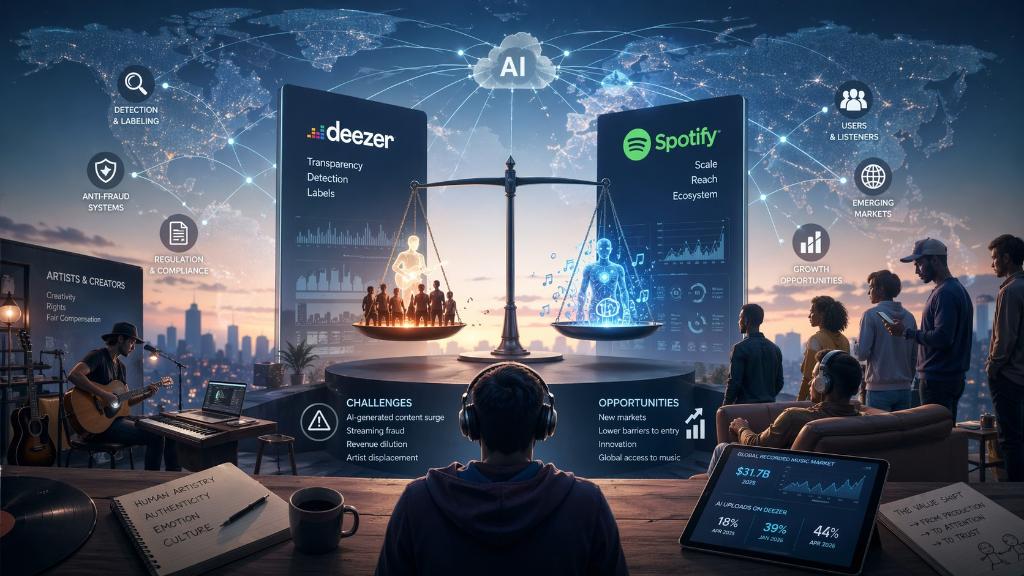
- 44% of new tracks received by Deezer are AI-generated, or about 75,000 per day.
- These tracks account for only 1 to 3% of listening.
- In January 2026, Deezer said that up to 85% of streams linked to this content could be fraudulent.
- Spotify, the global leader with more than 100 million tracks, does not publish comparable AI data.
The signal comes from France, but its interpretation requires nuance. On April 20, 2026, Deezer announced that 44% of the tracks it receives daily on its platform are generated by artificial intelligence, or about 75,000 songs per day. In its statement, the company said that 'AI-generated content continues to flood streaming platforms at an unprecedented pace'. This figure, widely repeated, applies only to new uploads and not to the overall catalog or actual usage.
This distinction is essential. Deezer says that these tracks still account for only 1 to 3% of listening. Production is therefore rising much faster than consumption, revealing a structural imbalance. This pattern recalls dynamics seen in other digital economies, especially in China, where content abundance came before demand stabilized.
Historical data confirms rapid acceleration. In 2025, Reuters reported that AI uploads represented 18%. At the start of 2026, Deezer said the figure had reached 39%, before rising to 44% today. Reuters noted that 'the surge highlights growing concerns over streaming fraud and artist compensation'.
Fraud is a structural issue, but it must be placed in its temporal context. In January 2026, Deezer said that up to 85% of streams linked to this content could be artificial. That figure, published before the April announcement, reflects a specific observation phase and should not be read as a current measurement.
This reading must also be weighed against the interests of the players involved. Deezer develops and sells AI-content detection tools. Highlighting the scale of the phenomenon indirectly increases the value of those solutions. By contrast, Spotify, the global streaming leader with more than 100 million available tracks, does not publish comparable data on the share of AI-generated content. This information asymmetry currently limits a broader understanding of the phenomenon and raises an implicit question: does the framing of the issue depend on platform strategy?
Tensions are especially visible on the artists' side. In 2024 and 2025, several major labels took action against music-generation tools such as Suno and Udio, accusing them of using existing catalogs to train their models. In that context, one industry representative summed up the issue this way: 'the question is not only technological, but economic: who captures value in a saturated universe?'. That question reflects a growing conflict between innovation and remuneration.
On the platform side, strategies differ. The Verge notes that Deezer is 'currently the only streaming service to explicitly label AI-generated tracks at scale'. This proactive approach contrasts with the discretion of other players, reinforcing the sense of a market still in an experimental phase.

At the global level, the economic backdrop remains solid. According to the IFPI, the recorded music market reached 31.7 billion dollars in 2025. Growth continues, but the nature of value is changing: scarcity no longer lies in production, but in attention and credibility.
These concerns are reinforced by projections. A CISAC study suggests that up to 24% of revenues could be at risk by 2028. The report states that 'generative AI could significantly disrupt traditional revenue streams'.
In emerging markets, the reading is different. According to Rest of World, AI could lower barriers to entry in Africa and Latin America. The phenomenon therefore appears ambivalent: a risk in mature markets, an opportunity in developing ones.
Europe is trying to frame this shift. Through the AI Act, the European Commission imposes transparency obligations. It states that 'users should be informed when they are interacting with AI-generated content'.
Finally, the signal must be kept in perspective. The 44% figure does not mean AI is culturally dominating music, but that it is rapidly transforming production. The gap between uploads and listens shows that demand remains mostly oriented toward human-made content.
The shift underway amounts to a gradual reconfiguration of the value chain, where creation becomes more accessible but visibility, trust and monetization become the central challenges.
FAQ
Is the 44% figure representative of the market?
No, it refers only to the new tracks received by Deezer.
Why does Spotify not publish data?
There is no official explanation, which limits market transparency.
Are artists under threat?
Yes, especially in terms of revenue sharing and visibility.