
 ezna-io
Hormuz: Macron pushes naval mission without alignment
6 months ago

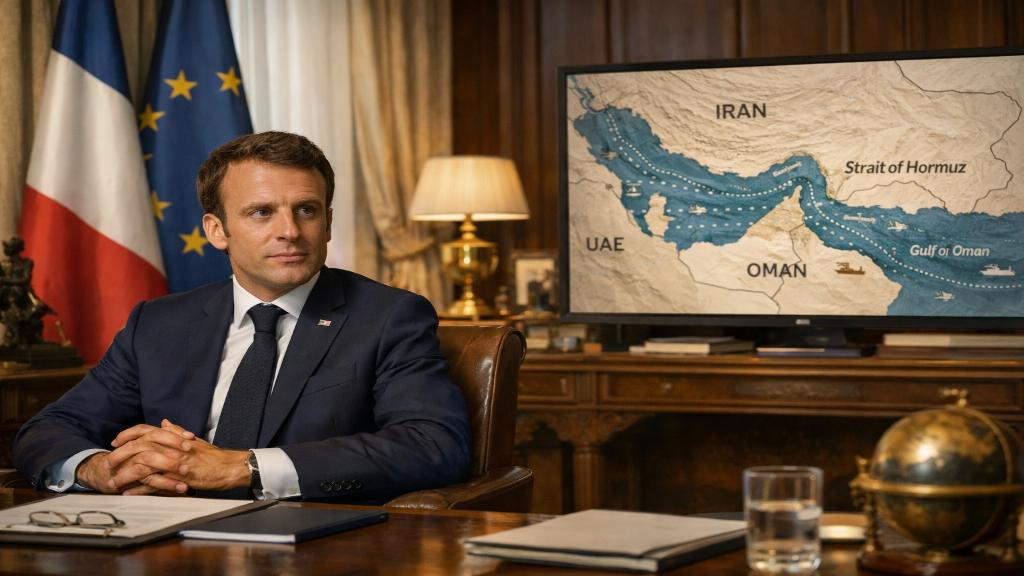
- On April 13, 2026, Paris and London said they would hold talks this week on a possible 'strictly defensive' naval mission in the Strait of Hormuz.
- France is refusing to join the US blockade of Iranian ports and is arguing for an operation separate from the warring parties.
- The stakes go well beyond the Gulf: according to the IEA, nearly 20 mb/d of oil and about 19 percent of global LNG trade move through Hormuz.
- The exact format of the mission, its participants, its rules of engagement and its timeline remain uncertain at this stage.
The most consequential French political development of the past 24 hours is not unfolding inside the National Assembly but in a maritime corridor that shapes energy prices, alliance politics and the executive's room for manoeuvre. On April 13, 2026, Reuters reported that France and the United Kingdom would co-host talks this week on restoring freedom of navigation in the Strait of Hormuz, including discussions on a possible multinational naval mission. Emmanuel Macron set the political frame in a short but important formula. He described a 'strictly defensive mission', 'separate from the warring parties', to be deployed 'as soon as the situation allows'. The wording matters. Paris is not talking about an offensive escort operation or joining a blockade coalition. It is outlining a third option: act, but outside the architecture designed in Washington.
The contrast with the US line is explicit. Reuters reported that NATO allies including France and the United Kingdom would not participate in Donald Trump's blockade plan. Al Jazeera, citing Reuters, AFP and the BBC, captured the same split through Keir Starmer's blunt phrase: 'We are not supporting the blockade.' On the British side, the public argument focuses on economic damage and the need to reopen the waterway. On the French side, the reasoning is more institutional and strategic: protect shipping without sliding into political co-ownership of the war. For the Elysee, that distinction is not a communications detail. It allows Macron to hold together three objectives that often collide: remain a Western ally, preserve diplomatic room for dialogue and defend the idea of European freedom of judgement.
This line did not appear suddenly on April 13. It extends earlier published positions. On April 8, in a joint statement posted by the Elysee after the ceasefire between the United States and Iran, the signatory governments said: 'Nos gouvernements contribueront a garantir la liberte de navigation dans le detroit d'Ormuz.' Three weeks earlier, on March 19, a statement published by the UK government on behalf of leaders including the United Kingdom, France, Germany, Italy, the Netherlands and Japan recalled that 'Freedom of navigation is a fundamental principle of international law' and called on Iran to stop 'its threats, laying of mines, drone and missile attacks and other attempts to block the Strait to commercial shipping'. In other words, the April 13 sequence is not improvisation. It is the political monetisation of an already written position: France is trying to turn a principle into an operational mechanism.
France's interest is also material. The Strait of Hormuz is not simply the backdrop to a distant crisis. According to the International Energy Agency, nearly 20 mb/d of oil moved through Hormuz in 2025, representing about 25 percent of world seaborne oil trade. The IEA adds that about 19 percent of global LNG trade also transits the strait, with particularly high reliance for Qatar and the United Arab Emirates. The US EIA offers a closely related measure for 2024: 20 million barrels per day, equal to about 20 percent of global petroleum liquids consumption. The IEA also stresses that alternative routes can absorb only part of the shock: between 3.5 and 5.5 mb/d of capacity can be redirected outside the strait through Saudi and Emirati pipelines. In practical terms, even a partial disruption or heavily threatened transit is enough to push up insurance premiums, freight costs and, very quickly, the European political debate on energy and living costs.

The French executive's calculation can be read as a route with three stops. First stop: Washington. By rejecting the blockade, Paris risks adding another point of friction to an already strained transatlantic relationship. But the refusal is also a statement of control: France does not want to be pulled into an escalatory logic whose political aims and exit strategy it does not command. Second stop: London. The United Kingdom shares the refusal to join the blockade and is co-hosting this week's initiative. That gives Paris a credible military and maritime partner without waiting for a fully formed European Union position. Third stop: the other states that might join the mission. Reuters notes that Britain had already convened representatives from more than 40 countries on the issue and that the United States was not involved in those talks. For Macron, the geometry is useful: a coalition broad enough to matter, distinct enough to signal independence and cautious enough to remain defensive.
The treatment of the story differs across sources, and that difference is revealing. Reuters places the emphasis on the strategic split with Washington and the NATO dimension: allies are refusing the blockade and favouring diplomatic, non-military solutions. The Elysee frames the issue through regional security and the risk of a global energy crisis, using the language of responsible intergovernmental action. The UK government foregrounds international law and maritime security. Al Jazeera highlights the delicate 'balancing act' in London and places the issue inside the wider war with Iran. None of these frames is neutral in emphasis. Reuters privileges alliance management, the Elysee political legitimacy, London legal principle and Al Jazeera regional context plus the geopolitical cost of alignment. These differences do not cancel one another out, but they show how the same event can be narrated as an act of European sovereignty, a crisis-management move or a symptom of stress inside the Western camp.
The blind spots are as important as the announcements. No one has yet published the mission's exact format. The number of ships is not confirmed. The list of participating states is not public. The rules of engagement are unknown. The line between presence mission, escort mission and mine-clearing effort has not been defined in public detail. Reuters speaks of talks this week and of a mission to be deployed 'as soon as the situation allows', which means that a political and security threshold still has to be met. Uncertainty is therefore not marginal. It is central to the story. The strategy can be identified; the order of battle cannot. This is a classic case of an executive stating the principle of action before locking in the operational architecture.
On the French institutional side, the sequence restores presidential depth to a power otherwise constrained by parliamentary fragmentation. In domestic politics, the executive has to navigate a divided Assembly and tighter scrutiny over spending choices. In foreign and security policy, Macron regains a more direct command space: diplomacy, coalition design, military posture and consultation timing. That does not mean acting without constraints. Any sustained mission in the area would quickly raise questions about cost, naval availability and parliamentary oversight. But in the current phase, the control of tempo belongs mainly to the Elysee. That is also why the file is politically useful. It lets the president speak in the language of collective security while repositioning France between alliance discipline and strategic autonomy.
The real novelty of the past 24 hours is therefore not only naval. It is doctrinal. Paris is not merely saying that Hormuz must be protected. Paris is saying it should be protected without joining the US blockade, through a defensive multinational mission independent from the warring parties. That is a wager on the credibility of a medium power with global ambitions: strong enough to propose a framework, not strong enough to impose it alone; allied enough to matter, not aligned enough to follow automatically. As in a major international airport, the question is not only who controls the runway, but under which flight plan others still agree to take off. For France, the April 13 flight plan is clear. The rest will depend on volunteers, actual military risk and Paris's ability to turn a political line into a workable instrument.
FAQ
What exactly did Emmanuel Macron propose on April 13, 2026?
He proposed a 'strictly defensive' naval mission, separate from the warring parties, to restore freedom of navigation in the Strait of Hormuz.
Is France joining the US blockade of Iranian ports?
No. The reporting cross-checked by Reuters indicates that France and the United Kingdom are refusing to take part in the blockade backed by Washington.
What hard data shows why Hormuz matters?
According to the IEA, nearly 20 mb/d of oil moved through the strait in 2025, around 25 percent of global seaborne oil trade, and about 19 percent of global LNG trade also passes there.
- Reuters - UK and France to co-host talks this week on possible defensive naval mission for Hormuz
- Reuters - NATO allies refuse to join Trump's Strait of Hormuz blockade
- Élysée - Joint statement following the ceasefire between the United States and Iran
- GOV.UK - Joint statement from the leaders on the Strait of Hormuz
- Al Jazeera - Starmer says UK will not support US blockade of Strait of Hormuz
- IEA - Strait of Hormuz
- EIA - Amid regional conflict, the Strait of Hormuz remains critical oil chokepoint