
 ezna-io
Iran hostages: France's quiet strategy comes into view
7 months ago

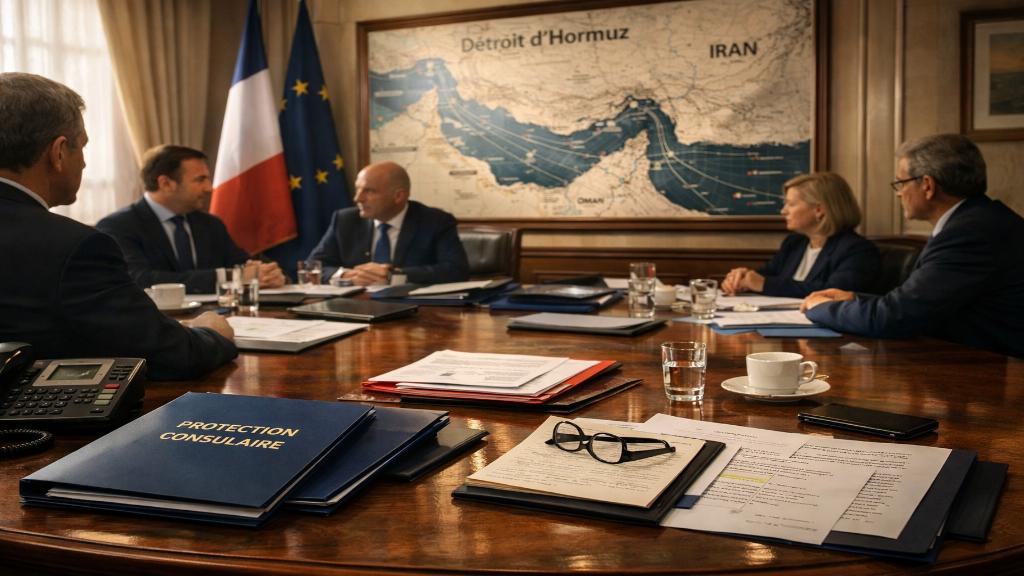
- Cécile Kohler and Jacques Paris left Iran on April 7, 2026 after more than three years of detention or restricted retention.
- Paris denies any formal swap, while Iranian media describe the move as involving Mahdieh Esfandiari.
- The episode highlights a French strategy built on de-escalation, consular protection and sustained diplomacy.
- The case connects foreign policy, maritime security in the Strait of Hormuz and parliamentary pressure on the executive.
The departure from Iran of Cécile Kohler and Jacques Paris, announced by Emmanuel Macron on April 7, 2026, is not only a consular ending. It sheds light on a broader political choice by the French executive: lower the public temperature with Tehran, protect French nationals exposed in the region and preserve room for mediation at a moment when the war around Iran is already disrupting the Strait of Hormuz and testing European positioning. On the core facts, the picture is clear. The two French citizens, held since 2022, were taken out of Evin prison in November 2025 but were not allowed to leave Iranian territory. They had remained inside the French embassy in Tehran before their departure for France.
What gives the episode its political weight is not just the announcement but its setting. Reuters presents the release as the result of mediation, notably by Oman, and places it within a more cautious French posture on the regional war. The agency notes that France tied any action on freedom of navigation in the Strait of Hormuz to a ceasefire and consultation with Iran. AP puts more emphasis on the Elysee's refusal to endorse the idea of a swap, while recalling that Iranian authorities publicly argued that there was a counterpart. Le Monde, for its part, puts the spotlight back on the duration of detention and on the sentences handed down in October 2025, respectively twenty and seventeen years for espionage, before the transfer to the embassy and then the exit from the country. These angles describe the same sequence, but not the same editorial priority.
Seen from Paris, the case looks like a diplomatic itinerary built through detours. A traveller crossing a tense border does not always take the fastest road; sometimes the safe route matters more than speed. The French executive appears to have chosen that logic. The concrete decision was not to raise the volume once more, but to keep a channel open, rely on Omani mediation and separate, as far as possible, the fate of the detainees from the military escalation around them. This does not erase France's rejection of the Iranian accusations, which Paris considers unfounded. It suggests that, at this stage, effective release mattered more than rhetorical toughness.
The available figures reinforce the institutional dimension. In a parliamentary hearing, France's foreign minister said roughly one thousand French nationals were in Iran. The Kohler-Paris case therefore did not concern only two highly visible detainees, but the wider protection architecture for a national community exposed to a volatile regional conflict. That partly explains the government's caution on military options around Hormuz. At the same time, Reuters reported that a CMA CGM vessel, owned by a French group, crossed the strait in early April, while Al Jazeera, citing Lloyd's List Intelligence, said only about 150 vessels had transited since March 1. SCMP notes that roughly 20 percent of the world's oil normally moves through the waterway. For Paris, the issue is therefore not limited to hostages or diplomatic posture; it also concerns energy flows, maritime insurance and the exposure of French corporate interests.

This is where the power game becomes readable. In recent days, Emmanuel Macron has stayed away from any plan to reopen Hormuz by force, calling that option unrealistic. Reuters also reported that French diplomacy had worked to soften a United Nations Security Council resolution that could have opened the way to more coercive action. SCMP reads that positioning as part of a European attempt to contain the fallout and mark a degree of autonomy from Washington, even if the room for manoeuvre remains narrow. Put differently, Paris is trying to stay inside the file without being pulled into a war architecture defined elsewhere.
This line has a domestic political price. It exposes the executive to two opposite criticisms. One comes from those who see in it a constrained moderation, close to concession, at a moment when Iran is multiplying pressure tactics. The other comes from those who argue that a louder public stance would have increased the risks for French nationals still in the country and for French economic interests. In both the National Assembly and the Senate, parliamentary questions in recent months showed that the government was pressed to clarify both the safety of French citizens in Iran and the coherence of its regional posture. The release announced on April 7 gives the executive a concrete result to answer its critics with, but it does not remove every grey zone.
The main uncertainty concerns the exact shape of the understanding that made the departure possible. According to AP and Reuters, Iran described the release as part of an arrangement involving Iranian student Mahdieh Esfandiari in France and the withdrawal of a French complaint before the International Court of Justice. Paris disputes the reading of a formal swap. Several elements therefore still require caution. First, the ICJ complaint had already been withdrawn earlier. Second, Esfandiari had already served her sentence and appealed. In plain terms, there is a clear time overlap between several gestures, but there is still no complete public proof establishing a formal transaction and its precise terms. In a case this sensitive, that distinction matters.
The way sources frame the story also says something about international balances. French outlets naturally focus on the two citizens, the state's duty and the judicial timeline. Anglo-American agencies place the episode more firmly inside the regional war, navigation through Hormuz and the impact on Western alliances. Asian coverage, especially from Hong Kong, is more inclined to stress the limits of European influence and the Franco-German effort to preserve a diplomatic corridor. None of these framings is fully neutral in practice. Reuters and AP privilege strategic dynamics and fast fact-checking. Le Monde privileges close tracking of the French case. SCMP watches the sequence through the prism of Europe, the United States and Asia. These biases do not make the reporting unusable, but they do shape what readers are invited to see first.
For the French executive, the immediate gain is tangible: two nationals are coming home, the state's message regains a concrete anchor and Paris can argue that its de-escalatory line was not only declaratory. But the horizon remains unstable. The Strait of Hormuz is not durably reopened, the regional war continues and France still has to arbitrate between Western solidarities, the safety of its nationals, commercial interests and the ambition of diplomatic autonomy. The release of Cécile Kohler and Jacques Paris is therefore more than a consular success. It reveals a method: in a crisis where every move can send shockwaves across the continent, Paris has chosen the narrow passage over frontal collision.
FAQ
Why is this release a major French political story?
Because it involves the state's responsibility toward its citizens, the executive's diplomatic line on Iran and the management of a regional conflict with direct effects on French interests.
Did Paris admit to a swap with Iran?
No. The Elysee and French officials reject the idea of a formal swap, while Iranian media presented the sequence as involving a counterpart. That point remains only partially verified in public.
How is the Strait of Hormuz connected to the case?
France linked maritime security and freedom of navigation to a de-escalatory approach. The detainee file, French companies and the waterway's energy weight all intersect in the same crisis.
- Reuters - French nationals leave Iran after three and a half years amid softer France tone on war
- AP - Iran has allowed two French former detainees to leave the country, Macron says
- Le Monde - Cécile Kohler and Jacques Paris are free and on their way to France
- French Foreign Ministry - Hearing by Jean-Noël Barrot
- Reuters - French-owned CMA CGM container ship passes Strait of Hormuz, data shows
- South China Morning Post - Strait of Hormuz: are France and Germany just out to manage their irrelevance?
- Al Jazeera - French-owned container ship transits Hormuz Strait in first since Iran war