
 ezna-io
Pope in France: 800,000 gather in striking calm
By Hugo Delorme
3 hours ago

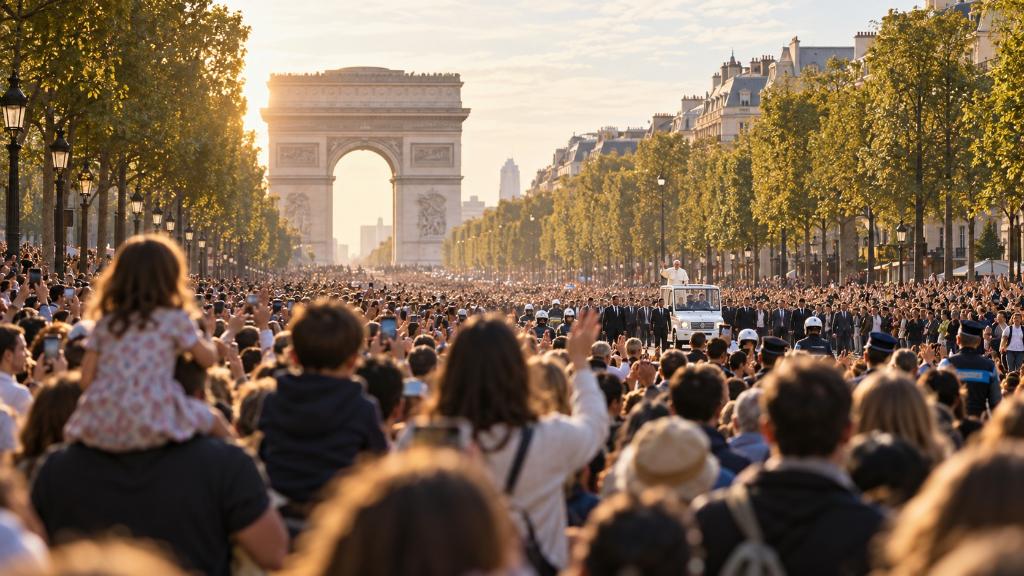
- The Vatican estimated attendance at Leo XIV's Mass on the Champs-Élysées and Place de la Concorde at 800,000; about 600,000 people had registered beforehand.
- Xinhua reported that no case of violence had been recorded by the end of the event; the other major sources reviewed reported no significant incident.
- France's 1905 law protects the free exercise of religion while requiring state neutrality. The visit also had a diplomatic dimension because the pope is sovereign of Vatican City State.
- No large anti-clerical counter-demonstration aimed at disrupting the Mass appears in the sources reviewed; the reasons for that absence are undocumented.
A dense crowd stretched along an event zone of roughly two kilometres between the Arc de Triomphe and Place de la Concorde, while a popemobile moved through the participants with almost no images of disorder. On September 26, 2026, Leo XIV's Mass in central Paris drew around 800,000 people according to the Vatican. The figure, repeated by Reuters, Associated Press, Al Jazeera, Xinhua and Le Monde, was about 200,000 higher than advance registrations.
The number remains an estimate: it came from the Vatican or local figures relayed through it and was not independently audited. The scale is nevertheless enough to establish the exceptional size of the Paris gathering. The previous evening, around 80,000 young people attended a vigil at the Stade de France and, according to Le Monde citing Vatican figures, more than 1.3 million people took part in the various French stages of the visit.
800,000 people, no violence reported
Xinhua explicitly reported that no case of violence had been recorded by the end of the gathering, which lasted more than four hours in central Paris. Reuters, AP, Al Jazeera and Le Monde likewise reported no major incident.
Available sources do not rule out minor incidents. They do, however, show no significant violence or disruption in the main reports reviewed.
The operational challenge was considerable. France's Interior Ministry announced up to 15,000 police officers, gendarmes, mobile units and Operation Sentinelle troops for September 25 and 26. Associated Press cited 14,500 security personnel for the main Mass, while Le Monde also reported 17,000 volunteers.
A September 3 decree had formally classified the visit as a major event under France's Internal Security Code, citing terrorist risk and expected attendance. The Champs-Élysées and Place de la Concorde were included in the protected areas.
Security does not explain the outcome on its own
Access was tightly controlled, with searches, pat-downs and major traffic restrictions. Part of the result therefore reflects an organisation designed in advance to separate flows and reduce risk.
Yet several hundred thousand people cannot be controlled individually. The outcome of a gathering of this scale also depends on participant cooperation, volunteer organisation and the nature of the event itself. A crowd attending a religious ceremony does not have the same dynamics as a protest march or a spontaneous sports celebration. The two types of gathering are not directly comparable.
Secularism: what the law actually says
The choice of Place de la Concorde and the presence of public officials revived debate over secularism. Article 1 of the December 9, 1905 law states that the Republic ensures freedom of conscience and guarantees the free exercise of religion, subject to public-order restrictions. Article 2 states that it does not recognise, pay or subsidise any religion.
Holding a Catholic ceremony in public space is therefore not, by itself, incompatible with secularism. The relevant legal questions concern authorisation, financing, security and equal treatment.
The visit also had a diplomatic dimension. France Diplomatie notes that a pope is both spiritual head of the Catholic Church and sovereign of Vatican City State. His meetings with French authorities therefore also formed part of France's relationship with the Holy See.

A secularised France still deeply marked by Catholic history
The Champs-Élysées crowd might suggest that France remains predominantly Catholic. The data call for greater caution. An Insee-Ined survey of people aged 18 to 59 living in metropolitan France found that in 2019-2020, 29% identified as Catholic while 51% said they had no religion. Among those identifying as Catholic, 8% attended a place of worship at least once a month.
These results do not cover the entire population, particularly those over 59, and should not be mechanically extrapolated to all French residents. They nevertheless show the gap between cultural heritage, religious identification and regular practice.
The papal visit therefore points less to a proven Catholic 'return' than to a continuing ability to mobilise large numbers. A crowd of this kind can include regular worshippers, occasional Catholics and curious visitors; it cannot by itself measure religious affiliation across the population.
No large counter-mobilisation documented
Reuters, AP, Al Jazeera, Xinhua and Le Monde mention no large anti-clerical counter-demonstration intended to disrupt the Mass. That stands out in a country where relations between religion, secularism and politics remain regularly contentious.
A lack of coverage does not prove that no local or symbolic action occurred. More importantly, none of the sources reviewed establishes why organisations most critical of Church influence did not stage a major mobilisation at the site.
Such a disruption could have been perceived differently from institutional criticism. But no source documents that kind of political calculation. The possibility of a political cost therefore remains a hypothesis rather than an established explanation.
Different media, one central finding
The emphasis varies by newsroom. Reuters focuses on the scale of the crowd and the contrast with declining Catholic affiliation; Associated Press gives more operational detail on registrations and security; Al Jazeera places greater weight on French arguments over secularism and controversies surrounding the Church. Xinhua, China's official news agency, explicitly notes that no violence had been reported, a finding consistent with the other sources reviewed. Le Monde provides the most detailed French framing of the organisation and social significance of the visit.
The 800,000 figure, however, comes from the Vatican, which was directly involved in the event. It should therefore remain labelled an estimate even though independent media widely repeated it. Interior Ministry figures document the official security deployment but come from the institution responsible for organising it.
What the calm allows us to say
Leo XIV's visit does not demonstrate a mass Catholic return in France, nor the disappearance of tensions surrounding religion. It also does not allow the calm to be attributed solely to police, worshippers or an assumed strategy by opponents.
What can be established is simpler: around 800,000 people, according to the Vatican estimate, attended a religious gathering in central Paris under an exceptional security operation, with no violence reported by Xinhua and no major incident reported by the other main sources reviewed.
In a country whose secularism is sometimes portrayed abroad as pushing religion out of public life, the episode points to a more nuanced reality. The French model combines state neutrality, freedom of conscience and free exercise of religion. For several hours on the Champs-Élysées, that coexistence was most visible in what did not happen: there was no large-scale confrontation.
FAQ
How many people attended Leo XIV's Mass in Paris?
The Vatican estimated attendance at 800,000, a figure repeated by Reuters, AP, Al Jazeera, Xinhua and Le Monde. Around 600,000 people had registered. The total remains an estimate rather than an independently audited count.
Was the Mass at Place de la Concorde contrary to French secularism?
Its mere occurrence is not enough to establish a breach of secularism. The 1905 law protects the free exercise of religion while requiring state neutrality. The pope also has a diplomatic role as sovereign of Vatican City State.
Why was there no major anti-clerical counter-demonstration?
No large mobilisation intended to disrupt the Mass was identified in the main sources reviewed. Reliable sources do not document the motives of organisations that might have opposed it. Political cost is a possible explanation, but it cannot be presented as established fact.
- Reuters — Hundreds of thousands in Paris cheer Pope Leo in largest event of French tour
- Associated Press — By the Numbers: Pope Leo XIV's open-air Mass in Paris draws many more than expected
- Al Jazeera — Pope Leo draws 800,000 to open-air Mass in Paris
- Xinhua — France: 800,000 attend a major Mass celebrated by Pope Leo XIV in Paris
- Le Monde — Leo XIV draws a huge crowd in Paris for the Concorde Mass
- Le Monde — The pope reveals some of France's fractures in a presidential campaign period
- French Interior Ministry — Pope Leo XIV's visit under heavy protection
- Légifrance — September 3, 2026 decree classifying the visit as a major event
- Légifrance — December 9, 1905 law, Articles 1 and 2
- France Diplomatie — Leo XIV's visit and relations between France and the Holy See
- Insee — Religious diversity in France