
 ezna-io
Fuel prices France: global shock and narrow room
By Hugo Delorme
7 months ago

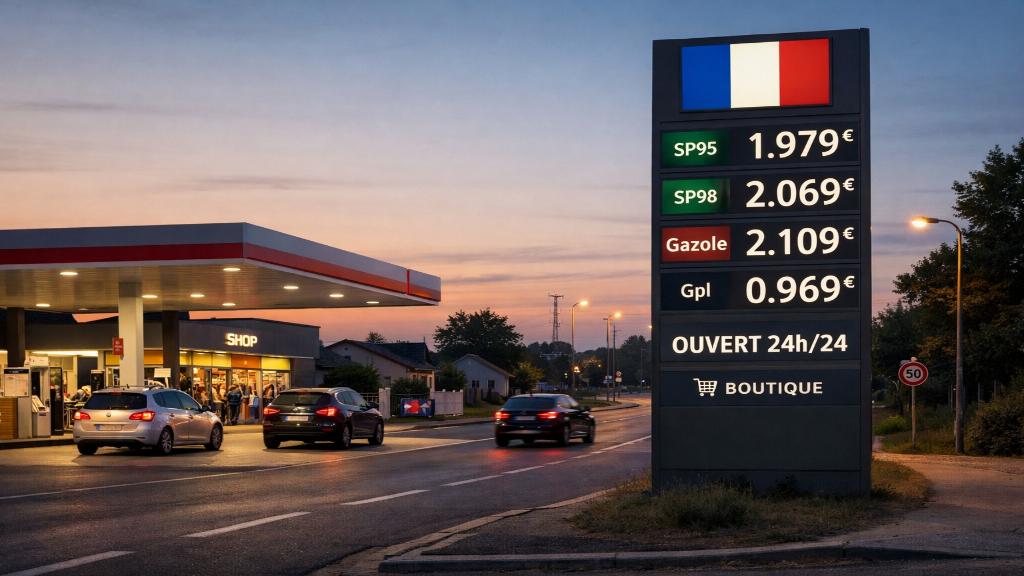
- Around 18% of French fuel stations were facing partial shortages in early April.
- French inflation reached 1.7% year on year in March, with energy up 7.3%.
- Paris is rejecting a broad pump rebate and relying instead on roughly 70 million euros in targeted April support.
- US sources confirm that the oil and diesel shock remains global even after the recent military de-escalation.
The story looks familiar, almost too French to be fully understood from Paris alone. Yet the renewed pressure on fuel prices is not born first on ring roads or in roadside anger. It begins on a maritime map. In early April 2026, France is seeing pump prices rise again, local queues reappear and a familiar political question return: how far can the state cushion an energy shock without reopening a social crisis and without worsening an already constrained fiscal position.
What makes this moment serious is not only the rise in prices, but the nature of the shock itself. France is not dealing with a new domestic tax or an internal reform gone wrong. It is absorbing an imported shock tied to the Middle East crisis, disruptions around the Strait of Hormuz and the abrupt repricing of petroleum products. In France, that shows up at the pump. In the United States, energy institutions and financial media describe it as a wider global imbalance in flows, prices and refined products.
Visible strain, but not a nationwide shortage
The clearest signal came from the ground. Reuters reported on April 7 that around 18% of French fuel stations were facing shortages of at least one product. The French government attributed this to internal logistical problems and to a rush toward TotalEnergies stations after the company capped unleaded petrol at 1.99 euros per litre in April. Diesel was capped at 2.25 euros per litre, with more favourable conditions for some of the group's retail energy customers.
That distinction matters. France is not, at this stage, facing a nationwide wartime-style shortage. It is facing something more diffuse and sometimes more politically combustible: high prices, uneven availability depending on networks, local surges in demand and precautionary behaviour among drivers. That is often how an energy problem turns into a confidence problem.
The testimony gathered by Reuters in Nantes gives a more concrete sense of the ripple effect. A construction-sector entrepreneur warned of a possible wave of layoffs if diesel and non-road diesel prices keep climbing. In many economies, fuel is an irritant. In France, it also remains a cash-flow variable for small businesses, transport operators and parts of rural and peri-urban life.
Energy inflation is central again
INSEE has provided the statistical frame that turns public perception into an economic fact. In its provisional estimate published on March 31, the institute said consumer prices in France were up 1.7% year on year in March 2026, after 0.9% in February. The main driver was energy, up 7.3% year on year after falling 2.9% the month before. On a monthly basis, inflation reached 0.9%, driven in particular by petroleum products.
In other words, the fuel issue is no longer just a checkout impression. It is back inside the official inflation data. That matters because a lasting rise in energy costs can spread far beyond private driving through freight, construction, farming, fishing, urban logistics and eventually a broad range of consumer prices.
US sources confirm the scale of the shock. On April 6, the U.S. Energy Information Administration said Brent crude had moved from 61 dollars a barrel at the start of the year to 118 dollars by the end of the first quarter. The agency also said this quarterly increase was the largest on an inflation-adjusted basis in its data going back to 1988. It tied that jump to military action in the Middle East, the de facto closure of the Strait of Hormuz and disruptions to shipping and regional production.
Bloomberg adds another layer, one closer to Europe's diesel reality. On April 2, the agency reported that European diesel futures had climbed to their highest level since 2022, topping 200 dollars a barrel and surging as much as 9.7% in London during the session. For a country such as France, where diesel still powers a large part of professional activity, that is more than a market datapoint. It is almost a macroeconomic early warning.

The French response: targeted, deliberate and fiscally tight
In response, the government has chosen a clear line: no broad rebate at the pump, but targeted and temporary support. A French finance ministry statement published on March 27 put the immediate plan at close to 70 million euros for April 2026 alone. Road transport receives an exceptional flat-rate package estimated at 50 million euros, equivalent to 20 euro cents per litre for eligible firms. The fishing sector gets 5 million euros, also calibrated at 20 cents per litre. Farmers benefit from a full excise exemption on agricultural non-road diesel for April, with an estimated cost of 14 million euros.
The choice is not only economic. It is political. On April 10, Le Monde noted that opposition parties are pushing more aggressive options, including broader price caps. But the newspaper also laid out the legal and fiscal limits of such ideas, while recalling the cost of earlier support packages. The gas and electricity shields of 2022 and 2023 cost about 25 billion euros, and the 2022 fuel rebate cost 7.6 billion euros according to figures cited in the article.
Seen from abroad, the French strategy resembles that of many European states after several consecutive shocks: protect the most exposed sectors without rebuilding an expensive universal shield. It is neither full retreat nor full protection. It is a fiscal trade-off.
Why Paris resists a broad gesture
The most underestimated part of the debate is probably the budget arithmetic. Reuters reported on April 3 that extra tax revenue from higher fuel prices had reached 270 million euros in March, according to budget minister David Amiel. But rising government borrowing costs were running at around 300 million euros per month. Once existing support measures are added, the total extra monthly cost is about 430 million euros.
That changes the political reading of the moment. The idea that the state automatically profits from expensive fuel contains a short-term accounting truth, but becomes misleading at the full budget level. Part of the extra revenue is offset by higher debt-servicing costs and by the cost of emergency measures. The energy shock brings in revenue, but it also creates new spending and new macroeconomic risks.
This is where the French experience overlaps with what is being seen elsewhere. When energy prices rise, governments are expected to absorb the shock as though their fiscal capacity were untouched. Yet several years after the pandemic, the Ukraine war and the return of high rates, that capacity is narrower. France is not unique. It is simply one of the places where this contradiction becomes visible very quickly in public debate.
Different international readings, similar underlying diagnosis
Comparing sources remains instructive. Reuters sticks to the mechanics of numbers: stations under strain, the cost of support, extra tax receipts and the debt burden. Le Monde treats the issue first as an internal public-policy choice, testing what is and is not feasible for consumers and businesses. Xinhua, China's state news agency, places France inside a broader comparison of national strategies and notes that around 16% of French stations were facing difficulties, while emphasizing the Strait of Hormuz as a systemic chokepoint. Al Jazeera, from Qatar, reads the story mainly through a geopolitical and diplomatic lens, focusing on the conditions for the gradual return of maritime traffic in the area.
US sources add a useful analytical layer. The EIA objectifies the global oil and refined-products shock through precise price series. Bloomberg highlights the specific vulnerability of European diesel, which matters greatly for industrial and logistics-heavy economies. This combination of views is valuable because it prevents the French story from shrinking into a purely domestic quarrel over the price of a litre and puts it back into a global chain of energy stress.
Biases and conflicts of interest: real, but visible
Biases do exist, and it is better to name them than to overstate them. Xinhua is a Chinese state agency with a natural preference for state coordination, stability and comparisons of national management. Al Jazeera belongs to the Qatari state, which gives it real regional depth on Gulf issues but also a specific diplomatic environment. French government sources present public action from the executive's point of view. Reuters places strong emphasis on fiscal, regulatory and market implications. Bloomberg primarily reads the shock through prices, flows and energy products. None of those angles erases the cross-checked facts. They simply show what each newsroom or institution considers most important.
Substantively, the overlap is strong: the shock is global, European diesel is especially exposed, France is avoiding a broad rebate and fiscal constraints are already shaping the public response. Where the sources differ is mostly in the hierarchy of causes and consequences.
A contained crisis, but more strategic than it looks
France is not mechanically reliving 2018. The government has not launched a new diesel tax increase and supply tensions remain partial. But it would be a mistake to treat the episode as a short-lived fever. In France, fuel remains a rapid-propagation issue: from pump prices to company cash flow, from logistics to inflation, and then from household budgets to politics.
The most important fact on April 10, 2026 may not be the exact number on each station sign. It is that several lines of fragility are crossing at once: an external shock that is not fully resolved, energy that is inflationary again, professions already under pressure and a state forced to arbitrate more tightly than before. That intersection is what gives the fuel story a broader significance than a simple price rise at the pump.
Uncertainty remains. After the ceasefire announcement, some markets relaxed, but neither the EIA nor major financial media describe a full return to normal. Damage to flows, stocks, infrastructure and risk premia can outlast the diplomatic moment. Any confident forecast of a rapid and lasting fall in prices should therefore be treated with caution.
FAQ
Why are fuel prices rising in France in April 2026?
They are rising because of a global energy shock linked to Middle East tensions, disrupted flows through the Strait of Hormuz and a sharp repricing of petroleum products, especially diesel.
Is France facing a nationwide fuel shortage?
No. Cross-checked reporting points to partial shortages in part of the network, around 18% of stations in early April, but not a full national shortage.
Why is the government not introducing a broad fuel rebate?
The government argues that universal support would be too costly in a context of high debt and rising borrowing costs, so it is focusing on targeted aid for the most exposed sectors.
- Le Monde - Prix des carburants : quatre propositions pour aider les consommateurs passées au crible
- Reuters - Nearly a fifth of French gas stations facing supply issues, truckers protest in west
- Reuters - Rising debt costs wipe out French fuel tax windfall, minister says
- INSEE - Consumer prices up 1.7% year on year in March 2026
- French Ministry of Economy - Immediate support plan in response to the energy crisis
- U.S. Energy Information Administration - Crude oil and petroleum product prices increased sharply in the first quarter of 2026
- U.S. Energy Information Administration - Hormuz closure and related production outages are key drivers in EIA's latest forecast
- Bloomberg - European Diesel Futures Top $200 as Iran War Hits Supply
- Xinhua - Countries explore options as Hormuz safe passage remains elusive
- Al Jazeera - Omani, French and Japanese vessels transit the Strait of Hormuz