
 ezna-io
Facial recognition: illegal police use exposed in France
By Hugo Delorme
7 months ago

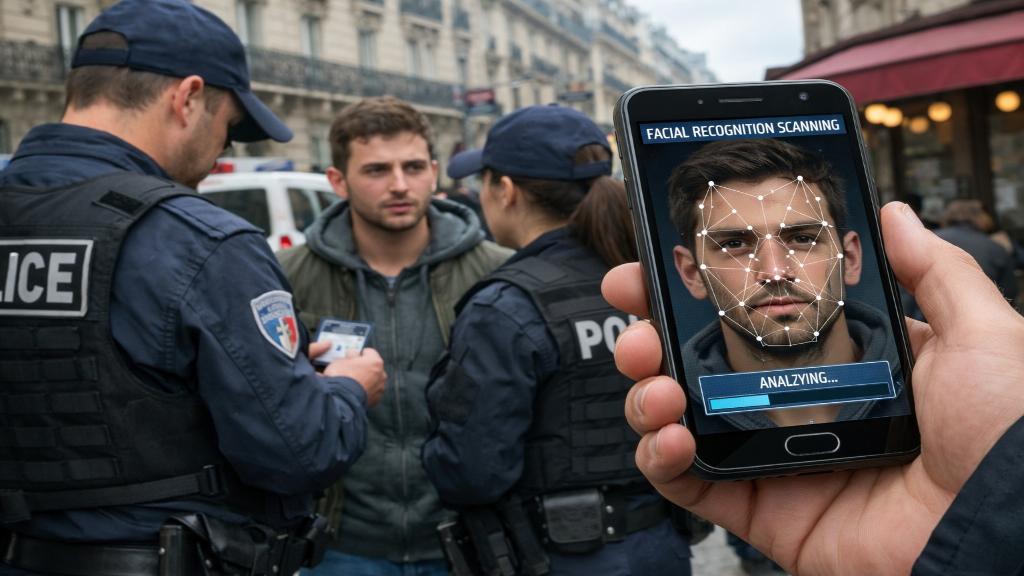
- A Disclose investigation reveals illegal smartphone-based use.
- Police allegedly use TAJ database via mobile devices.
- The CNIL confirms irregularities and enforcement actions.
- The issue raises tensions between security and civil liberties.
Recent revelations about facial recognition use by French law enforcement reflect a broader transformation of policing practices in the digital age. The investigation by Disclose highlights a discreet but significant shift: the integration of biometric tools into everyday police checks via smartphones and tablets.
According to the report, officers may take photos of individuals during identity checks and compare them to databases such as TAJ. This process resembles real-time facial recognition and lacks a clear legal basis in France. Existing laws allow certain biometric uses, but only under strict judicial oversight.
The core issue lies in this legal gray area. Access to TAJ may be lawful under specific conditions, but combining it with smartphone-captured images raises new legal questions. Legal experts argue that such practices could violate GDPR due to unauthorized biometric data processing.
Organizations like Amnesty International describe this as a silent transformation of policing. Surveillance technologies are becoming mobile, individualized, and harder to monitor, making democratic oversight more complex.
These uses appear to remain limited but raise important concerns. Are they tolerated informally? Are they isolated initiatives or part of a broader strategy? Authorities have so far described them as isolated or non-compliant cases.
The BriefCam precedent offers additional insight. Between 2015 and 2023, this video analysis software was used without proper authorization, according to a report cited by Le Monde. Although different, it reflects a broader trend: technology adoption outpacing legal frameworks. The CNIL has since intervened.
Globally, similar tensions exist. The US shows mixed approaches, China widely deploys facial recognition, and Europe seeks a balanced regulatory model. France sits in between, with strict laws but contested practices.
The role of smartphones is central. Modern devices allow real-time access to databases and image processing, transforming policing methods. What once required heavy infrastructure can now be done with a handheld device.

This technological shift raises operational and ethical questions. While such tools may improve efficiency and speed, they also introduce risks: lack of traceability, algorithmic bias, and potential errors. Studies have shown that facial recognition systems can have uneven accuracy across populations.
Transparency becomes a major concern. Unlike visible surveillance systems, smartphone-based checks are discreet. Individuals may not be aware that biometric data is being processed, increasing concerns about hidden surveillance.
Politically, the issue remains sensitive. Some advocate for regulated legalization, others for strict prohibition. The ongoing European AI regulation debate may shape future rules, potentially allowing limited law enforcement use under strict conditions.
These revelations highlight the limits of current frameworks and the need for clear policy choices. France faces a strategic decision: strict control, regulated expansion, or reinforced prohibition.
Finally, while investigations confirm problematic practices, claims of widespread systematic use remain unverified. The phenomenon appears real but limited, underscoring the importance of careful, evidence-based analysis.
FAQ
Is smartphone facial recognition legal?
No, it requires a strict legal framework and is currently not broadly authorized.
What did the investigation reveal?
Potentially illegal use during identity checks via mobile devices.
Why does it matter?
It concerns the balance between policing efficiency and fundamental rights.
No reliable internal articles could be identified at this time.