
 ezna-io
Alternative trade routes: new global balances emerge
By Zoé Marquand
7 months ago

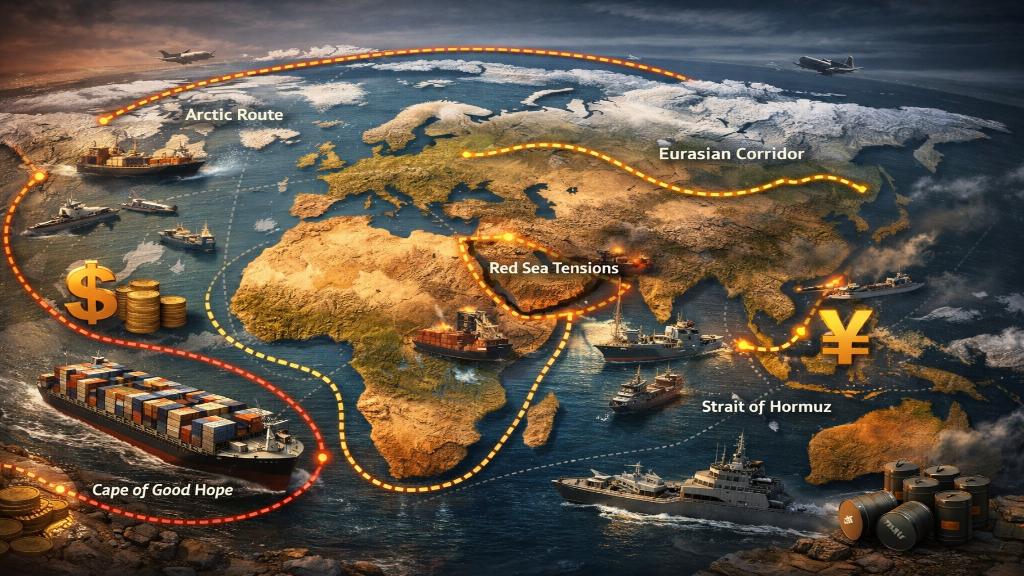
- Alternative trade routes are gaining importance as Suez, Bab el-Mandeb, Hormuz and Panama become more exposed to geopolitical or climate-related disruption.
- UNCTAD notes that maritime transport carries about 80% of world merchandise trade, which makes every major shipping disruption quickly visible at global scale.
- The Cape of Good Hope, selected Gulf land bridges and several Eurasian corridors are increasingly used as continuity solutions.
- Russia is redirecting a larger share of its flows toward Asia, especially India and China, while some African and Gulf ports are benefiting from rerouted traffic.
Alternative trade routes are taking on greater importance because several strategic arteries of world commerce have become more vulnerable, more expensive or more difficult to use predictably. The point is first and foremost logistical. A large share of international trade still depends on a limited number of chokepoints. UNCTAD notes that maritime transport accounts for about 80% of global merchandise trade. When one major passage slows down, becomes costlier or is seen as riskier, the impact spreads rapidly through freight prices, transit times, insurance costs and supply-chain planning.
The Suez Canal remains the clearest case. According to UNCTAD, it handled roughly 12% to 15% of global trade in 2023. In a January 2024 note, the agency said trade volumes passing through Suez had dropped by 42% over two months, while weekly container ship transits there had fallen by 67%. In a February 2024 update, it said Suez transits were down 42% from their peak and Panama Canal transits were down 49% from theirs. The IMF also reported that during the first two months of 2024, trade through Suez fell by 50% year on year, while Panama traffic dropped by 32%.
These figures illustrate a basic point: the main shipping lanes are not easily interchangeable. Global maritime trade was built around dominant corridors because they save time, fuel and transport cost. When a carrier avoids Suez and sails around Africa via the Cape of Good Hope, it preserves the movement of goods, but with a longer voyage. That route keeps cargo moving without matching the efficiency of the direct path. UNCTAD also noted that the weekly increase in average container spot rates reached 500 dollars in late December 2023, the largest weekly jump on record, and that rates from Shanghai had more than doubled since early December, including a 256% increase on the Shanghai-Europe route.
The added cost does not come from a single factor. It combines longer distance, longer vessel deployment, higher fuel consumption and more expensive insurance. UNCTAD also noted that rerouting and faster sailing to maintain schedules can sharply raise emissions. For a Singapore-Rotterdam round trip, it estimated that greenhouse gas emissions could rise by as much as 70% under some rerouting assumptions.
Energy adds another layer. The Strait of Hormuz remains one of the most sensitive chokepoints in global trade. In a note dated March 10, 2026, UNCTAD said the strait carries around one quarter of global seaborne oil trade, along with significant volumes of liquefied natural gas and fertilizers. When Hormuz is disrupted, the impact is not limited to Gulf shipping. Energy markets, freight costs, fertilizer prices and, indirectly, some food-related costs can all be affected.
As a result, alternative routes are multiplying without fully replacing the historical arteries. The most visible solution is the rerouting around southern Africa. Other options are land-based or multimodal. Reuters reported on March 26, 2026 that Maersk was using land-bridge routes through Saudi, Omani and Emirati ports to keep some Gulf cargo moving, especially food and medicines. The company said this network could absorb a typical weekly flow of about 35,000 containers and that cargo throughput at Jeddah had risen by 40% since the conflict cited in the report began. This does not mean overland routes replace normal sea traffic, but it shows they can absorb part of the flow in urgent conditions.
The use of alternative routes is not confined to the Middle East. In Eurasia, rail and road corridors are also regaining relevance. The International North-South Transport Corridor linking Russia, Iran and India, the Northern Sea Route in the Arctic, and some routes through Central Asia and the Caucasus are regularly cited as supplementary options. Their value lies in diversification. Their limits lie in capacity, transshipment needs, infrastructure and local political constraints. In practice, these routes mostly add redundancy to the system rather than replacing it all at once.
Russia provides a documented example of trade redirection. Since Western sanctions tightened after 2022, a growing share of its energy flows has been diverted toward Asia. The Associated Press reported in March 2026 that India was still buying Russian oil under a temporary US waiver and that Indian authorities were seeking to secure supplies by diversifying sources. Reuters reported on March 20, 2026 that Indian imports of Russian crude, which had fallen to about 1 million barrels per day in February, could recover to 2 to 2.2 million barrels per day in March. These figures do not describe the full Russia-Asia relationship, but they do show a concrete eastward shift in trade flows.
This redirection is not based on diplomacy alone. It requires markets able to absorb volume, transport contracts, refining capacity, payment systems and workable routes. India and China have taken on a larger role because they combine market size, energy demand and purchasing flexibility. Reuters also reported on March 26, 2026 that several Asian countries, including Vietnam, Thailand, the Philippines, Indonesia and Sri Lanka, were seeking more Russian oil amid regional tension and the disruption of flows through Hormuz.
Who benefits from these detours?
The clearest beneficiaries are some ports and service hubs located along rerouting paths. Reuters reported on March 23, 2026 that several African bunkering hubs were benefiting from the rise in traffic around the Cape of Good Hope. It cited Mauritius, where bunker fuel sales in Port Louis nearly doubled in 2024. Other locations such as Walvis Bay in Namibia, Morocco and some West African ports are gaining activity in refueling, maintenance and transshipment. In the Gulf, ports used in overland or multimodal solutions are also seeing additional traffic. Exporters able to sell quickly into Asian markets, whether in crude oil, refined products or intermediate goods, can also benefit from the redirection. Finally, logistics operators already present across multiple corridors hold a practical advantage because they can switch faster from one route to another.
Those gains remain relative. Detours generate activity for some actors, but they do not remove the overall cost of dislocation. Alternative routes are often longer or operationally more complex. They require more coordination, more safety stock and greater contractual flexibility. That is why they are best described as continuity solutions rather than perfect substitutes.

The available data therefore suggest not a complete replacement of the old map, but a gradual diversification. The main historical arteries remain central, yet companies and governments are investing more in backup and complementary options. The dominant logic is no longer only the cheapest route; it increasingly includes continuity of access and lower dependence on a single passage. That shift is visible in the Gulf, in the Red Sea, around Suez, along selected Eurasian corridors and in the redirection of part of Russia's trade toward Asia.
For consumers and manufacturers, the main effect is measurable: longer lead times, higher costs and more volatility. For ports, shipping companies and transit states, the challenge is different: capturing part of the rerouted flow. World trade is still moving, but within a framework that is more redundant, more expensive and more sensitive to geopolitical and climate events.
FAQ
Why are alternative trade routes becoming so important?
They help keep trade moving when major passages such as Suez, Hormuz or Panama are disrupted, more expensive or judged too risky.
Is Russia now selling most of its energy to Asia?
A growing share of its flows has been redirected toward Asia, especially India and China, but that does not mean every economic link with Europe has disappeared.
Do rerouted paths really reduce risk?
They reduce some dependence on a single chokepoint, but they usually lengthen journeys and do not always offer the same capacity as the historical routes.
- UNCTAD - Red Sea, Black Sea and Panama Canal
- UNCTAD - Unprecedented shipping disruptions raise risk to global trade
- UNCTAD - Hormuz shipping disruptions raise risks for energy, fertilizers and vulnerable economies
- IMF - Red Sea attacks disrupt global trade
- Reuters - Maersk says Gulf land bridge routes still have capacity for food, medicines
- Reuters - African bunkering hubs gain as ships reroute around the Cape
- Reuters - Russian oil set to regain top spot in India after February dip
- Reuters - Fuel-thirsty Asian countries line up for Russian oil
- AP - US allows India to keep buying Russian oil for a month