
 ezna-io
Solar Cells: European Research Reduces Optical Losses
an hour ago

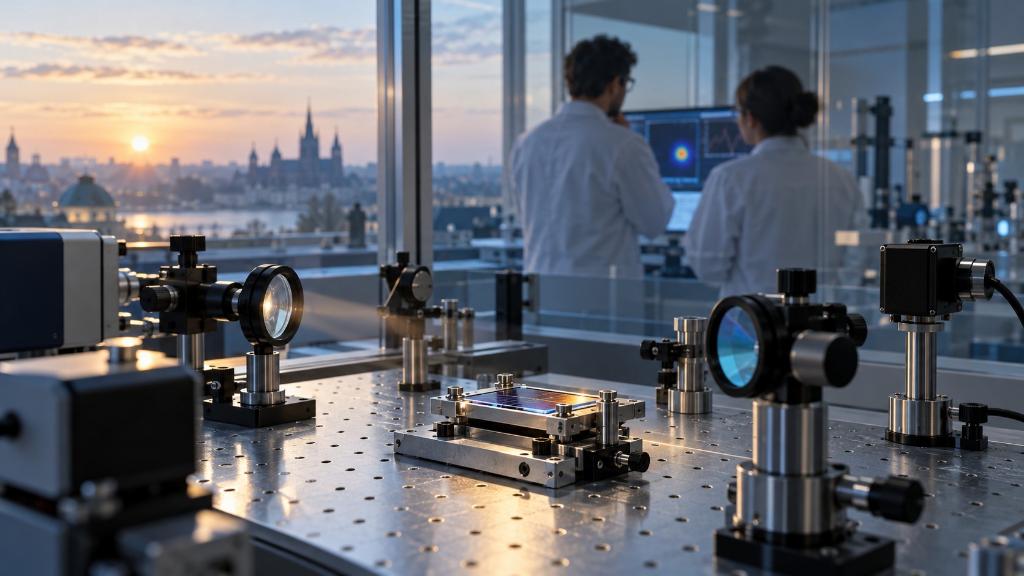
- Researchers at Barcelona's Institute of Photonic Sciences have improved organic solar-cell efficiency by controlling the directions in which the cells emit light.
- According to German science publication scinexx, the best experimental device achieved 19.08% efficiency, compared with 18.23% for a reference cell, a gain of 0.85 percentage points. These measurements were not independently certified for this article.
- The widely reported 43% efficiency figure is a conditional theoretical prospect, not an achieved experimental result.
- The experiment demonstrates European research capabilities in an industry dominated by Chinese manufacturing. Commercial relevance still depends on durability, cost and performance under natural sunlight.
Solar cells lose energy not only through heating or the transmission of certain photons. They also face a thermodynamic limitation associated with the directions in which they emit light. Researchers in Barcelona have demonstrated that modifying a cell's optical architecture can reduce part of this loss and improve the conversion of sunlight into electricity.
The team at the Institute of Photonic Sciences (ICFO) integrated an organic solar cell into an optical cavity containing silver electrodes. According to results reported by German science publication scinexx, the best modified device achieved 19.08% conversion efficiency, compared with 18.23% for an experimental reference cell.
The research was published in Energy & Environmental Science in 2026 and announced by ICFO on October 5. Media coverage continued through October 11, particularly around a theoretical efficiency prospect near 43%, a figure very different from the measured outcome.
The research raises two separate questions: what physical improvement has actually been demonstrated, and under what conditions could it become a useful energy technology?
An energy loss associated with the directions of light
Photovoltaic cells absorb photons whose energy can be converted into electricity. Several mechanisms limit this process. Low-energy photons cannot generate usable electrical charges, some excess energy is dissipated as heat, and electronic recombination reduces recoverable output.
The Catalan team investigated another limitation known as Boltzmann loss.
From Earth, the Sun occupies a small apparent angle. Direct sunlight therefore reaches a cell within a relatively narrow cone. A conventional photovoltaic device, by contrast, can emit photons across much of the hemisphere above its surface.
This difference between absorption and emission directions increases the entropy associated with radiation. It reduces the maximum voltage theoretically available and, consequently, the cell's potential efficiency.
The phenomenon does not simply involve photons reflected or lost to the surroundings. It concerns the thermodynamic conditions under which a light-absorbing device can also emit radiation, and the amount of useful electrical energy that can be extracted.
Restricting photon emission angles was already an established concept in photovoltaic physics. The Spanish contribution lies in implementing an experimental architecture that exploits the principle in a functioning organic solar cell and produces a measurable electrical benefit.
An optical cavity using silver electrodes
The study, Inhibited photon emission to overcome Boltzmann losses in an organic solar cell with a cavity configuration, was authored by Francisco Bernal-Texca, Chiara Cortese, Mariia Kramarenko, Quan Liu and Jordi Martorell.
The researchers used an inverted organic cell based on the PM6:Y6 blend. These donor-acceptor materials perform complementary roles in generating and separating electrical charges following photon absorption.
The essential modification concerns the device's optical environment. According to scinexx, the team replaced the conventional transparent indium-tin-oxide front electrode with a silver film only a few nanometers thick. Together with a rear silver electrode and a tungsten-oxide layer, it forms an optical cavity.
The structure's transmission and reflection properties vary with photon propagation angle. It allows incoming sunlight to reach the active layer efficiently while reflecting more of the light emitted in oblique directions.
The objective is not to make the entire cell more reflective. A metallic film can also absorb useful radiation and reduce the current produced. Researchers must therefore optimize transparency, reflectivity, layer thickness and electrical properties simultaneously.
Angular fluorescence measurements reported by scinexx indicate that the modified cell emits less light at large angles. The analysis also accounts for absorption by metallic layers and internal reabsorption, helping distinguish changes in emission processes from simply blocking outgoing radiation.
This optical observation alone does not demonstrate higher photovoltaic efficiency. An electrical effect must also be established through measurements of voltage, current and conversion efficiency.
ICFO considers the cavity relatively straightforward to fabricate at laboratory scale. That assessment does not guarantee industrial reproducibility or competitive manufacturing costs.

19.08% versus 18.23%: a measurable experimental improvement
The results reported by scinexx make it possible to quantify the improvement while distinguishing published measurements from independently certified performance records.
According to the German publication, the best cavity-equipped cell achieved 19.08% conversion efficiency, compared with 18.23% for a reference device tested under comparable conditions. The difference is 0.85 percentage points, equivalent to approximately 4.7% relative improvement.
Average performance across the experimental series also shows an advantage. scinexx reports 18.52% for the most favorable cavity configuration, compared with 17.76% for the corresponding reference series. The increase is 0.76 percentage points, or approximately 4.3% in relative terms.
In one investigated configuration, open-circuit voltage also increased by 7.9 millivolts, alongside a small improvement in current density.
Why these measurements need to be considered together
Solar-cell efficiency depends primarily on three electrical quantities: open-circuit voltage, short-circuit current density and fill factor. The fill factor describes how closely the device's maximum delivered power approaches the product of its open-circuit voltage and short-circuit current.
Under a given irradiance, efficiency can be expressed as PCE = Voc × Jsc × FF / Pin, where Voc is the open-circuit voltage, Jsc the short-circuit current density, FF the fill factor and Pin the incident optical power per unit area.
Higher voltage can improve efficiency, but the outcome also depends on current and fill factor. The reported 7.9-millivolt increase for one configuration therefore cannot, by itself, explain the entire measured efficiency gain. The accessible information does not allow a precise breakdown of how much each electrical quantity contributed.
Reduced fluorescence characterizes optical behavior. Electrical measurements determine whether the optical modification translates into improved power conversion. The consistency between these observations is the experimental significance of the study.
The results do not establish a commercial advantage. The best device in a laboratory series does not necessarily represent reproducible industrial performance, and a 4.7% relative improvement is not a 4.7-percentage-point efficiency increase.
One documentary limitation remains: detailed numerical results come from scinexx, which attributes them to the scientific study. The full article and its supplementary data could not be examined directly for this report. Complete measurement conditions, statistical distributions and any external certification could therefore not be independently confirmed here.
Why the researchers discuss 43% efficiency
ICFO refers to the conventional Shockley–Queisser limit of approximately 33.16% for a single-junction photovoltaic cell under the assumptions of the relevant model. The framework incorporates several thermodynamic losses, including those associated with photon emission.
According to research leader Jordi Martorell, a cell whose emission cone more closely approaches the narrow cone of incoming sunlight could theoretically achieve efficiency near 43%.
This scenario assumes much stronger angular restriction and control over other losses that remain present in real devices. It does not correspond to the result obtained with the prototype.
The Shockley–Queisser limit is not a universal ceiling. Multijunction devices and systems operating under concentrated sunlight can exceed limits applicable to certain single-junction architectures because their physical conditions differ.
The significance of the experiment therefore lies in an additional photovoltaic design parameter, rather than the announcement of a new efficiency record.
Comparing solar technologies without confusing their performance
Assessing the Spanish prototype requires distinguishing laboratory cells, large-area modules and technologies using multiple junctions.
The Solar Cell Efficiency Tables, version 68, published in Joule in July 2026, compile independently confirmed photovoltaic performances according to defined scientific criteria.
The publication reports 28.1% efficiency for a 140 cm² crystalline-silicon cell, 26.4% for a silicon module of approximately 1.91 m² and 35.2% for a perovskite-silicon tandem cell of around 1 cm². These results are associated with Chinese manufacturer LONGi across distinct device categories.
For organic photovoltaics, the tables also list a Waystech/Nanobit module with a designated aperture area of 1,475 cm², achieving 13.1% efficiency with a measurement uncertainty of 0.3 percentage points.
These figures cannot be compared directly with the 19.08% reported for the Spanish experimental cell. Device materials, dimensions and architectures differ. Their metrological status also differs: the Joule tables contain results verified under defined criteria, while the ICFO figures are available here through secondary reporting.
Reference terrestrial photovoltaic measurements are generally conducted under an AM1.5G spectrum, irradiance of 1,000 W/m² and a cell temperature of 25°C for the applicable categories. These standardized conditions facilitate comparisons but do not directly represent annual energy production outdoors.
Silicon benefits from mature manufacturing processes and high performance. Tandem technologies seek to exploit more of the solar spectrum. Organic cells may offer advantages when low weight, flexibility or integration into specialized surfaces matters, provided their stability proves adequate.
The angular-restriction principle developed in Barcelona could complement these approaches. The researchers believe it is not limited to organic materials, but its application to silicon devices remains experimentally unproven.
Europe and China: distinguishing scientific invention from industrial power
The Spanish experiment confirms that innovation capabilities are not necessarily concentrated in the regions that dominate manufacturing. It does not, however, demonstrate European industrial convergence with China.
In Energy Technology Perspectives 2026, the International Energy Agency estimates that China accounts for approximately 85% of global photovoltaic supply-chain manufacturing capacity and 95% of wafer capacity, the semiconductor slices used to produce solar cells.
Deployment also illustrates China's scale. According to the IEA Photovoltaic Power Systems Programme, approximately 690 GW of new solar capacity was installed worldwide in 2025, including 415 GW in China. The European Union added 68 GW, India 54 GW and the United States 43 GW.
These figures demonstrate industrial and commercial strength, not a ranking of scientific capabilities.
LONGi's results illustrate Chinese manufacturers' contributions to high-efficiency photovoltaic technologies. ICFO, meanwhile, demonstrates European expertise in photonics and energy-device physics.
The competition is therefore not a simple division between a Europe that invents and a China that manufactures. Both regions conduct research and industrial production, but at different scales.
A discovery made in Europe is not necessarily manufactured there. If the optical cavity becomes commercially useful, manufacturers in different regions may pursue it depending on available processes, licensing arrangements and economic opportunities.
A new approach facing sharply lower solar-module prices
Turning a scientific improvement into a profitable product is particularly demanding in the current photovoltaic market.
According to an IEA analysis published in August 2026, solar-module prices fell by approximately 50% between 2023 and 2025. Investment in photovoltaic manufacturing also more than halved amid excess capacity and intense price competition.
These trends benefit equipment buyers but make it harder to justify new manufacturing facilities. A more efficient technology must now compete with panels produced at scale using established processes and substantial economies of scale.
Higher efficiency can reduce the area needed to generate a given amount of electricity. However, the economic benefit also depends on manufacturing costs, material consumption, operating lifetime and actual electricity generation.
Geographical concentration of suppliers adds a strategic dimension. The IEA notes that certain manufacturing stages outside the largest supplier country lack sufficient capacity to compensate rapidly for a supply disruption. Such vulnerabilities can justify diversification of processes and suppliers, without demonstrating that the Catalan technology would directly address them.
No verified data currently allow an industrial cost per watt or levelized electricity cost to be calculated for the optical-cavity architecture.
Three conditions for commercial application
Maintaining the improvement under natural illumination
Outdoor solar panels receive both direct sunlight and diffuse radiation from the sky. The direction and angular distribution of incoming light change throughout the day and with weather conditions.
Researchers will need to determine whether the cavity continues to absorb useful photons efficiently across different incidence angles. If the optical restriction also reduces absorption of diffuse light, part of the laboratory advantage could disappear in realistic conditions.
The decisive measure will be energy generated over a representative operating period, not only peak instantaneous conversion efficiency.
Ensuring durability and reproducibility
Organic photovoltaic devices may be suitable for lightweight, flexible or integrated applications. Their resistance to moisture, oxygen, temperature changes and prolonged illumination remains important.
Ultrathin metallic electrodes must retain their properties over time. A cavity that functions over a small laboratory area must also be reproduced with uniform layers, stable interfaces and low defect rates across larger modules.
Silver is already used in some photovoltaic technologies, but its quantity and deposition requirements in this architecture still need industrial evaluation.
Demonstrating competitive electricity costs
For end users, value depends on electricity generated throughout the device's lifetime relative to manufacturing, installation and maintenance costs.
The reviewed sources provide no certified lifetime, large-scale manufacturing yield or comprehensive environmental assessment for this cavity. These data are essential before credible economic comparisons can be made.
What international coverage reveals
The sources consulted across Europe and Asia broadly agree on the physical mechanism but emphasize measured findings and theoretical prospects differently.
In Spain, ICFO directly presents the research and highlights reduced Boltzmann losses. This institutional source is essential for describing the experiment, although the institute has an interest in publicizing its own work.
International photovoltaic publication pv magazine Global focuses on cavity architecture and potential application to other materials. In Germany, scinexx provides more quantitative information, including best-cell efficiencies, series averages and an open-circuit voltage change.
In India, Electronics For You emphasizes engineering design and potential uses. In the United Kingdom, TechRadar gives greater prominence to the theoretical 43% efficiency prospect while distinguishing it from the achieved performance.
These regional accounts do not represent an equivalent number of independent scientific confirmations: they primarily derive from the same study. No external replication was identified in the reviewed material. Joule's efficiency tables and IEA analyses provide separate references for examining competing technologies and the industrial context.
ICFO discloses European and Spanish research funding and support from Catalan foundations. These relationships are documented; no specific commercial conflict of interest capable of undermining the conclusions was established from the accessible information.
The next proof will be higher electricity output under real conditions
The Barcelona team has demonstrated that an optical cavity can restrict selected photon emissions and improve organic solar-cell efficiency. The reported gain is measurable, but does not establish superiority over existing industrial technologies.
The decisive question is no longer simply whether a cell can emit less light in certain directions. It is whether this restriction enables more electricity to be generated over a year, under variable sunlight, without disproportionate costs or reduced lifetime.
The study illustrates Europe's continued contribution to photovoltaic innovation in an industry where China combines manufacturing power with scientific expertise. Independent replication, followed by durability tests and larger-area demonstrations, will determine its practical economic significance.
FAQ
What efficiency did the Spanish solar cell achieve?
According to scinexx, the best modified cell reached 19.08%, compared with 18.23% for a reference device, an improvement of 0.85 percentage points. These figures come from secondary reporting and are not independently certified for this article.
Have researchers developed a solar cell with 43% efficiency?
No. The 43% figure is a conditional theoretical projection requiring much stronger restriction of photon emission directions. The experimental prototype remains close to 19% efficiency.
Could this discovery strengthen Europe's solar industry?
Potentially, if the principle can be applied to durable and competitive products. For now, the experiment confirms European scientific capabilities but does not establish industrial convergence with China or guarantee commercialization.
- ICFO, Spain, October 5, 2026 — Solar cells gain efficiency by emitting light in fewer directions. Institutional account of the experiment, underlying mechanism and funding.
- Bernal-Texca et al., Energy & Environmental Science, 2026 — Inhibited photon emission to overcome Boltzmann losses in an organic solar cell with a cavity configuration. Original study, DOI confirmed by ICFO. Full-text access was not obtained through automated verification.
- scinexx, Germany, October 8, 2026 — Solarzellen werden effizienter, wenn sie Licht in weniger Richtungen abgeben. Reported experimental efficiencies and electrical measurements. Human access confirmed; automated access remains intermittent.
- pv magazine Global, October 9, 2026 — Spanish researchers reduce losses in organic solar cells by restricting emission angle. International industry analysis.
- Electronics For You, India, October 2026 — Solar Cell Design Reduces Light Losses. Asian coverage of the research.
- TechRadar, United Kingdom, October 11, 2026 — Scientists announce solar panel breakthrough. Coverage of the theoretical efficiency prospects.
- European Commission Joint Research Centre, July 31, 2026 — Solar cell efficiency tables: Version 68. Official record of the Joule publication compiling independently confirmed photovoltaic performances, DOI 10.1016/j.joule.2026.102494.
- International Energy Agency, Energy Technology Perspectives 2026 — Supply chain risks and industrial competitiveness. Manufacturing concentration and supply-chain risks.
- IEA PVPS, Trends in Photovoltaic Applications 2026. Global and regional photovoltaic installations during 2025.
- International Energy Agency, August 2026 — Energy technology manufacturing is rebalancing in a dynamic era for trade and industrial policy. Solar-module prices, manufacturing investment and overcapacity.