
 ezna-io
SPIEF 2026: Trump, Riyadh and Hormuz Risk
By Léo Piquemal
5 months ago

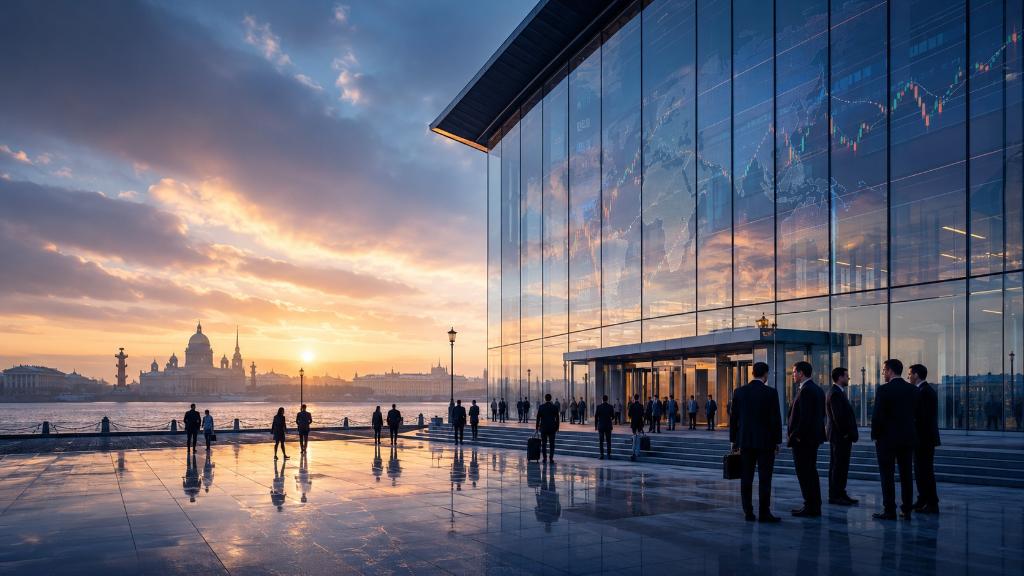
- SPIEF 2026 will take place in St Petersburg from June 3 to 6, with Saudi Arabia as guest country.
- According to TASS, Rodney Mims Cook Jr., chairman of the U.S. Commission of Fine Arts, is expected to attend the forum, with the Russian outlet presenting him as a representative sent by Donald Trump.
- Risk around Hormuz gives Riyadh greater weight: the strait carries about one-fifth of global oil and petroleum-product consumption.
- Since 2022, SPIEF has shifted from Russian Davos to a barometer of sanctions-era routes, payments and capital flows.
The 2026 St Petersburg International Economic Forum, or SPIEF, can no longer be read as it was before 2022. For two decades, it projected the image of a Russia open to international capital, energy groups, investment banks and major Western companies. Since the invasion of Ukraine and the tightening of sanctions, its function has changed: it now measures less Russia’s conventional investment appeal than its ability to rebuild payment, transport, energy and investment channels. The 2026 edition, scheduled for June 3-6 at St Petersburg’s ExpoForum venue, with Saudi Arabia as guest country, fits that trajectory.
The most politically sensitive fact comes from the United States. According to TASS, Rodney Mims Cook Jr., chairman of the U.S. Commission of Fine Arts, is expected to take part in forum events, with the Russian outlet presenting him as a representative sent by Donald Trump, including for a session on Russian-American cultural dialogue. That report qualifies the idea of a SPIEF entirely cut off from Washington. It does not, however, demonstrate a return of American capital. Cook heads a U.S. federal commission dealing with architecture, monuments and public arts; the institution confirms that he was elected chairman on January 22, 2026, but the consulted sources do not assign him any trade, financial or sanctions-related mandate.
Before 2022: a forum of global integration
Before the war in Ukraine, SPIEF was often presented as the Russian Davos. Reuters notes that the forum, launched in 1997, was designed to attract foreign investment, discuss economic policy and show that Russia was open for business after the end of the Soviet Union. That function had concrete relevance: investors watched hydrocarbons, infrastructure, privatisation prospects, domestic consumption, banks, technology and large public contracts.
At that time, SPIEF’s global impact rested on integration. Russian leaders used the forum to engage with multinationals, sovereign funds, European industrial groups, energy companies and financial advisers. Announcements could influence expectations around foreign direct investment, oil and gas projects, supply chains and Russia’s place in globalisation. The forum did not set global prices by itself, but it signalled access to a large market for raw materials, consumption and infrastructure.
That architecture fractured in 2022. Sanctions, banking restrictions, corporate exits, asset freezes and reputational risks changed the cost of operating in Russia. Reuters estimated in 2024 that losses linked to exits or reduced activity by foreign companies had exceeded $107 billion. SPIEF therefore lost part of its old function: it is no longer primarily a venue for courting Wall Street, London, Frankfurt or Paris.
Since 2022: less integration, more corridors
The post-2022 trajectory does not mean trade has stopped. It means it has been redirected. Reuters noted in 2025 that foreign direct investment in Russia had fallen sharply, with a 62.8% drop in flows in 2024 according to UN data, while foreign holdings had nearly halved since the invasion. UNCTADstat also gives the scale: FDI inflows into Russia were about $3.35 billion in 2024, compared with $31.67 billion in 2010 and $11.86 billion in 2015. These comparisons should be read carefully, because they also reflect commodity cycles, the effects of 2014 and global financial conditions, but they show a clear break.
At the same time, exchanges with some non-Western partners have become more important. China-Russia trade reached a record in 2024 at 1.74 trillion yuan, or about $237 billion according to Reuters, before declining in 2025 for the first time in five years to 1.63 trillion yuan. That slowdown shows that alternative corridors are not frictionless: secondary sanctions, payment difficulties, weaker Russian demand for Chinese cars and lower oil prices weighed on volumes and values.
India illustrates another recomposition. Reuters reported that Russian oil accounted for more than a third of India’s crude imports over part of 2025, with 1.73 million barrels per day between January and July. Before 2022, Russian oil had only a limited place in India’s import basket, notably because of distance and logistics costs. Sanctions and discounts on Russian crude changed the economic calculation: for an Indian refiner, the issue translates into margins, delivery times, insurance risk and final fuel prices.
Rodney Cook: an expected U.S. signal, not a return of capital
In this trajectory, Rodney Cook’s expected participation would be politically visible but economically limited. The Moscow Times says he could become the first U.S. official to attend SPIEF in nearly ten years, recalling former ambassador John Tefft’s presence in 2017. Kyiv Independent and European Pravda have also reported the story, while stressing that it originates from Russian media. The strongest formulation is therefore limited in scope: according to TASS, Cook is expected to take part; his official status is verifiable; no American economic return is established.
For Moscow, the symbol would be useful. Russia could show that a representative appointed under the Trump administration is taking part in a public discussion while U.S. and European sanctions remain in place. For Washington, if the trip is confirmed, the signal can remain confined to cultural diplomacy. For companies, banks and investors, nothing changes mechanically: compliance, payment, insurance, transport and secondary-risk constraints continue to structure economic relations with Russia.
Hormuz gives Riyadh greater weight
Saudi Arabia was already a strategic guest for SPIEF 2026. It becomes more important when the risk around the Strait of Hormuz is included. The EIA estimates that in the first half of 2025, oil flows through Hormuz averaged 20.9 million barrels per day, or about 20% of global petroleum-liquids consumption and one-quarter of global seaborne oil trade. The U.S. agency also estimates that around one-fifth of global LNG trade transited Hormuz in 2024, primarily from Qatar. For markets, this is not a geographical detail: it is a focal point for energy prices, insurance premia and freight costs.
In this context, Saudi participation is not just protocol. Riyadh is a major OPEC+ actor, a key Gulf producer, a holder of capital and a country able to speak to Washington, Beijing, Moscow, New Delhi and Brussels. In the event of Hormuz disruption, Saudi Arabia and the United Arab Emirates have some pipeline bypass capacity, but the EIA estimates available capacity that could avoid the strait at about 2.6 million barrels per day, far below total flows through Hormuz. The Gulf can cushion part of the shock, not erase it.
For an energy-importing household, this geography rarely appears as a maritime map. It arrives later in fuel prices, road-transport costs, airfares, fertilisers and food products. For an airline, a carrier or an Egyptian wheat importer, Hormuz risk changes fuel hedges, insurance quotes, delivery times and sometimes public subsidies. This link between geopolitics and everyday prices gives Riyadh’s presence at SPIEF a more concrete weight.

Northern Sea Route: strategic argument, not immediate substitute
Hormuz risk also strengthens Moscow’s narrative around the Northern Sea Route. Reuters reported on May 28, 2026 that Russia had sent its first LNG tanker of the year toward Asia along the Arctic route earlier than usual, from the U.S.-sanctioned Arctic LNG 2 project. The Northern Sea Route, running between Murmansk and the Bering Strait, can theoretically shorten some journeys between Europe, the Russian Arctic and Asia, while avoiding more exposed passages such as Suez, Bab el-Mandeb, Hormuz or Malacca depending on the route.
But it would be excessive to treat it as a replacement for Hormuz. The Moscow Times, citing consultancy Gecon, said cargo volumes on the Northern Sea Route reached 37.02 million tonnes in 2025, down 2.3% year on year, after 38 million tonnes in 2024. These levels remain far below Moscow’s stated ambitions of 80 million tonnes in 2024 and 200 million in 2030. High North News also distinguishes pure transit, estimated at around 3.2 million tonnes in 2025, from total cargo carried along the route. The route therefore remains driven mainly by Russian resource projects rather than a massive shift in global trade.
The Northern Sea Route is a long-term argument in the battle of corridors, not an immediate solution to a Hormuz crisis. It remains limited by ice, seasonality, insurance, sanctions, icebreaker capacity, port infrastructure and cargo type. Its relevance for SPIEF lies elsewhere: it illustrates how Russia is trying to sell an alternative geography to Asia at a time when traditional routes look more vulnerable.
What the forum can change — and what it cannot
SPIEF is not the place where oil prices, the architecture of sanctions or the security of straits are decided alone. It is rather where actors publicly test routes, partners, payment instruments and economic narratives that could reduce their exposure. Its direct impact is measured in contracts, amounts, guarantees, financing and execution timetables. Its indirect impact is visible in signals: who accepts to be seen in St Petersburg, which corridors are promoted, which risks become negotiable and which costs remain uncovered.
This distinction is essential. A memorandum signed at SPIEF can announce cooperation without producing immediate flows. A bilateral meeting may have no effect on prices, but signal that a channel remains open. An energy announcement may not move the market that day, but later guide investment, maintenance contracts or delivery routes. The forum therefore works as an echo chamber of global fragmentation: it reveals constraints as much as it claims to bypass them.
What SPIEF says about global balances
SPIEF 2026 does not prove that Russia has replaced the West on a like-for-like basis. It shows instead a global economy increasingly organised through blocs, corridors, exemptions, arbitrage and grey zones of compliance. Gulf states, India, Egypt, China and several African countries are not necessarily placing themselves in a single camp. They are trying to preserve access to several markets, payment systems, energy suppliers and sources of finance.
This evolution makes globalisation harder to read. Before 2022, SPIEF was a gateway to a Russian market integrated into Western financial circuits. In 2026, it has become an indicator of fragmentation: which banks can pay, which routes can transport, which insurers can cover, which states accept public visibility, which contracts are financeable and which companies prefer discretion. Its impact on the world economy is less spectacular than before, but more structural.
Regional sources support this reading. Ahram Online highlights Egyptian interest in energy, industry, tourism, food security and investment. Sberbank India presents the forum as a platform for Indian participants, with themes linked to the BRICS, payments, technology and infrastructure. BRICS Magazine emphasises Roscongress’s International Cooperation Area. These sources have their respective biases, but they point to the same reality: SPIEF now helps organise alternative economic connections, not restore the pre-2022 model.
A more human forum through concrete effects
Making SPIEF more readable does not require dramatising the event. It requires following economic chains down to their ordinary effects. Tension around Hormuz can raise the fuel bill of a delivery driver, the kerosene cost of an airline or the fertiliser price faced by a farmer. Payment difficulty with Russia can delay a cargo, increase an insurance premium or force an importer to look for another supplier. An energy agreement signed in St Petersburg may have no immediate effect, but later reshape power capacity, maintenance contracts or technological dependence.
This is where the forum keeps global relevance. SPIEF 2026 will not change the economic order by itself. It can, however, reveal which actors still have options when sea routes, currencies, insurance and sanctions become everyday constraints. For readers, the question is not only who appears on stage in St Petersburg. It is whether the announcements will reduce, shift or increase the costs that eventually reach prices.
Critical reading of the sources
Russian sources such as TASS and Roscongress are necessary for tracking the official agenda, but they naturally emphasise the forum’s international reach. Ukrainian sources such as Kyiv Independent and European Pravda read the Cook announcement through the war and the political cost of contacts with Moscow. Reuters, Le Monde, the EIA and UNCTAD provide a more financial, energy-focused and institutional reading. Regional sources such as Ahram Online, Sberbank India, Xinhua and BRICS Magazine show why some partners still use SPIEF as a business platform.
The most robust conclusion remains measured. SPIEF 2026 is neither a return to the pre-2022 world nor proof that the Russian economy is cut off from all global circuits. It has become a barometer of fragmentation. Rodney Cook’s expected presence shows that a symbolic U.S. channel can exist. The role of Riyadh, Hormuz risk, the Northern Sea Route, India, Egypt, China and the BRICS shows that economic flows are shifting, renegotiating and becoming more complex. That complexity makes the forum a global economic object, even when its direct impact on Western capital remains limited.
FAQ
Does SPIEF 2026 mark a U.S. return to Russia?
No. According to TASS, Rodney Mims Cook Jr. is expected to attend the forum, but the consulted sources show no trade, financial or sanctions-related mandate. The signal is cultural and diplomatic.
Why does Hormuz change the reading of Saudi participation?
Because the strait concentrates a major share of global oil and LNG flows. In the event of tension, Riyadh becomes central to market expectations, bypass routes and energy prices.
Can the Northern Sea Route replace Hormuz?
No, not in the short term. It may become more attractive as a strategic corridor, but volumes, climate constraints, infrastructure, sanctions and insurance limit its immediate role.
- TASS — representatives from more than 130 countries and announcement on Rodney Cook as a representative sent by Donald Trump
- The Moscow Times — Rodney Cook expected at SPIEF and context of the first U.S. official presence in years
- Kyiv Independent — Ukrainian contextualisation of the Cook report
- European Pravda — Cook’s U.S. Commission of Fine Arts role and RIA Novosti source
- U.S. Commission of Fine Arts — official election of Rodney Mims Cook Jr. as chairman on January 22, 2026
- SPIEF / Roscongress — Saudi Arabia as guest country at SPIEF 2026
- Interfax — SPIEF 2026 dates from June 3 to June 6
- Reuters — SPIEF as Russian Davos and the 2022 shift
- Reuters — FDI decline, sanctions and limited Western presence at SPIEF
- UNCTADstat — Russia financial profile and FDI data
- Reuters — foreign companies’ losses linked to Russia exits
- Reuters — record China-Russia trade in 2024
- Reuters — China-Russia trade decline in 2025
- Reuters — Russian oil’s role in Indian crude imports
- EIA — world oil transit chokepoints and Hormuz flows
- Reuters — oil and LNG flows exiting Hormuz toward Asia
- Reuters — first 2026 Russian LNG tanker eastward along the Northern Sea Route
- The Moscow Times — 2025 cargo volumes on the Northern Sea Route
- High North News — 2025 Northern Sea Route transit traffic
- Ahram Online — Egyptian interest in energy, industry, tourism, food security and investment
- Sberbank India — SPIEF 2026 programme and Indian angle on BRICS, payments and technology
- BRICS Magazine — Roscongress International Cooperation Area at SPIEF 2026
- Le Monde — SPIEF’s shift toward China, the Middle East, Africa and Central Asia
- Xinhua — SPIEF 2025 results and Saudi Arabia announced as guest country in 2026