
 ezna-io
Chinese Industrial Overcapacity in 2026: Global Impacts
By Léo Piquemal
10 months ago

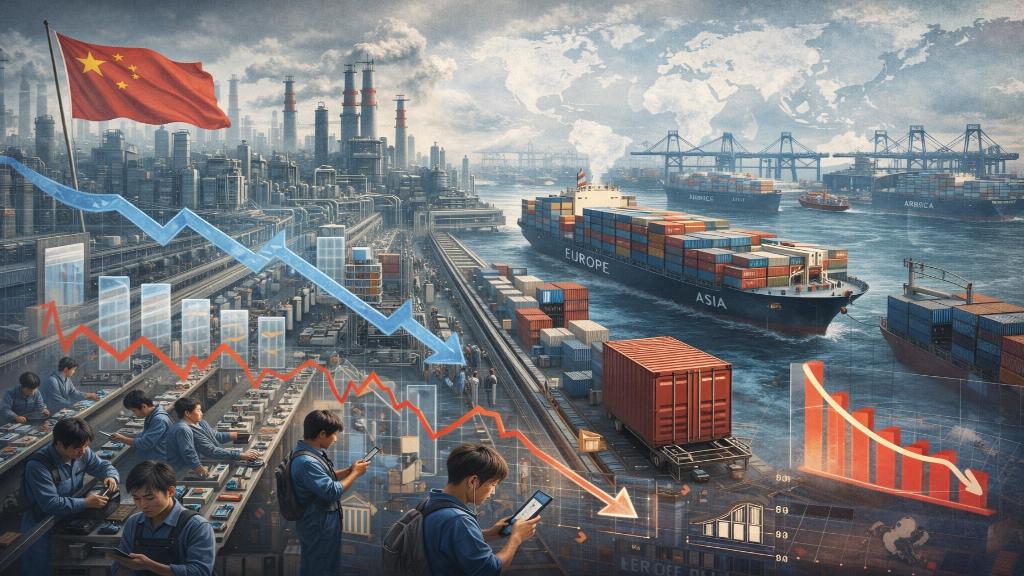
- China projects global export share at 16.5% by 2030, per Morgan Stanley.
- Chinese trade surplus may hit 1% of global GDP, per Goldman Sachs.
- Scenarios: absorption by emerging markets risking local jobs, or boosting Chinese domestic demand.
- Affected sectors: EVs, batteries, petrochemicals, with falling prices hitting global producers.
- Chinese growth projected at 4.4% in 2026 by World Bank, amid deflation and property crisis.
Chinese Overcapacity: A Growing Phenomenon
China's industrial capacity far exceeds domestic demand, leading to massive exports. In 2025, exports hit records despite US tariffs, reducing China's US import share to pre-WTO levels. This results in excess production in electric vehicles (where China makes 85% of global batteries), petrochemicals (18% rise in polyethylene vs. 10% domestic demand), and other high-tech sectors.
Economic Projections for 2026
Per Bloomberg and Goldman Sachs, China's surplus could equal 1% of global GDP in 3-5 years, the highest historically. World Bank estimates Chinese growth at 4.4% in 2026, hampered by persistent property downturn and producer price deflation (negative for 32 months). IMF forecasts 4.8%, while OECD highlights trade imbalance risks.
Concrete Societal Consequences
This overcapacity lowers global prices, benefiting consumers but destroying jobs in local industries. In Europe, German chemical plants operate at 1991 lows, threatening thousands of jobs and rising unemployment. In emerging markets like Indonesia, protests arise against cheap goods influx, limiting industrialization and trapping populations in persistent poverty. In China, 30% of industrial firms lose money, affecting wages and social stability for 600 million citizens earning under $2,000 yearly.
Comparison of International Sources
World Bank and IMF stress shifting to domestic consumption for balance. OECD and Eurostat note pressures on European supply chains. Financial Times and The Economist criticize Chinese subsidies ($230 billion in EVs and batteries), seen as unfair, while South China Morning Post highlights Chinese high-tech dominance. Kommersant reports impacts on Russia via disrupted supply chains, and Al Jazeera Business notes risks for Global South. Divergences: Western sources (WSJ, Bloomberg) emphasize geopolitical threats, possible anti-China bias; Chinese sources (SCMP) stress resilience. On X, views vary: some see national security strategy, others economic coercion. No conflicts of interest identified.

Critique of Financial Dynamics
Critically, this overcapacity reflects a subsidized mercantilist model, risking a 'China shock 2.0' reducing global growth by 0.1% annually (Goldman). Linking numbers to lives: solar price drops aid poor households, but close factories elsewhere, increasing inequalities. If not confirmed by independent sources, like surplus projections, noted as estimate. China could boost domestic demand, but without reforms, exports persist, penalizing vulnerable societies.
Geopolitical Risks and Responses
Responses include EU tariffs on Chinese dairy (43%), Mexico (50% on Chinese imports). Potential 'Fortress America' via USMCA. On X, debates on Chinese coercion (withholding rare earths). Divergences: Reuters and AFP report trade tensions; Kommersant sees opportunities for Russia. Without bias, these dynamics show how financial flows affect daily lives, from Chinese workers to European farmers.