
 ezna-io
Ukraine: Strikes Highlight Ongoing Strategic Deadlock
By Zoé Marquand
7 months ago

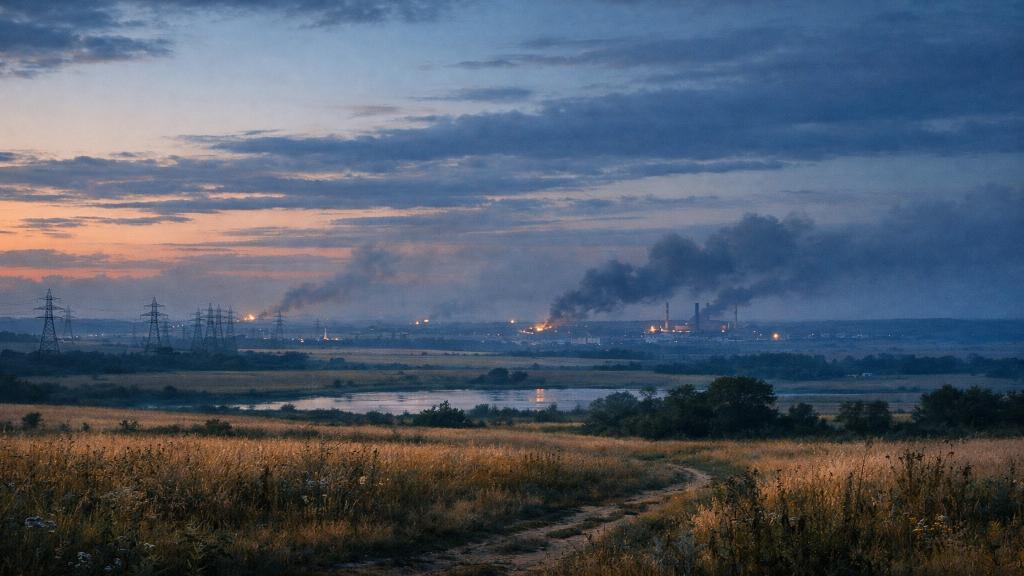
In the past 24 hours, multiple waves of strikes have been reported across Ukraine, particularly near energy and logistical infrastructure. These developments, reported by several international agencies, illustrate a now familiar pattern: a prolonged conflict where operational intensity contrasts with relatively stable front lines.
According to Reuters and the Associated Press, the strikes may have targeted critical facilities as part of a broader effort to weaken Ukraine's industrial and energy capabilities. This strategy has already been observed in recent months, with civilian and energy infrastructure becoming indirect levers in a longer campaign of pressure.
Russian media, however, describe the strikes as precision operations aimed exclusively at military objectives, once again highlighting the divergence of narratives that defines this war. The contrast is not new. It reflects deeply rooted communication strategies in which each side orders facts according to its own military and political priorities.
From an Asian perspective, the South China Morning Post places these events within a broader rebalancing of international power. The war in Ukraine is not treated as an isolated theatre, but as one sign among others of wider tensions affecting energy, technology and financial influence.
Al Jazeera focuses more directly on the human dimension, describing civilians confronted with power cuts, internal displacement and constant uncertainty. Yet, despite the violence of the attacks, the front lines remain broadly unchanged, reinforcing the idea of a strategic stalemate.
This relative stagnation should not be mistaken for inactivity. Local clashes, limited tactical advances and reconnaissance operations continue to shape the conflict on a daily basis. Still, no major breakthrough has been independently confirmed over the last 24 hours.
According to unverified information circulating on some digital channels, preparations for broader operations may be underway. At this stage, however, such claims remain speculative and cannot be reliably confirmed.
Economically, the consequences extend well beyond Ukraine. Energy markets, already weakened by years of geopolitical strain, react sharply to any potential disruption of infrastructure. This volatility continues to feed inflationary pressure in several parts of the world.
Agricultural supply chains, another essential dimension of the conflict, also remain under close watch. As Ukraine is a major grain exporter, any logistical deterioration can trigger ripple effects across global food markets, especially in parts of Africa and the Middle East.

From a strategic standpoint, several analysts describe the conflict as an explicit war of attrition, in which each side seeks gradually to exhaust the other's resources. Historically, such wars depend less on swift gains than on the ability to sustain effort over time.
Media bias remains visible in international coverage. Western outlets stress humanitarian consequences and possible violations of international law. Russian outlets emphasize military legitimacy and operational objectives. Non-aligned media often adopt a more detached posture, focusing on the broader systemic implications of the war.
This contrast points to a wider reality: in a multipolar world, information itself becomes a contested space. Every narrative, every image and every interpretation contributes to the global perception of the conflict.
One constant remains. Despite tactical fluctuations, the war appears set to continue. That continuity, almost routine in form, stands in contrast with the dramatic intensity of individual events, creating a paradox in which the extraordinary slowly becomes ordinary.
FAQ
Why is it described as a strategic deadlock?
Because no decisive breakthrough has been observed despite the intensity of operations.
Are civilians being targeted?
Interpretations differ by source: some point to civilian infrastructure, while others describe military targets.
What are the global consequences?
Effects are visible in energy markets, food supply chains and broader geopolitical balances.
To extend this analysis, here are two related articles on recent strategic and energy tensions: