
 ezna-io
Nvidia H200 Exports to China: Washington Considers a Partial Policy Reversal
a year ago

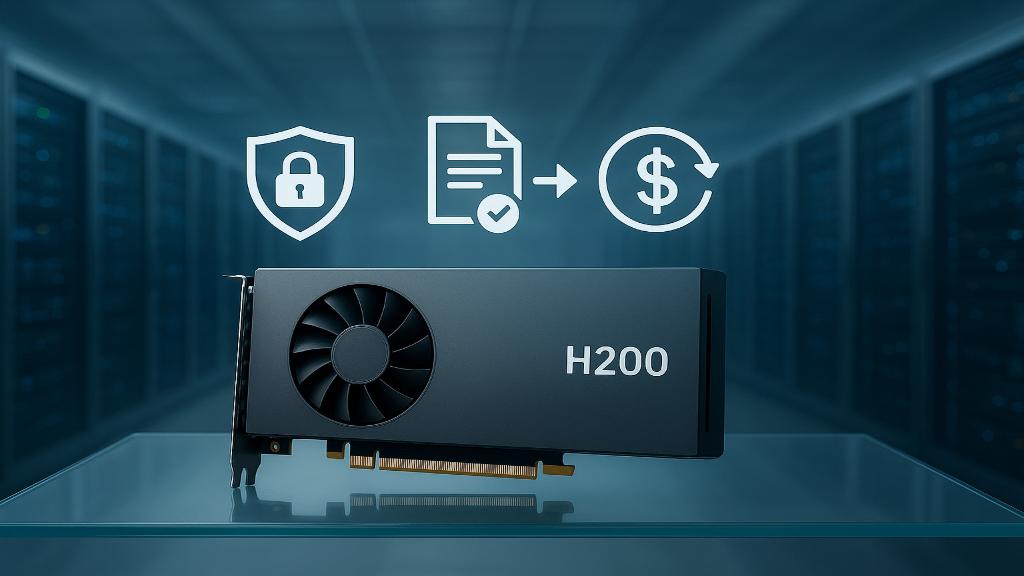
- Multiple outlets (Reuters, FT, Bloomberg, AP) report that the U.S. administration is preparing limited approvals to export Nvidia's H200 AI GPUs to approved customers in China, subject to security conditions and fee arrangements (public mentions of ~25%).
- The move would explicitly exclude the most advanced chips (Blackwell family) while reopening a large market – details remain being finalized by the Commerce Department.
- Western, Chinese and Russian media frame the development differently; social media shows polarized investor and security reactions.
Over the past 24 hours a set of internationally respected news organizations have reported that the U.S. executive branch is preparing to permit limited exports of Nvidia's H200 AI accelerators to selected Chinese customers. The core facts — a Commerce Department process and public statements from the President — are corroborated by several outlets, but many operational specifics (approved customer lists, audit mechanisms) remain unpublished.
Confirmed points (multiple independent sources)
- The administration has signaled it will allow limited H200 exports to approved customers; Reuters, FT, Bloomberg and AP report the same basic development.
- The scope excludes the latest-generation chips (Blackwell), a distinction emphasized across technical reporting.
Unconfirmed or partial claims include the exact monetary terms (some reports cite a 25% fee) and whether Beijing will formally accept the arrangement — press reports are not uniform on this point.
Technical and societal implications
The H200 is a high-performance GPU suitable for training and inference. Allowing controlled exports could raise industrial productivity and enable beneficial applications (health, climate modelling), but also risks enabling dual-use capacities (surveillance, military AI). The net social utility depends entirely on the transparency and enforceability of the proposed export controls and end-use restrictions — elements still opaque in public reporting.
Media tone comparison
Western outlets (Reuters, FT, Bloomberg, The Verge) emphasize geopolitics, economic consequences, and security debates, providing technical context and quoting lawmakers and industry actors.
Chinese/Asia outlets (SCMP, Tech in Asia) focus on pragmatic economic impacts and domestic reactions (both interest in technology access and stress on self-reliance), often noting the government's balancing act between opening markets and protecting sovereignty.
Russian media coverage tends to stress market consequences and strategic narratives — sometimes highlighting lobbying and financial benefits for US firms — and occasionally adds a skeptical or critical undertone regarding Western policymaking.
Social media and public debate
Social platforms show bifurcated responses: investor optimism and price movements for Nvidia shares on the one hand; civil-society and national-security concerns on the other. Key posts and threads come from market analysts and technologists, some of whom have industry ties — a factor that complicates the signal-to-noise ratio and calls for scrutiny of potential conflicts of interest.

Conflicts of interest to watch
- Industry lobbying: reporting (Bloomberg, Reuters) documents intensive lobbying by Nvidia and allies; when experts quoted have consultancy or funding ties to large tech firms those relationships must be disclosed.
- Sponsored analysis: market and policy research paid for by industry players can skew risk/benefit assessments — always check funding disclosures.
What remains to be clarified
- Exact terms of the Commerce Department's approval (technical constraints, auditing rights).
- Which Chinese entities would be eligible, and whether their activities would be publicly auditable.
- China's formal government position — reporting currently shows mixed signals and statements from Chinese authorities are not uniformly available.
Final appraisal
The reported decision to permit H200 exports appears to be a calibrated political choice that balances industrial and diplomatic interests against security concerns. The technical capability of the H200 can deliver societal benefits, but only under robust, transparent controls. At present the headline (a planned limited reopening) is supported by several major outlets; the substantive judgment about whether this is wise for society requires further public disclosure of the controls, end-users and enforcement mechanisms.
Sources
- Reuters – US to allow Nvidia H200 chip shipments to China, Trump says
- Financial Times – Nvidia can sell H200 AI chips to China, Donald Trump says
- Bloomberg – Nvidia set to win US approval to export H200 AI chips to China
- The Verge – Nvidia may be able to sell H200 chips in China
- Semafor – Commerce to open up exports of Nvidia H200 chips to China
- AP – Trump approves sale of more advanced Nvidia computer chips used in AI to China
- South China Morning Post – Nvidia's Huang not sure if China would accept H200 chips
- Kommersant – (Russian coverage of commercial and political implications)
- Wall Street Journal – U.S. plans to approve export of Nvidia's H200 chip to China